|
Poll analysis: Friday May 6
MORI chairman Sir Robert Worcester analyses the latest opinion poll data.
The headline across the top of the Daily Mail this morning reads 'Labour majority may be slashed to 66, says exit poll'.
I'm awaiting the call from the media to ask me to explain why we (the pollsters) got it wrong. I did relish the call from PA asking 'how the polls got it so accurate with the exit polls?'
When I spoke to the lady, she began by saying that "...in 1992..." which allowed me to remind her that in both 1997 and 2001 the exit polls were by any standard accurate.
This time the difficult task was to factor in the postal vote, up three or four times from the 2001 election.
This was accomplished by both NOP and MORI, who shared responsibility for the fieldwork for the exit poll, tracking on their respective omnibus surveys during the campaign the public's intention to apply for a postal/proxy vote, and if they had, asking for whom they intended to vote.
This data were then used as an input into the model which was used to forecast the estimate of a 66 seat Labour overall majority in the House of Commons.
Lord Hattersley lost it on ITV News' election night coverage, fiercely shouting at ITV saying that it they continued to quote the exit poll when it was obvious that it was wrong with its estimate of 66 seat Labour majority.
Professor Colin Rallings was then asked by Jonathan Dimbleby to explain why ITV was still using the exit poll estimate. Colin replied with some force, if more politely put than the Hattersley attack, that as at the time there had been very few marginal seats declared, that it was still a much better measure than any calculation of 'real people voting in real seats' which at that point were almost entirely in safe, urban, low turnout, Labour-held seats. Score at the end of the ding-dong? Rallings one, Hattersley nil.
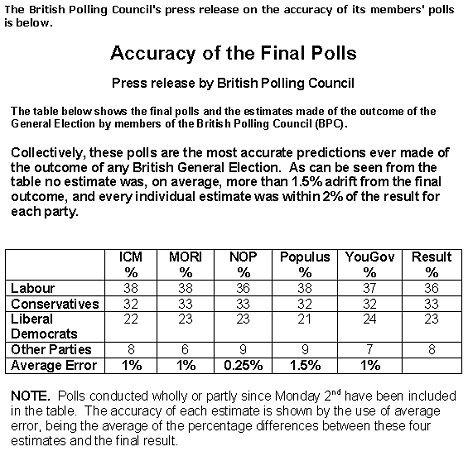
As of writing, there are still about seven British seats (excluding Northern Ireland) not declared, but it is quite clear that all of the seven polls which reported yesterday did very well what they do, which is to measure the share of the vote.
If the result does indeed turn out to be 36 per cent for Labour, 33 per cent for the Conservatives and 23 per cent for the Liberal Democrats then two polls - a telephone poll by NOP (published by the Independent) and an internet poll by the British Elections Study team (paid for by us, the taxpayers) - were spot on, and the other five all clearly within the margin of error of plus or minus three per cent, whichever the methodology employed.
|