|
Poll analysis: Monday May 2
MORI chairman Sir Robert Worcester analyses the latest opinion poll data.
All eyes are now fixed on Thursday, to see not if, but by how much, Labour's third-term victory will turn out to be.
And the operative word is 'turnout', because that's what this election is turning on. Just before the election was called on April 5, MORI's poll in the Financial Times showed a five point Labour lead, but among those 'absolutely certain to vote' it found a five point Tory lead.
But it also showed that among those definitely voting, that the average included 75 per cent of intending Conservative voters, only 55 per cent of Labour's and 60 per cent of Liberal Democrats.
Estimated turnout is now in the low 60s, where it was four years ago, and on those estimates, the final turnout was 59 per cent. The older voters, those 65 and older, were at 70 per cent, and those 25 and under just 39 per cent. Now, three in four of the older folks swear they'll turn out on Thursday, but just 33 per cent of the under 25s. We'll see on Thursday night.
But after the weekend the political junkies' eyes will turn to France for their European constitution referendum on May 29. And then the Dutch referendum three days later.
For the last few weeks, some 22 polls have shown more and more of the French electorate reported as opposing the adoption of the EU constitution, until opposition reached almost two to one against.
Yet just this past week the tide seems to have turned, as two polls, one by TNS/Sofres, have a much narrower margin, 52 to 53 per cent opposed, down about 10 from a week or two ago, and another even 52 per cent in favour.
Whichever, the Dutch a couple of days later will likely approve it unless the French vote is decisively no. If that, the Dutch will likely follow the French lead.
Tony Blair said first that what happened in France won't affect the British referendum. Then he said it might, and then it would likely determine whether we hold one in this country. So what is the situation here?
I believe that the simple 'yes/no' question format disguises some important nuances about how the British mood is shifting.
For nearly 10 years we tracked the level of support for Britain joining the European single currency. Early on we adopted a four point measure of public opinion on the issue, asking people to choose which of four alternatives best represented their view.
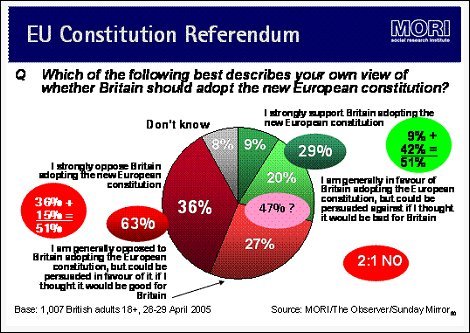
'I strongly support Britain adopting the new European constitution.'
'I am generally in favour of Britain adopting the European constitution, but could be persuaded against it if I thought it would be bad for Britain.'
'I am generally opposed to Britain adopting the European constitution, but could be persuaded in favour it if I thought it would be good for Britain.'
'I strongly oppose Britain adopting the new European constitution.'
Now, pay close attention or quit while you're ahead.
Just nine per cent say they are strongly in favour, while four times as many, 36 per cent, say they are strongly opposed. I believe that these are the most likely to vote in the referendum, if it ever comes.
Another 20 per cent say they're generally in favour, so the 'greens' are 29 per cent of the electorate, a long way from a majority, and it's a majority that counts in referendums.
Opposing generally are another 27 per cent, which added to the 36 per cent who say they 'strongly oppose' the new constitution adds to 63 per cent. So, discounting the don't knows, who mostly won't vote, you get two to one against.
But nearly half are persuadable. What will persuade them?
First, Britain being at the end of a long string of referendums in other countries that pass with a substantial margin. It looks like it will fail on that criterion alone.
Second, having the united support of Tony Blair and Gordon Brown, which may be the superglue that holds them together a bit longer once this election is won and another's on the horizon.
Third, that the referendum is fought on a platform of it being a limiting constitution, not an expanding one. I can hear them now: "We've boxed them in, and they can't creep out any more." Good luck.
And fourth, that they get pretty united support from groups people trust, and they sure don't trust Blair, and trusting Gordon just isn't enough. So, they'll need to look to business leaders, economists, and above all the City for support. They don't have it now. Our survey for the FT among financial directors last month showed a strong majority against Britain signing up.
A mighty high mountain to climb.
|