|
Poll analysis: Sunday May 1
MORI chairman Sir Robert Worcester analyses the latest opinion poll data.
Interesting, three polls today are almost identical in their findings, a phone poll by MORI in the Observer (36 per cent Labour, Conservatives 33 per cent and Lib Dems 22 per cent), and internet polls by YouGov in the Sunday Times (36 per cent, 33 per cent and 23 per cent) and BPIX in the Mail on Sunday (37 per cent, 33 per cent, 21 per cent), all three with the Tories on 33 per cent.
MORI's 'all with voting intention' has a wider spread (38 per cent, 32 per cent, 22 per cent), virtually the same as BPIX's 38 per cent, 31 per cent, 22 per cent based on all voters.
This confirms what all the pollsters have been saying all along, that the Labour vote is softer than the Tories', but the Tories are doing no better in 2005 than they did in 2001.
Two other phone polls, ICM in the Sunday Telegraph (39 per cent, 31 per cent, 22 per cent) and Communication Research in the Independent on Sunday (39 per cent, 31 per cent, 23 per cent) have Labour higher at 39 per cent and the Tories at a dismal 31 per cent.
All five have the Liberal Democrats at 22 per cent plus or minus just a single percentage point.
All were taken over the past couple of days. The MoS puffed the BPIX poll as "the first since the publication last week of the government's legal advice on the Iraq war". That is of course other than the other four also published today.
The projection of the YouGov results if replicated on Thursday is a 96 seat Labour majority in the House of Commons, while the MORI finding projects to 94, nothing in it. BPIX claims a "three-figure majority".
Comparing the MORI poll published in the Financial Times on Wednesday (which was based on a face-to-face, in-home survey of 2,256 electors with fieldwork April 21 to 25) and the telephone poll (Of 1,007 people April 28 to 29) has the Tories down one point, Labour the same and the Liberal Democrats also down one.
If this consistency holds on Thursday, all the claims of the internet pollsters that their methodology is superior will be another confirmation of what was found in the US election, although there the two internet polling organisations - YouGov and Harris - were by some way the furthest away from the actual vote, and both, the one British and the other American, with exactly the same forecast.
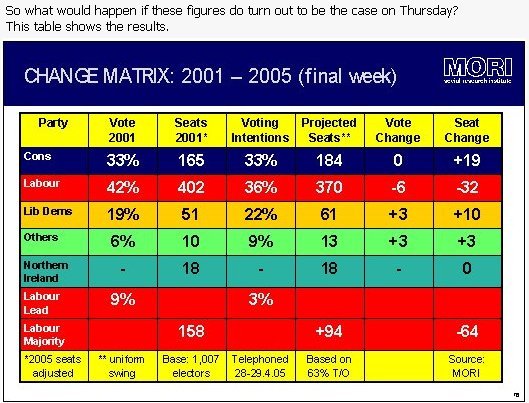
There are, however, many caveats which must be taken into account.
1. Fieldwork for these five surveys between Thursday April 28 and Saturday April 30, so starting a week before polling day and as a wise man (and excellent client, Harold Wilson) said: "A week is a long time in politics". He would say that, wouldn't he, as his 1970 election was lost in the final week of the election, as Neil Kinnock lost the 1992 election in that final week as well. I've always said that 'the poll that polls last, polls best', and our publication in the Evening Standard will therefore be based on the last possible fieldwork other than that of the combined MORI/NOP exit poll for the combined use of both ITV Election Special and the BBC's.
2. Postal votes have to be taken into account, which each poll so far as I can tell calculates differently the likely impact of the much higher effect of postal votes.
3. Turnout is, I believe, the principal factor. The pollsters' error overestimating Labour's share in 1997 and 2001 was largely due to overestimating turnout, and insufficiently factoring in the softer Labour vote. It was the cause of Wilson's defeat in 1970, when more Tories wanted to turf him out than Labour people wanting to keep him in, and the reverse in February 1974 when more Labour wanted Heath out than Tories who wanted to keep him in. Much is made by the academic poll pickers and political journalists of the so-called 'error' by the pollsters in past elections. Forgotten, conveniently, is the excellent record of both NOP, for the BBC, and MORI, for ITN, in both 1997 and 2001.
4. Uniform swing is the basis of all the voting models, and whatever the swing is, it won't be uniform - never has been, never will be. From detailed analysis of the marginals on large (12,000+ aggregate interviews), it would appear that some of the most marginal Labour seats will be held by relieved and surprised Labour MPs, while seats much less marginal will be lost to the Tories.
5. Least important in my view is so-called margin of error, which is the statistical calculation of probability that a sample's result, if perfectly random (and no sample ever is), will be within defined limits, usually quoted as plus or minus three percent. But that is if it is random, on a 95 per cent (2 Sigma) margin, on a sample of 1,000 (our total sample for the FT was over 2,200, and therefore if it had been completely random would have been plus or minus two per cent).
6. And there are many other factors as well, but I've said many times on both radio and TV that if I were to send 100 interviewers into the field with 100 carefully calibrated thermometers, and instruct them to stand on the highest point in the randomly selected area in their randomly selected constituency and at precisely noon read out the temperature, email their reading into the office, where the statisticians would calculate the mean temperature, that if I were to do the same the following day, say election day, then the average temperature would be the same. But this is what the media insist that we should be able to do, and the academic critics are quick to criticise us when we don't, despite the fact that about one voter in 11 says that he or she makes up their mind in the final 24 hours of an election campaign.
And people are much more mercurial than the weather.
|
Published: Sun, 1 May 2005 15:09:13 GMT+01
Previous weblogs
See www.MORI.com for more information
|
|