|
Poll analysis: Thursday April 28
MORI chairman Sir Robert Worcester analyses the latest opinion poll data.
The MORI survey for the Financial Times published yesterday and today has an embarrassment of riches psephologically speaking. Yesterday, if late, I covered the basic political details and the marginals. Today, some of the more arcane and complex messages from vox populi.
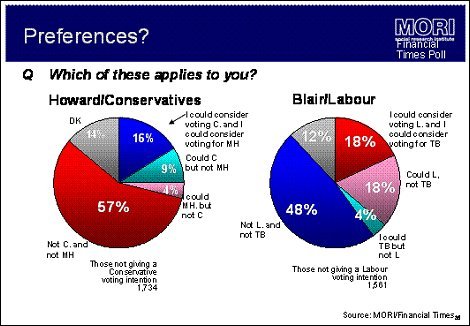
The first is the best measure I’ve seen of the 'Blair Factor'. Some 36 per cent of the 61 per cent of the public who are certain to vote say it is their intention to vote Labour on May 5.
But why aren't the rest voting Labour? Just under half of those not voting Labour say they wouldn't consider it. But four in 10, about a quarter of the electorate, say they could consider voting Labour, nearly half of whom, 18 per cent, say they might.
But another 18 per cent would consider voting Labour, but not with Tony Blair as prime minister, so of the potential pool of 'maybe Labour' people in the total electorate, 11 per cent, say that it is the prime minister himself who keep them from supporting the Labour Party next Thursday.
By contrast, only three in 10 of those not now saying they will vote for the Tories would consider it, and only nine per cent, half the figure for Blair, are put off considering the Tories because of Howard.
You may recall seeing the Worcester’s Weblog on ePolitix.com on April 20 about the 'Political Triangle' which relates the four dimensions of electoral contests: values, issues, leader image and party image.
Its focus on 'floating voters' takes into account that only about four per cent of the electorate, the 20 per cent who are not in the core voter categories of Labour (around 30 per cent), Conservatives (around 30 per cent) and Liberal Democrats/Nats/UKIP/Greens/etc. (20 per cent or more), leaving the 20 pre cent who are the 'floating voters' who determine the outcome of the election, if they live in the 20 per cent of the constituencies which can be described fairly as marginal.
So what moves them? I think of an analogy of iron filings and a magnet. As the magnetic field is altered, the iron filings are repelled and attracted in just the way floating voters are repelled and attracted by the parties' positions on issues, voters' reactions to the party leaders, and to the parties themselves.
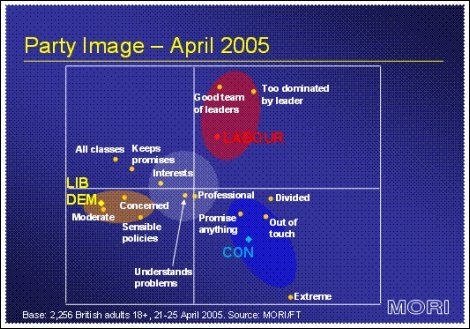
Today, let's look at the party image, accounting for around 20 per cent of the electorate's aggregate determinants of their voting behaviour (further details of this model in 'Explaining Labour’s Landslide', Politico’s, 1999).
It is a pretty bleak picture for the Conservative Party, seen by the electorate as a whole as 'out of touch', 'divided', being willing to 'promise anything to win votes' and, above all, 'extreme'. In poker, a hand like that would fold.
Labour is seen as having 'a good team of leaders', but is seen as 'too dominated by its leader', Tony Blair.
The Liberal Democrats are, as always, 'moderate' and 'having sensible policies', and have captured a former Labour attribute: being 'concerned about people in real need'.
The battleground of the election isn't, but should be, the three attributes that are in between the parties, not yet captured by anyone: 'looking after the interests of people like me', 'understanding Britain's problems' and being a 'professional party'.
|