|
Poll analysis: Saturday April 30
MORI chairman Sir Robert Worcester analyses the latest opinion poll data.
More than a third of 2001 Labour voters have defected from Labour, saying they are no longer intending to vote in this election for the Labour Party, according to a massive meta-analysis of electors interviewed by MORI so far during this general election.
The Tories have lost around a fifth of their 2001 supporters, and the Liberal Democrats have lost three in ten.
Half the defecting Tories (nine per cent of their 2001 vote) have gone to other parties, most of the remainder (seven per cent) are undecided.
Ex-Lib Dems go two-thirds (19 per cent) to other parties (including nine per cent to Con, five per cent to Lab), and nine per cent undecided.
All the campaign polls show Labour to be some way below its 2001 share of the vote. See www.mori.com/polltrack/index.shtml for a full set of voting intention results for all national polls in this campaign, updated daily.
This new analysis for the GMB analysis examined these questions:
Question 1: Who are the 'Labour disaffected' - those people who voted for the party in 2001 but now propose to vote for another party, or are not sure whether they will vote at all.
To help answer this question, MORI has conducted analysis on behalf of the GMB looking at more than 10,000 people interviewed during the campaign. This enables us to look at the views of the electorate in considerable detail. The MORI sample found 1,300 'Labour disaffected'.
We are able to look at their demographic profile and to compare their characteristics with other groups, including 'Labour loyalists' and the population as a whole.
What has happened to Labour's 2001 vote, ie. those who say they voted Labour four years ago? Our analysis gives us the following breakdown:
- A third, 35 per cent, no longer support Labour.
- However two thirds, 65 per cent, still support Labour.
- One in 10, 11 per cent, have moved to the Liberal Democrats.
- One in 20, six per cent, have moved to the Conservatives.
- Another one in 20, four per cent, have moved to another party.
- But the largest group, 14 per cent, have not moved to any party and are now saying they are 'undecided', 'would not vote' or refuse to answer the question. This pattern is particularly marked among women.
- They are a fluid group: most Labour disaffected, 55 per cent, say they may still change their mind before they vote. This compares with 41 per cent for all those currently supporting any of the political parties.
- Some six in 10 (61 per cent) say they are absolutely certain to vote. This compares with 70 per cent among Labour loyalists, although it is a little higher than for the electorate as a whole (57 per cent). In other words, 'disaffecteds' are at least as likely to turn out as anyone else.
- 'Labour disaffected' comprised 11 per cent of the electorate in interviews conducted pre-campaign (ie up to April 4). This figure has been at a stable 13 to 14 per cent for interviews conducted from April 5 to 19.
- Demographically, they are VERY similar to the population as a whole, in terms of gender, social class, work status, etc. But there are some interesting differences. For example, women are less likely than men to have moved from Labour to another party; almost half (46 per cent) are now in the 'would not vote/undecided/refused' camp, compared with 33 per cent of men.
Question 2: What are the views of 'Labour disaffected' on some of the key issues in the election?
'Labour disaffected' comprise around 13 per cent of the total electorate, so a campaign poll of 1,000 provides us with a relatively limited sample of around 130 to work with.
However, at the start of campaign the MORI/Evening Standard 'election issues' survey, conducted from April 7 to 11, gives us a sample of 1,973 to work with including the perspectives of some 256 'Labour disaffected'. We'll have more towards the end of this week and will report them when we do.
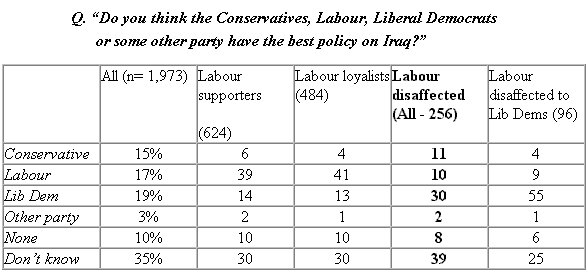
Today's news focuses very much on Iraq. The headlines on this issue are as follows:
- Among the public as a whole, 18 per cent single out Iraq as one of the issues they think will be very important in helping decide which party to vote for. This places it 14th out of the 16 issues measured. It is not an 'issue-issue' but an 'image-issue'.
- Labour loyalists are less likely to see Iraq as a central issue (13 per cent).
- But double that of Labour disaffected, 27 per cent.
- And among the sub-group of disaffected who have moved from Labour to the Lib Dems, this figure rises to a third, 33 per cent.
- Liberal Democrats also tend to be seen by Labour disaffected as the party with the best policies on Iraq.
Technical details:
MORI's aggregate analysis for the GMB is based on results from 10,060 interviews conducted between March 30 and April 19. Data has been weighted to the national population profile. The election was called on April 5, 2005.
The 'issues' analysis is based on the MORI/Evening Standard poll, conducted face-to-face between April 7 and 11, with a national sample of 1,973.
For full details, see www.mori.com/election2005
|
Published: Sat, 30 Apr 2005 00:01:00 GMT+01
Previous weblogs
|