|
Poll analysis: Saturday April 23
MORI chairman Sir Robert Worcester analyses the latest opinion poll data.
Congratulations to the YouGov founders and shareholders who will be wealthier on Monday, when their float delivers about £18 million valuation to the fledgling company. YouGov has a turnover of just under £2 million, so valued at about nine times their turnover, and with a profit last year of around £600,000, a 30x profit price. Well done!
In an interview in the Evening Standard last week, Peter Kellner extolled their enviable record on getting elections right, save Europe last June, but not mentioning the London mayor figures and ignoring completely their problems with the fact that President Kerry isn't after all in the White House. Both YouGov, polling for the Economist, and Harris International, the only other internet pollster, thought it would happen - the only two of the 18 polls released in the final two days of the campaign to be so far out, as the data shows.
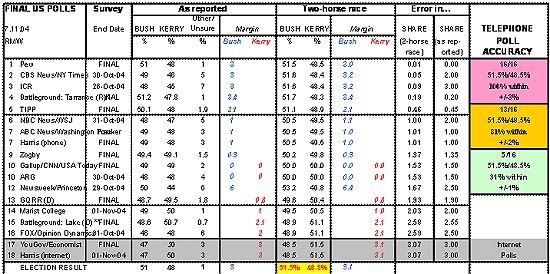
All 16 telephone polls were within three per cent of the election result of the share of each party, adjusting for different reporting policies. Twelve were within two per cent and five were within one per cent, yet I still hear many people here talking about how the polls got the American elections wrong.
Are we about to see a replay of the American experience?
So far in this British election, with under two weeks to go, there is evidence of a gap between the phone pollsters, NOP (two phone), ICM ( five phone), Communicate Research (one phone), Populus (one phone) and MORI (three phone and one face-to-face), and the two internet-based polls (six) and BPIX, organised by the academics Sanders and Whitely. BPIX (two) haven't told us who does their internet panel poll yet. So 23 polls in all, 14 phone/F2F and nine internet.
Since the start of the election each group has exhibited a remarkable consistency, but significantly different from the other group.
Of course, the gap may close between now and May 5, but according to our track, trying to average out the 'rolly pollys' so as not to count them more than once each per four-day 'fresh' sample, we find that the phone/F2F polls average 32.5 per cent for Tories, 39.2 per cent for Labour, and 21.0 per cent for the Liberal Democrats - a 6.7 point lead for Labour. The two internet pollsters, YouGov and BPIX's sub-contractor, have the Conservatives at 34.8 per cent, Labour at 36.3 per cent and the Lib Dems at 21.4 per cent - a 1.5 point lead for Labour.
There's a of 5.2 point gap then at the half-way mark between the different methodologies, just 1.2 points over what there was in the USA in November 2004.
|