|
Poll analysis: Saturday April 16
Dr Paul Baines of Middlesex University and Julia Clark of MORI, standing in for Sir Robert Worcester this weekend, analyse the opinion polls.
The 2001 British Election Study found a difference in turnout by age and gender amongst the youngest group of voters. Fewer than half (46 per cent) of young women (18 to 24) reported that they had voted in the last election compared with 60 per cent of men. Yet both men and women over 60 were equally as likely to vote (87 per cent).
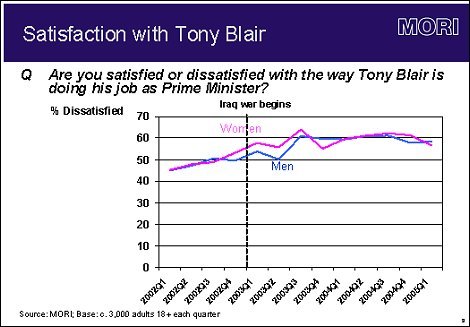
MORI's polls over the whole of the last parliament found that - contrary to what many commentators and pundits are saying - women are only very marginally less dissatisfied with Tony Blair than men, at around six people in 10. This has changed little since the Iraq war was first prosecuted in March 2003. Is the Iraq war 'turning off' millions of women voters? Not much, if at all.
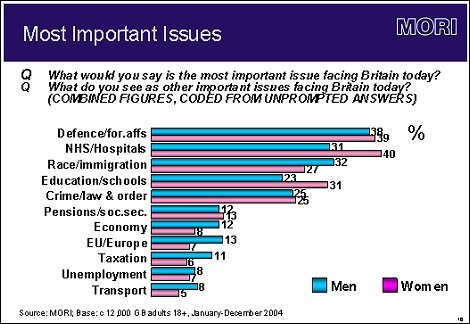
What is clear from the data is that women do place political issues in a slightly different order, with more women regarding health and education as important than men, although they place less importance on the economy.
Does this represent a women's agenda? In an unprompted question on what are the most important issues facing Britain today, MORI found that the issues that were of most concern to women were in the order (men's position of importance in brackets): 1) NHS (3rd); 2) defence/terrorism (1st); 3) education (5th); 4) immigration (2nd); and 5) law and order (4th). Not much of a gender gap there since they both share the same top 5 'basket of issues'.
They are, though, more likely to answer 'don't know' to pollsters' questions. Why is this? Perhaps because they feel that they do not want to commit themselves to an opinion which they do not hold strongly.
On the other hand, men might well be prepared to commit themselves to such opinions. The implication for the political marketers is that there appears to be no such advantage in designing policies specifically targeted at women, at least not just for women of all ages, because they are not sufficiently distinct a target segment to warrant this.
It would be better for campaign strategists to target the older men and women voters who are more likely to vote, as they have been doing with pension promises and pledges of more police on the streets. They are more likely to get out and vote.
For more on public opinion and the war in Iraq, see forthcoming article: Baines, P. and Worcester, R. (2005), 'When the British Tommy went to war, public opinion followed', Journal of Public Affairs, Vol.5, No.1, pp.1-15.
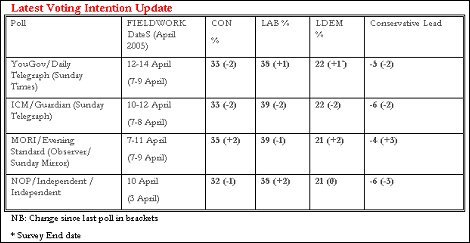
Dr Paul Baines is principal lecturer in marketing at Middlesex University and is on secondment to MORI. Julia Clark is a research executive at MORI.
Sir Robert is in the USA, delivering a lecture at the University of Kansas, and returns next week.
This article is based on a paper presented to the Political Studies Association conference at the University of Leeds on April 4 to 7, 2005 by Roger Mortimore, Paul Baines and Tom Huskinson.
|