|
Poll analysis: Thursday April 14
MORI chairman Sir Robert Worcester analyses the latest opinion poll data.
Two new polls to report on. MORI's for the Evening Standard among 1,973 British adults, interviewed face-to-face in their homes, carried out by CAPI (Computer Aided Personal Interview) from April 7 to 11. It found 39 per cent support for Labour, 35 per cent for the Tories and 21 per cent for the Liberal Democrats.
We also had ICM's 39 per cent also for Labour, 33 per cent for the Conservatives and 19 per cent for the Liberal Democrats. Their poll was done by telephone using CATI (Computer Aided Telephone Interview), among 1,524 people between April 10 to 12.
But today, let’s look at the issues.
It is indeed beginning to look as if Iraq, much discussed and dissected by the pundits, politicians and other talking heads so far in this campaign, is the dog that growled, not barked, in the night. It seems not to be an 'issue, issue', but is an 'image issue'.
It is an issue because it underpins the lack of trust that the public have in Tony Blair. He took Britain into a war along side the Americans on what many see as a false premise, and although George W Bush has replaced the head of the CIA, the president remains in the Oval Office - without a majority satisfaction rating now, it is true, but relatively unscathed.
Blair has been wounded, but not killed, and is helped by a bias in the boundaries favouring the Labour Party by some 50 or so seats (if the Labour and Conservative Party are equal on the day, Labour would have an overall majority of around 50 seats).
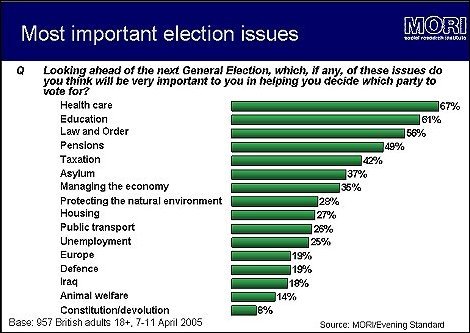
When you ask a sample of nearly 2,000 people interviewed face-to-face in their homes using a show card, as MORI did for the Evening Standard on April 7 to 11, not what are the issues facing the country but what might move votes from one party to another either by potential voters being attracted to one party or repelled by another, Iraq struggles to be in 14th place or so out of 16 issues tested.
There are four reasons why issues don't bite, although there are indications that this time issues will be deemed important to more people than other recent elections.
First they have to be salient, second there has to be a perceived difference between the parties' stands on the issue thought important, third is a belief that the party if in power would, and fourthly could, do something about the issue of concern.
So what does bite? The old traditionals: health, education, crime come top as usual.
Tomorrow, the rest of the story: which party has the lead on which issues, and by how much, and how has this changed since the 2001 general election.
On the weekend my column will be replaced by my colleague and co-author Dr Paul Baines of Middlesex, who is spending a four-month sabbatical with us.
|