|
Poll analysis: Thursday April 21
MORI chairman Sir Robert Worcester analyses the latest opinion poll data.
Today's news is the long awaited decision of the Sun on which party they will support in this election. In 1997, several months before the election I had a phone call from a man who introduced himself as the market research manager on the Sun newspaper.
He said that his opposite number on the Times said that we were collecting the newspaper readership of around 2,000 people, and that we could let them have the then current voting intention of their readers.
I did indeed have the data to hand, showing that Sun readers were in support of the Labour Party of Mr Blair by a wide margin; three weeks later the Sun came out for Labour.
They have done so again today. So what will be the impact of this? It's too soon to tell, but in past elections, chiefly 1992, it was indeed 'the Sun wot won it'. But that was an election so close that if one person in two hundred who voted Conservative across the country had voted for the second party in their constituency it would have been a hung parliament instead of a Conservative lead of 21 seats in the House of Commons.
So it was 'the Sun wot won it', and the Mail, but not the Express, and a lot of other things, in 1992. With the Blair landslide engulfing John Major in 1997, the media impact couldn't really be measured, but this time, in fact this weekend, we'll be seeing the impact of the Sun's endorsement of Labour in a 2,000 case, face-to-face, in-home, computer aided personal interviewing (CAPI) pukka survey nationwide, asking regular readership, which we will be able to use to see if there has been an exaggerated swing among Sun readers to Labour from a similar survey done for the Financial Times a fortnight before.
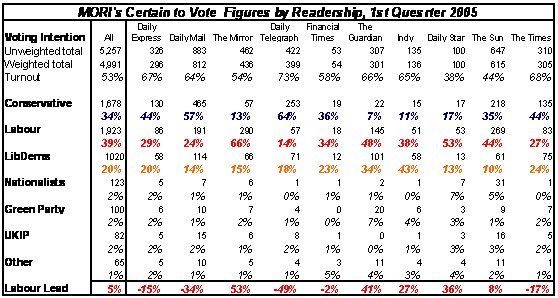
Latest Poll: Today ICM in the Guardian stays right in line with all the other telephone polls and MORI's face to face poll as well, with the Labour Party at 39 per cent, the Tories at 33 per cent and the Liberal Democrats at 22 per cent.
The Guardian prints a nice graphic showing the timeline since April 7, which shows how important it is to look beyond the 'gap' or 'lead' to the actual shares reported by the polling firms.
Since the start of the campaign, Labour's been flatlining in every single poll at either 39 per cent or 40 per cent. Yet the gap has gone from a five point Labour lead on April 7 to 9, to a 10 point lead on April 11 to 13 as a result of switching between the Conservatives and Liberal Democrats. Labour doesn't much care who is in opposition, as what counts is their number of seats in the House of Commons over all other parties.
The Guardian also reports an ICM analysis of postal voters intentions as 44 per cent Labour, 26 per cent Conservative and 22 per cent other, with an estimated six million intended postal voters this time, compared with 1.4 million in 2001, out of the 25.5 million votes cast. If replicated on May 5 this will only serve to widen the Labour share, and increase the size of the Labour landslide.
|