|
Poll analysis: Sunday April 24
MORI chairman Sir Robert Worcester analyses the latest opinion poll data.
Update on Sunday's polls:
Congratulations to the YouGov founders and shareholders who will be wealthier on Monday, when their float delivers about £18 million valuation to the fledgling company. YouGov has a turnover of just under £2 million, so valued at about nine times their turnover, and with a profit last year of around £600,000, a 30x profit price. Well done!
In an interview in the Evening Standard last week, Peter Kellner extolled their enviable record on getting elections right, save Europe last June, but not mentioning the London mayor figures and ignoring completely their problems with the fact that President Kerry isn't after all in the White House. Both YouGov, polling for the Economist, and Harris International, the only other internet pollster, thought it would happen - the only two of the 18 polls released in the final two days of the campaign to be so far out, as the data shows.
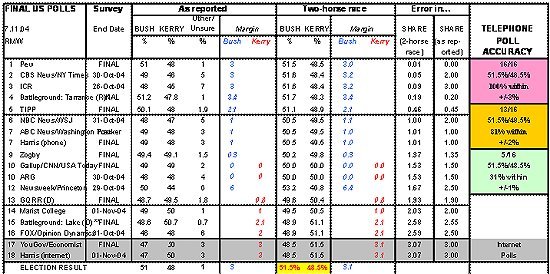
All 16 telephone polls were within three per cent of the election result of the share of each party, adjusting for different reporting policies. Twelve were within two per cent and five were within one per cent, yet I still hear many people here talking about how the polls got the American elections wrong.
Are we about to see a replay of the American experience?
So far in this British election, with under two weeks to go, there is evidence of a gap between the phone pollsters, NOP (two phone), ICM (six phone), Communicate Research (two phone), Populus (one phone) and MORI (three phone and one face-to-face), and the two internet based polls, YouGov (seven) and BPIX (three). Organised by the academics Sanders and Whitely, BPIX haven't told us who does their internet panel poll yet. So 27 polls in all, 16 phone/F2F and 11 internet.
Kellner states in his article in the Sunday Times (see below) that YouGov has conducted nine polls since the start of the election, but so far my team's only found seven. We'll search for the rest, and any others we've missed, and update the analysis begun yesterday as we hurtle, so it seems, to election day. He does state today that all nine of their polls have had Labour on 36 to 38 per cent, call it 37 per cent +/- one point, the Conservatives on 33 per cent to 36 per cent, say 34.5 per cent +/- 1.5 points, and the Liberal Democrats 20 to 23 per cent, say 21.5 per cent +/- 1.5 points.
Not much change there then, although the media's concentration on the gap means that naïve reporters and commentators are confused by this, calling poll findings 'ridiculously disparate'.
Every poll done by telephone or face-to-face during the first fortnight of the campaign (save one which reported 38 per cent) had the Labour Party on either 39 per cent or 40 per cent, yet the media could have taken such stable figures from ICM (39 or 40 per cent across all their polls) and on the five point initial gap and the 10 point gap a week later had headlines screaming 'Labour lead doubles', when all that happened was a bit of shuffling between Tories and Lib Dems.
Watch the share, not the gap. And remember, we're measuring shifting sands to the best of our technique's ability, systematically and objectively, not just spouting off like some commentators I could name.
There has been since the start of the election remarkable consistency by the internet pollsters and by the phone/F2F surveys, but each significantly different from the other group.
Of course the gap may close between now and May 5, but according to our track, trying to average out the 'rolly pollys' so as not to count them more than once each per three or four-day's 'fresh' sample, the phone/F2F polls average 32.7 per cent for Tories, 39.3 per cent for Labour and 20.8 per cent for the Liberal Democrats, a 6.6 point lead for the Labour Party.
The two internet pollsters, YouGov and BPIX's sub-contractor, have the Conservatives at 34.6 per cent, Labour at 36.4 per cent and LDs at 21.4 per cent, or a 1.8 point lead for Labour.
There's a gap then at the half-way mark of 4.8 points between the different methodologies; just an 0.8 point different from the USA in November 2004 when the internet folks elected President Kerry by a six point lead over George W Bush.
ICM's survey of issues asked 'Which political party is putting forward the best policies on...' and found Labour with a lead of
- 23 points on 'the economy generally' (14 per cent rated it 'most important').
- 14 points on 'health services' (21 per cent).
- 13 points on 'the fight against terrorism' (four per cent).
- 12 points on 'education' (13 per cent).
- Nine points on 'Europe' (four per cent).
- Four points on 'taxation and public services' (15 per cent).
Of the eight questions asked, the Tories led on only two, but 'taxation and public services' is a double-barrelled question, as some respondents would have had different answers on taxation and public services, and might well have said the Tories were ahead on one and not the other. Tories did lead by:
- One point on 'law and order' (13 per cent).
- Nine points on 'asylum and immigration' (nine per cent).
On 'Who would make the best prime minister?' ICM's 14 point lead for Tony Blair over Michael Howard stayed consistent, with a 15 point lead this week.
YouGov's Peter Kellner, one of Britain's latest millionaires (as of tomorrow), reports in today’s Sunday Times that their poll is in fact re-interviews with some of YouGov's internet panellists first polled two weeks ago.
He finds, as we did decades ago when he was on the Sunday Times as a journalist and I was their pollster, considerable 'churning' under the surface of the fairly stable headline figures.
Some 18 per cent of their panellists answer the voting intention question differently than they did just a fortnight ago, two thirds of the movement between the 'don't know' and 'will not vote' category but about six percent of the total sample switching directly from one party to another.
It is sad to see that the great tradition of panel studies' conduct and analysis has been pretty well lost due to tighter financial stringency on the part of the newspapers, as a great deal was learned from panels, repeatedly calling back week after week on the same respondents, which MORI did for several elections for the Sunday Times, and for the Independent on Sunday/Sunday Mirror in the last election.
Much hidden movement was measured and the reasons for the movements obtained through the use of open ended questions probing the reasons for the movement.
|