|
|
|
Education And Workable Study Methods Supported By The Foundation
|
|
|
Even though Britain ranks as one of the top ten countries in terms of its literacy level, millions are spent by the UK Government on handling matters resulting from lack of education such as ill-health, pregnancy, crime & violence, unemployment, etc.
No matter which way you look at it there is still the need for an effective educational method that works for all people in society, young or old.
For this very reason the Foundation encourages and supports educational methods developed by Mr. Hubbard which are validated educational methods based on his own personal experience. He saw that there were reasons why a student would lose interest or give up a certain course of study and that there were specific phenomena accompanying this. Have you ever read to the end of a page in a book or magazine and then wondered what you had just read on that page?
Based on the various discoveries he made, he further researched and found the exact barriers that would inhibit a student from effectively learning a subject and make him feel uninterested or unhappy with continuing his study. There are many who have experienced these phenomena and there are precise reasons for them. These barriers not only inhibit every day school education but they are the very reason why:
Per the Organisation for Economic Co-operation and Development, it is no coincidence that the poverty rate in Britain of 20 per cent - the worst in the industrialised world - matches its rate of functional illiteracy.
1 in 5 Britons over the age of 15 cannot read well enough to find a simple word such as 'plumber' in a telephone directory.
It was for this reason that Mr. Hubbard derived a way to overcome these barriers in providing a person with the fundamental basics of learning how to learn so that a person would not only be able to understand and apply the subject they were being taught but be able to learn and apply anything.
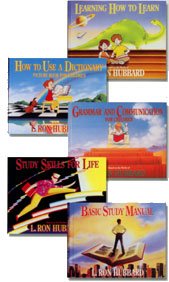
In short, there are three main educational texts that delineate this study method. The Basic Study Manual, Study Skills for Life and Learning How to Learn are courses used in educational projects throughout the world and essentially differ only in their treatment of the material; the first is designed for teenagers and above while the second is aimed at youngster readers, with the third offering the basics of Study Technology to children between the ages of eight and twelve. The point being, Mr. Hubbard's study methods have proven as effective in the elementary school as they have in the executive suites of multinational corporations.
Due to the workability of the courses and programmes utilising Mr. Hubbard's study method, the Foundation strongly supports the various corporations and charities that have been using these techniques and are dedicated to the improvement of education worldwide. As a result of their efforts to this date:
The L. Ron Hubbard educational method is currently applied in thirty-six countries on all six continents.
More than 3 million people have participated on the 213 literacy projects that have been carried out worldwide.
There are many charities or corporate organisations utilising the discoveries and study technique developed by Mr. Hubbard such as the UK-based Basic Education and Supplementary Teaching Association (B.E.S.T.). BEST has conducted a number of educational projects in the society that have proven successful in improving the reading capabilities of children. (Click here for more on this.)
|
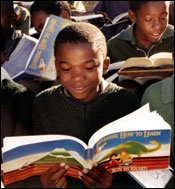
"Knowing and using the Study Technology allowed me to help my students to more fully understand and comprehend the technical material that I teach."
D.J. Kaup Ph.D.
Joint Professor of Mathematics, Physics and Computer Science
|
"As an Academic Skills Instructor at the university level, my students, after being given a few principles from Mr. Hubbard's Study Technology, gained strategies they needed to learn from a text and to apply what they learned."
Sandra Chapman
M.A. Instructional Material Designer
|
|
|
|
|
|
|


