|
It's Brown or Letwin, says Blair
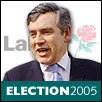 |
| Brown: Economy centre stage |
Labour is continuing its focus on the economy, with new campaign posters setting out the "choice" facing voters.
Having hinted strongly that Gordon Brown would be staying on as chancellor in a third term, Tony Blair on Thursday unveiled a pair of posters asking voters who they would want to run the economy and country.
Directly contrasting Brown with Tory shadow chancellor Oliver Letwin, and himself with Michael Howard, the prime minister said the options were clear.
He said the election was "a choice between this man, Gordon Brown" and the "untried and untested" policies of Letwin.
Brown himself paid tribute to Blair's leadership and willingness to take "tough decisions", saying he was respected around the world.
The party put the economy at the top of its election agenda for the second day running, as it seeks to exploit its poll lead on the issue and set the political agenda.
New Deal
Brown set out his vision of the future of the New Deal programme during a speech in a marginal Milton Keynes constituency.
The chancellor said the programme would be crucial to meeting the challenge of competing with new economic rivals such as China and India.
"Our new deal for jobs and skills also addresses the long term challenge all industrial economies – especially those with rising elderly populations - will now have to confront," he said.
"With the rise of China and Asia it is all to easy to accept a new conventional wisdom: that countries like Britain will find it difficult to compete.
"It would be all too easy to retreat to the old ideas of the 1980s that facing massive technological change full employment is, for a country like ours facing competition from china and India , once again an impossibility.
"The challenge is quite different. It is to train and equip people for the new jobs the new products and new services in which our economy must specialise.
"To succeed against the new Asian challenge, and, of course, to meet the demographic challenges all advanced industrial economies now face, Britain must employ not just some of the talents of some of our young people people, but all of the talents of all our young people."
Third term
Brown also said the New Deal employment scheme would be extended to one million more people during a third term.
It would help the 90 per cent of incapacity benefit claimants who want to work, and will focus on ethnic minorities, who are two times more likely to be out of work.
"Since 1997 we have halved the levels of unemployment. Now we must do even more to tackle the levels of inactivity in our economy," the chancellor claimed.
"Without a New Deal, not only does Britain waste the talents of thousands in communities where ethnic minorities live, but social tensions could worsen.
"These innovative measures to help into work those on incapacity benefit, lone parent benefit and the long term unemployed show how much in the coming parliament the New Deal matters."
Tory economics
The chancellor contrasted Labour's plans with Tory plans to scrap the programme.
"The Conservatives seek to persuade people that their opposition to the New Deal is because the programme is wasteful," he said.
"In fact they oppose the New Deal because they think exactly as they thought in the 1980s and 1990s: an unreconstructed party of laissez faire that thinks unemployment a price worth paying is happy to abandon the nation's responsibilities to those seeking work and will leave people on their own and isolated, struggling unaided to cope with often bewildering changes around them.
"For the Conservatives to abolish, in this period of fast moving economic change, the most successful employment programme in Britain's history – which has helped 1.2 million into jobs and is supported today by 70,000 employers – is simply to repeat the mistakes of the past that gave us three million unemployed."
|


