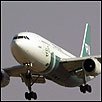
The 2003 white paper on the future of air transport set out plans for an unparalleled increase in the UK’s air transport capacity, from around 200 million passengers this year to more than 476 million by the year 2030.
To be fair, the accompanying overview of the resultant environmental impacts was wide-ranging. It was also quite scary. It proved difficult to track down and find an impact that actually went down, be it noise around airports, local air quality impacts, rising numbers of car-dependent passengers and airport and airline staff, habitat loss, the demolition of listed buildings, severe community disruption and displacement caused by new runway construction, or the worrying and increasing contribution to climate-change from aircraft exhaust emissions at altitude.
The white paper made clear that all of this got worse. But there was reassuring news that carbon monoxide would be appreciably less, due to better aircraft engine technology. So that’s okay then.
Lest any reader thinks this is the usual environmentalist grudge match at losing heavily yet again to an industry with a symbiotic relationship with its client ministry, the Department for Transport, here’s how the white paper was greeted by the government’s own environment protection advisory body, the Royal Commission on Environmental Pollution.
In a December 2003 press release, Sir Tom Blundell, RCEP chairman, explained: “The Royal Commission is not opposed to cheap air travel, and has no intention of suggesting that people should not have affordable access to their holiday destinations.
However, the levels of growth predicted in the aviation white paper are simply not environmentally sustainable, and the government needs now to start moderating demand, both by increasing the cost of air transport to a fair and equitable level, and by encouraging affordable and environmentally more benign forms of transport.”
The comments are strong stuff – but mirrored in similar language and critical tone by the Environment Agency and the Sustainable Development Commission, both at the time and since.
What happened next? Precisely nothing. The government airily waved off its critics, whether sandal-wearing or suited, community-based or with access to the corridors of power, with an oft-heard “it’s the economy, stupid” mantra.
But this year the government has promised to review the progress of the air transport white paper, so now might well be the time to re-open the debate. Road transport policy is heading in the direction of road congestion-charging with the government’s blessing. If you want to drive into central London tomorrow, it will cost you £8. This is demand-management.
So instead of hoping that a rather large and quite noticeable increase in air transport-related pollution might go away, why not look at a fair, reasonable and easy-to-introduce ‘congestion charge of the skies’?
The sums were done by think tanks Infras and IWW. The mechanism would be a distance-related variant of the current air passenger duty. The amount on a ticket? The princely sum of 3.6 pence a kilometre. Of course, there’s a catch – think of the distance you last flew. A low-cost airline trip from Luton to Glasgow, approximately 1,000 kilometres, would cost an extra £36. Travellers heading to Australia can do their own sums.
Now this would have an impact on demand; frankly, the only realistic way to reduce air transport’s negative environmental impacts. Instead of annual air transport growth of three to four per cent, the introduction of equitable environmental economics to a sector that pays zero tax on its fuel would see growth cut by half to one to two per cent annually in the future.
We know there is some good news, as better aircraft technology and air traffic-management systems will make flying less damaging by about the same figure; one to two per cent more efficient each year. So our demand-management policy proposal would see growth in balance with technology gains – and around 300 million passengers by 2030 needing no new runways.
Is anybody listening? Let’s hope the one-every-90-seconds queue of planes landing at Heathrow via Westminster are in super-quiet mode.
Correction: A previous version of this article online and in print said in the second paragraph, "It proved difficult to find an impact that wasn't going to diminish..." This should have read, "It proved difficult to track down and find an impact that actually went down..." Blue Skies apologises for the error.