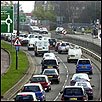
The UK’s transport infrastructure is currently more of a hindrance than a help for British business. A recent survey carried out by the Institute of Directors revealed that 65 per cent of directors believe the creaking transport system has a negative impact on their organisation.
It hardly seems necessary to state the obvious, but if the nation’s economic arteries are not unblocked very soon, the heart will suffer. We need a radical improvement in the health of our transport network over the next decade or we will endure the consequences.
Transport, of course, matters to us as individuals – as drivers, cyclists or passengers. But it also impacts hugely on businesses. We all have to get to and from work safely and efficiently, firms need to deliver and receive goods and supplies, and many people have to travel to meetings as part of their job. Quite frankly, at the moment, our rail and road networks are not fulfilling these basic functions with anything like the levels of efficiency that the economy needs.
Business has two key requirements from transport policy: extra capacity for rail, road and air; and a much greater sense of urgency from the government as it develops policies to provide it.
So, what can be done to create that extra capacity? Well, clearly, transport is crying out for investment, and with no extra money forthcoming from the government, road-pricing is a potential solution.
Currently, of the £43bn raised every year in road tax only £5bn is actually spent on the road network. Road-pricing is one way of easing the gridlock and raising additional revenue to re-invest. Some 56 per cent of businesses told us they were prepared to support the widespread introduction of toll-roads and congestion charging – providing the revenue generated is used to increase road capacity or reduce motoring taxes.
There was an impressive 84 per cent approval rating for the M6 Toll Road around Birmingham, for example.
However, we would like to go further and suggest that money raised from road pricing should be re-invested across the whole transport system and not merely ring-fenced for road improvements. The rail network is truly the weak link in transport and requires large amounts of real, and political, capital to restore to the levels of efficiency enjoyed by other developed countries. Capacity needs to be expanded and fragmentation reversed. There are simply too many agencies, bodies and companies involved in running the railways, leading to inevitable confusion, duplication and waste.
Getting more people travelling by train instead of car also helps the government meet its carbon emission reduction targets. I am not suggesting shifting investment away from the roads entirely – in many parts of the country cars and buses are the only option. The fact is, compared to the likes of France, Germany and Spain, our railways are an under-performing asset that we can no longer ignore.
There should be far less talk about notions such as ‘integrated transport’ and more actual action. The government’s 1998 transport white paper contained much about integrated transport. The Commission for Integrated Transport was set up to pursue this theme, yet several years later it is still possible to visit an information kiosk at a main London railway terminus to enquire about bus or Tube, only to be told that they are “just the railways”. Clearly the integrated transport message has not travelled to all parts. Further work needs to be done to enhance those web-based tools for travel planning, for instance.
Ultimately, we need to see a much greater sense of urgency from the government on transport. Difficult decisions have to be made, and made now. The study of the economic implications around transport strategy currently being carried out by the Treasury and the Department of Transport, led by Sir Rod Eddington, may come up with some radical proposals. If so, the government will need to think seriously about them and not simply set up another quango for better transport.
The UK has a poor transport infrastructure compared with other major industrial economies. If we are to maintain our competitive advantage, we have to sort out transport. For example, hints from government that the necessary technology for widespread road charging will not be available until 2014 suggests that ministers are kicking difficult decisions into the long grass. That simply is not acceptable.