|
|
CLIC
|
About CLIC
Facts About Childhood Cancer
Case Study
Research and Publication
 About CLIC About CLIC
Each day in the UK, five families are told their child has cancer or leukaemia. From that moment on their lives will never be the same again. Some children will survive, some will unfortunately die, but the scars on the family will remain.
CLIC - Cancer and Leukaemia in Childhood, is one of the UK's leading charities striving to eliminate childhood cancer and leukaemia. CLIC recognises the extreme pressures placed on families when a child is diagnosed with cancer or leukaemia and works towards meeting the financial, practical, emotional and clinical needs of those children and their families.
CLIC looks forward to a world where the impact of childhood cancer is minimised by:
Equal Access to the best possible treatment and care
The preservation of the highest possible quality of life for each child and their family
The formulation of effective strategies to identify, prevent and cure those diseases
Medical resources, practical help and research are the three main areas of focus for CLIC who aim to provide an all-embracing approach to care for families with children diagnosed with cancer or leukaemia.
What CLIC Funds?
Homes from Home - CLIC provide free self-catering accommodation for families close to specialist oncology centres around the UK. The service allows parents, children and siblings to stay together for as long as necessary during periods of treatment and offers the support from other families in similar circumstances.
CLIC Doctors, Nurses & Play Specialists - Across the UK CLIC fund specialist doctors, nurses and play specialists who work in the local community providing care for children with cancer or leukaemia at home, at school and in hospital. These professionals are involved in care from the time of diagnosis and throughout the course of treatment.
Teenager Support - CLIC recognises the unique needs of teenagers with cancer and leukaemia. TOPS offers fun activities and events to provide teenagers with their own independence as well as communication and support.
Care Grants - CLIC Care Grants offer relief to families, who due to their child's illness, have to cope with increased financial pressure. Care Grants alleviate the stress of worrying about the additional financial uncertainties of caring for a sick child and enable families to concentrate on their child's treatment and recovery.
Research - CLIC funds various research projects throughout the UK, and the CLIC Laboratory at Bristol university. CLIC funded research is aimed at investigating the causes of childhood cancers and leukaemia's. This research enables us to have a better understanding of these particular diseases and identify possible future treatments and cures.
Who Funds CLIC?
The charity receives no government funding and is totally dependent on voluntary contributions to maintain and develop its vital services.
[Top]
 Facts About Childhood Cancer Facts About Childhood Cancer
Approximately 2,100 children and young adults are diagnosed with cancer and leukaemia each year in the UK.
1 in 650 children are affected by cancer or leukaemia by the age 15
Cancer and leukaemia are the biggest childhood killer diseases in the UK.
After accidents, cancer is the second most common cause of death.
Leukaemias and brain tumours account for over half of all childhood cancers.
Combination therapy (chemotherapy and radiotherapy) and improved care mean that 70% of children now survive childhood cancer.
Survival is improved whenever a child receives rapid treatment at a specialist centre, followed by ongoing monitoring and support and adequate counselling for both child and family.
Although the news can be devastating, there is hope. Improvements in treatment and professional support mean that 7 out of 10 children now survive childhood cancer and leukaemia.
There are now over 20,000 survivors of childhood cancer in the UK.
[Top]
|
|
|
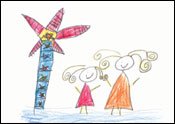 Case Study Case Study
Katie Omand will be 8, in August 2003 Katie was diagnosed with a cancerous tumour on the left side of her brain. After an operation to remove the tumour Katie underwent 7 weeks of Chemotherapy at Bristol Children's Hospital. Katie and her mum Julie stayed at CLIC House.
"Katie and I stayed in CLIC House in Bristol from Monday to Friday for her to attend daily radiotherapy sessions and travelled back every weekend to be with my husband Mark and Katie's sisters. Obviously at times like this the strain put on a family is immense especially when you are trying to keep everything as normal as possible for the other children - travelling alone can be tiring, however, all the pressures and pain were certainly helped by us being able to stay at CLIC House and being able to use this as our home for seven weeks."
"Katie became quite proud of showing relatives around 'her room' when they came to visit and everyone was always made welcome by the staff who worked there and all helped to give a friendly and warm atmosphere in the house. The fact that you are staying in a place with other parents in similar situations also gave us support and helped us talk things through, as everyone understood how you were feeling."
"The work CLIC does to give support to families like us is absolutely marvellous and I don't know what we'd have done without them. It has certainly opened our eyes to a lot of things and now our whole family has a better understanding of what CLIC does. They don't just help the child who is ill, but all the brothers and sisters, parents, grandparents - everyone connected in the family and believe me when it suddenly hits your own family you cannot put into words how grateful you are."
[Top]
 Research and Publication Research and Publication
CLIC fund various research projects throughout the UK as well as the CLIC research laboratory at the University of Bristol. CLIC-funded research is aimed at investigating the causes and effects of childhood cancers and leukaemias.
These studies enable researchers to have a better understanding of particular cancers in order to work towards identifying possible future treatments and cures.
Here three CLIC researchers give us a brief insight into just some of the projects CLIC are funding:
Dr Karim Malik
Dr Anthony Penn
Dr Pamela Kearns
Dr Karim Malik is a Senior Research Fellow and has worked at the CLIC Research Unit at the University of Bristol since 1992, he now jointly heads up the team with Dr Keith Brown who is a Reader in Molecular Pathology.
Our body is made up of cells that have the ability to grow and function in very specialised ways. For example, nerve cells produce molecules (known as proteins) which are used to transmit information between the brain and the body, whereas cells in the liver produce proteins often involved in removing toxins from the body. Thus, in normal circumstances, cells are "programmed" to perform certain duties (using the set of proteins they produce).
In cancer cells, however, the normal programming goes awry, with the cells producing too little or too much of certain proteins. The overall effect of such changes is often the uncontrolled cell growth of cancer cells.
We at the CLIC Research Unit plan to investigate how the normal programming of cells goes wrong in cancer cells, and how we may use the detection of such changes in cancer diagnosis and therapy.
[Back to Names] [Top]
Dr. Anthony Penn, is a CLIC Paediatric Neuro-oncology Fellow based at Frenchay in Bristol and is working on The CLIC Childhood Brain Tumour Study
Brain tumours are the second most common cancer in childhood after acute leukaemia and account for approximately 20% of all childhood cancer.
Dramatic advances have been made over the last few decades in diagnosis and treatment and these have resulted in a significant improvement in survival for children with brain tumours. Very little information is available concerning the long-term outcomes of children with brain tumours and their families.
CLIC has given us a major grant to find out more about the effects of brain tumours on the child and family. The study will take place in Bristol and will include all children diagnosed with a brain tumour in the South West of England.
Children and their parents will be assessed in their own homes. In this study we hope to gain more information on the effects of having a childhood brain tumour and help develop effective and holistic management for children with
brain tumours and their families.
[Back to Names] [Top]
Dr Pamela Kearns is a Consultant Senior Lecturer and works at both the Bristol Children's Hospital and the University of Bristol. Her work on a new CLIC funded research project began this spring.
There has been considerable progress in the treatment of childhood leukaemia and in the UK approximately 80% of children with acute lymphoblastic leukaemia (ALL) can be cured with current chemotherapy. Leukaemia is treated with a combination of drugs designed to kill the leukaemia cells. Unfortunately some leukaemia cells are resistant to these current drugs. This means that a significant number of children with ALL have disease, which is resistant to treatment.
One way to overcome this resistance is to study the biology of resistant leukaemia cells and use this information to develop new drugs specifically targeted to overcome the mechanism of resistance.
The expression of some genes in leukaemia is controlled by a process called 'DNA methylation'. Our research is investigating the relationship between DNA methylation and the development of resistant disease in childhood acute leukaemia. We know that DNA methylation is a reversible process; therefore understanding how it is involved in resistant disease may lead to the development of new treatments for children with leukaemia in the future.
[Back to Names] [Top]
|
|
|
|