|
PMQs: The key exchanges
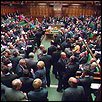
Wednesday's clashes between Tony Blair, Michael Howard and Charles Kennedy will be the only direct debate they participate in during this election campaign.
The full text of their exchanges follows below.
Howard - Blair
Michael Howard: At the last election the prime minister promised not to raise National Insurance contributions. In its first Budget afterwards the government raised National Insurance contributions - in the words of the chancellor, why should people ever believe him again?
Tony Blair: On the specific promises on the basic and top tax of tax we have kept to those promises.
It's correct that we raised National Insurance in order to pay for extra investment in the National Health Service, we want to keep that investment going into the NHS.
His plans are to take over £1bn out of the health service to pay for half of the cost of operations in the private sector. There is no policy more elitist than that, and we are proud of the investment in the NHS, proud of the work it is doing, and under this government at least, the NHS is safe.
Michael Howard: Before the last election he was asked specifically whether people should suppose he was going to increase National Insurance contributions and he said they shouldn't. Now he said that wasn't a promise. Doesn't that tell you every thing you need to know about this prime minister?
In 1997 he said Labour had no plans to introduce tuition fees to higher education, he then introduced tuition fees.
In 2001 he said 'we will not introduce top up fees and have legislated to prevent them'. He then introduced top-up fees. In the words of the chancellor, why should people ever believe a word he says again?
Tony Blair: I am very happy to compare our record in government with the record of the right honourable gentlemen.
We are proud of the fact that our economy is strong, that investment is going into our and schools and hospitals. It is what we've promise and it is what we've done.
And let me just remind him of what he did when he was in government.
When minister of the environment he introduced the poll tax; when minister for employment, unemployment rose by one million; when minister in charge of labour regulation he ended up opposing the minimum wage; and when he was home secretary he cut the numbers of police.
In the end the judgement people will make is between our record and future programme and his, and I know what judgement they will make.
Michael Howard: He was asked specifically about his broken promises on top-up fees and tuition fees and he couldn't bring himself to say a word in defence of those broken promises.
In 1997 he promised firm control over immigration but since then net immigration has tripled. In the words of the chancellor, why should people ever believe a word he says again?
Tony Blair: We inherited an immigration system where when he was home secretary it took 20 months to process an asylum claim, when the number of removals was one in 10.
And yes it is true that we need to control immigration but the way to do it is not his proposal of halving the immigration budget. Yes it is an issue, yes it is important that we discuss it, but it is an issue that should be dealt with and not be exploited.
Michael Howard: They are cheering him now but lets find out what they really think of him, how many are putting a photo of him on their election posters?
Doesn't that tell you all you need to know about what they really think of him?
The prime minister promised to tackle the unacceptable level of anti-social behaviour, he said he would remove housing benefit from anti-social tenants, anti-social tenants have still got their housing benefits and the level of anti-social behaviour has got worse.
In the in the words of the chancellor, why should people ever believe him again?
Tony Blair: Let me just remind him what the chief constable of North Wales said about the Conservative Party policy and their advertisement on crime. He said 'his misleading advert quite improperly seeks to stir up fear of rising crime when it was well established fact crime has been falling for years both locally and nationally.
When he was in office crime doubled under the Conservatives, it has fallen under Labour.
So we have the strongest economy, falling unemployment, investment in our health and education services, falling crime, investment in the police. And that is opposed to a policy that would put our economic stability at risk and have cuts in public service,
Once people know that choice, and they will over the coming weeks, then I say to the right honourable gentlemen it will be quite clear what they will choose.
Michael Howard: The figure we used in those advertisements are the police's own figures, the figures he just used a couple of minutes ago when he was describing the figures of the last government. Lets have none of this clap trap.
He talks about his record but his chief election coordinator, where is he? His chief election coordinator said that his biggest fear has always been that this election would turn into a referendum on the Labour Party. Is that what the prime minister thinks too?
Tony Blair: I think it is a choice between a Conservative Party that when it was in office had unemployment at three million, had interest rates at 10 per cent for four years, had boom and bust recession twice, and ended up cutting spending on our NHS and in our schools.
And I think its a choice between that and a Labour government over the past eight years that have delivered economic stability, low mortgages, low unemployment, low inflation, record investment in our NHS and in our schools.
I think that is the choice, and I think that when the country comes to consider not just the record of the Conservative Party but the fact that their economic and health and education plans are exactly the ones they rejected in 1997, I think when they do that then yes I will be very happy that people compare the choice between their record and ours, between our future programme and theirs.
Michael Howard: I will tell him about his record: taxes up, crime up, immigration up, waiting times up, MRSA up, truancy up
And let's have a look at what has gone down. Take home pay down, pensions down, productivity growth down, manufacturing employment down, detection rates down.
After eight years of Labour government our voting system is like that of a banana republic and pensioners who can't find an NHS dentist are reduced to pulling out their own teeth.
Isn't there now a clear choice at this election. Rewarding this prime minister for eight years of broken promises or choosing a government that will take action on the things that matter to hard working Britons.
Tony Blair: I am going to begin by agreeing with him. I think it does mean a choice, and the choice is very, very clear.
People remember the years before 1997. People remember the people who lost their homes in the recession, that lost their jobs in the recession, that used to end up with mortgages they could not afford.
They remember the winter crisis every year in the National Health Service, they remember the outside toilets and the freezing classrooms in the schools, they remember when the police officers were cut when he was home secretary. They remember all that.
And what we will remind them of between now and polling day is what they have now and what is therefore at risk.
What they have now is the economic stability and the investment in public services and the action on crime. So the choice is indeed very clear.
What I say to the British people is this: economic stability is at risk, your job is at risk, your mortgage is at risk, the economy is at risk.
And therefore when you come to make that choice on May 5, realise the fundamental nature of it.
Realise what you experienced under 18 years of Tory government, realise the progress we have made under eight years of Labour government.
And then go out and realise too that unless people come out and support it, that stability, that investment will no longer happen, the clock will be turned back and the very self same crew they voted to get rid of in 1997 will come back.
Yes, it is a big choice and I can't wait till the public make it.
Kennedy - Blair
Charles Kennedy: Mr Speaker, on behalf of my honourable and right honourable friends, can I also completely associate myself entirely of course with the opening comments of tribute to the Pope by the prime minister.
Now, Mr Speaker, after eight years of this Labour government, the prime minister will recognise that most women in this country still do not receive a full state pension in their own right, because they have had to take time out of work to raise children, or in many cases to care for elderly relatives.
Surely women should receive a pension as of right, rather than on the basis of national insurance contributions? After eight years, why hasn't the prime minister put that fundamental unfairness right?
Tony Blair: Well I'm sure that the right honourable gentleman knows that two thirds of the beneficiaries of the pension credit are in fact women and that helps enormously with relieving people in poverty, and raising the living standards for pensioners.
And actually, living standards for pensioners have risen considerably above not just inflation but earnings over the past few years.
Of course we've always got to try to do more, but I think if we look back over the record over eight years, the winter fuel allowance, the free TV licences for the over-75s and in particular, the pension credit and the help for the poorest pensioners in our country, the help the chancellor has just announced with the council tax for pensioners, I think this government's got a record on pensioners for which we can be very proud.
Of course there's always more to do, and we will do it, if elected.
Charles Kennedy: Mr Speaker, staying on the issue of fairness but looking at the other end of the age spectrum, why is that we are saddling now so many of our young people with thousands of pounds worth of debt being wrapped around their necks because of this policy of imposing top-up fees?
It's his policy of top-up fees, Mr Speaker, which is in direct breach of the pledge that he made in his last general election manifesto. So why should any of us believe any of the promises he's about to make in his next general election manifesto?
Tony Blair: Of course, there are now going to be no fees paid when someone actually goes through university at all.
What is more, the repayment that will be made by people once they graduate will be linked to their ability to pay, there will be no real interest on that loan, and there will be special help, with the reintroduced maintenance grant, for the poorest people.
But of course we believe that we have to get more money into our university system, and I think he does as well. But his proposal to take that money out of general taxation by a 50 per cent top rate of tax, I do not think is something that will recommend itself to people. It is a proposal that in my view would not raise the money that he thinks it would raise, and in any event it would not be a fair use of resources.
Can I just remind him on education, this country is now investing more each year as a proportion of our national income on education; in Sure Start, in nursery education, in primary schools, in secondary schools, and in universities and for those taking skills courses as well.
I think we can be very proud of our record in education, but it's true we have to modernise our system continually to keep up with the new world in which we live.
|