|
Blair rejects Tory terror law offer
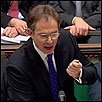 |
| Blair: No deal |
Tony Blair has rejected the Tories' offer of support on the government's anti-terror plans in exchange for a "sunset clause".
Speaking at prime minister's questions, he said he could not support the idea because "sufficient safeguards" are already in place.
The Conservatives made the move on Wednesday in a bid to achieve a cross-party consensus on the plans for control orders for terror suspects who cannot be tried in court.
Opposition leader Michael Howard called for an eight-month limit on the legislation currently going through parliament, ahead of a March 14 deadline when the current powers run out.
Howard said a move by home secretary Charles Clarke on Monday to allow judges to issue orders for house arrest was a "welcome concession".
However, he added that the eight-month limit should be applied so that "parliament has the time to consider these issues properly before permanent legislation is put in place".
Blair said he was not deliberately denying MPs and peers time to debate the measures, but was responding to the law lords judgement that the current legislation breaches human rights.
"The 14th of March is when the renewal of that legislation comes up," he said. "It is not that we are rushing this through."
He added that control orders for restrictions such as as house arrest, which require an opt-out from the European convention on human rights, are "already going to be subject to a sunset clause" as they would be annually renewed.
Other orders for lesser restrictions on suspects' movements and communications would be subject to "continual reports" by an independent watchdog.
There are "sufficient safeguards for the civil liberties of the subject" the prime minister said.
Consensus
Howard responded by saying that it "would be highly desirable if we could arrive at a consensus on these issues".
The Tory chief argued that there is "concern on all sides of this House, which is why over 60 Labour members voted with me on Monday night" against the bill.
"Which is why it would be better if the whole of this legislation could be subject to a sunset clause instead of ramrodding this through," he said.
Blair said that Howard wanted to continue with the detention without trial ruled unlawful by the law lords.
"The police and the security services tell us they want these powers. It would be frankly bizarre to take up his suggestion," he said.
Limit
The Conservatives had earlier agreed to allow the government's new anti-terror legislation to become law for eight months.
The party said it would back the Prevention of Terrorism Bill regardless of changes made to the legislation in the Lords.
But under an amendment that the Tories will propose in the Lords this week, the new legislation would expire after eight months to allow a new measure to be brought forward by whichever party wins the general election.
Labour described the move as a "major climbdown" which confirmed that the Conservatives "do not want to be on the wrong side of the argument on terror".
Clarke said: "If the Conservatives have a proposition they want me to to consider, I will be very happy to meet and discuss it."
David Davis, the shadow home secretary, said ministers had indicated that the terrorist risk to Britain had not changed in the past year, but the imminent general election meant that the government had to have anti-terror legislation in place.
The Tories are also to propose the establishment of a Privy Council committee to review the operation of the new laws after four months and eight months.
The legislation is due to return to the Commons next week.
Meanwhile, former judges and law lords used the debate in the House of Lords on Tuesday to declare that planned anti-terror laws undermined Britain's historic legal rights.
|


