|
MPs narrowly back security screen
MPs have narrowly voted to erect a permanent security screen in the Commons chamber.
The House voted 112 to 76 in favour of a security screen - but only narrowly defeated an amendment which would have delayed the permanent introduction of the measure.
Peter Hain told MPs that the £1.3 million security screen was necessary to prevent terrorists launching a chemical or biological attack on the chamber.
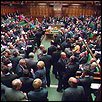
The Commons leader was speaking as MPs debated whether to make a temporary security screen a permanent feature of the chamber.
The screen is intended to prevent members of the public who are visiting the Commons gallery from attacking the chamber.
Hain warned that terrorists now used "a range of weapons undreamed of a few years ago, many of which are not always apparent or easily detected".
He said there had been an "unequivocal" recommendation from the head of MI5, Eliza Manningham-Buller, that the screen should be installed.
"This was not a decision lightly taken," he added
"We are not talking about guns, we are talking about other threats mounted by terrorists to our security."
"To ignore the advice we received would have been irresponsible," he added.
Hoping that the screen would prove "unobtrusive", Hain admitted it was not "fully in keeping with the architecture" of the commons.
A permanent structure would fit in better, he said, with work planned to take place in the summer of 2005.
Hain also gave a graphic warning of the type of threat MPs were facing.
The danger was from possible chemical or biological attack, he said. Organisations such as al Qaeda had indicated an interest in acquiring such weapons.
"If an al Qaeda group managed to throw a vial of anthrax or ricin into the chamber, or maybe even worse a suicide agent releases it without anybody noticing, which we've been advised is quite feasible, the particles would immediately begin spreading throughout the chamber. Because of the way the airflows work within minutes total contamination could occur," he said.
"Decontamination procedures would then be activated, everybody, not just members, would then be locked in and be decontaminated before being allowed to leave."
A "major and comprehensive" review of parliamentary security is also being carried out by the security services and the Metropolitan Police service, it was revealed.
But in frequently rowdy questioning, some MPs made their hostility to the screen known, expressing fears that it would cut members off from the public.
With backbenchers branding the move a "white elephant" and "wretched", Liberal Democrat spokesman Paul Tyler said MPs had been "faced with a fait accompli".
He also called for MPs to be given more time before approval is needed for a permanent screen.
But with the Conservatives being given a free vote on the issue, shadow Commons leader Oliver Heald said he had been convinced to back the measure by the seriousness of the terror threat.
"There is a tension between the needs of security and the openness of a free parliament, and recent events have made this tension greater," he added
Earlier, Conservative MP Gerald Howarth was defeated in a bid to debate the security screen in secret session.
"I do not see how we can have a proper debate on this matter and discuss some of the serious issues which need to be addressed without being able to meet in private," he argued.
But the motion was defeated by 15 to 211.
|