The All Party Foreign Affairs Select Committee, of which Sandra Osborne is a member, went to Iraq as part of their current inquiry into the War on Terror.
They had meetings with President Talibani, Prime Minister Ja’afari, Foreign Minister Zebari, US Ambassador Khalilzad, the Commander of the Multi National Force in Iraq - General Casey, Basra Chief of Police General Hassan Swadh. They also met Religious and Tribal leaders in Basra, representatives of Political Parties, and representatives of Non Governmental Organisations as well as UK Embassy Officials and representatives of the UK Armed Forces.The Committee visited Baghdad, Basra and the Al-Rustimayah Military Training Academy.

Sandra with Chair of the Foreign Affairs Committee, Mike Gapes and Iraqi Foreign Minister, Hoshyar Zebari
The Journey
“We had been warned that the helicopter would descend quickly and steeply to avoid being a target - and it did. It was almost literally with heart in mouth we set foot in Baghdad to see for ourselves what it was like on the ground.
We had travelled to Baghdad from Kuwait in a Hercules jet and then on to the International Zone by helicopter for security reasons. This is where the British Embassy is located.

Sandra arrives by helicopter
The Multi National Force in Iraq
The Multi National Force in Iraq is mandated by the UN Security Council resolutions 1511 and 1546 which authorized a multi national force under unified command to take all necessary measures to contribute to the maintenance of security and stability in Iraq. The UN also agreed the handover of sovereignty to the interim Iraqi Government and endorsed the timetable for the political transition to a constitutionally elected Government by 31st December 2005. It also set out the future status of the Multi National Force and its relationship with the Iraqi Government.
The mandate was to be reviewed upon completion of the political process in December 2005 or could be terminated early at the request of the Iraqi Government. On 8th November 2005 the UN Security Council adopted Resolution 1637 which extended the mandate of the Multi National Force, at the request of the Iraqi Government, until 31st December 2006. As with the original mandate this extension can be reviewed at the request of the Iraqi Government and can be terminated prior to that date if so requested.
The Multi National Force is made up of 26 countries and is led by US General Casey. The UK retains Divisional Command for the South East provinces and retains a presence in Baghdad. There are now less than 10,000 UK personnel deployed in Iraq.

Multi National Force is led by US General Casey
Calls for the British Government to withdraw our forces have been made in the UK ever since the conclusion of major combat operations on 1st May 2003. The evidence I saw and heard brought me to the clear conclusion that an immediate withdrawal would be both irresponsible and impractical. Very few people I spoke to wanted this and many felt it would lead to a Civil War. There is scope to take troops out of parts of the more stable provinces in the south of the country in the near future and for more withdrawals as the security position allows.
It is entirely different in the Baghdad area. Whatever any of us feel about the decision to go to war I believe it would be morally wrong to leave the Iraqi people in the lurch before they are ready. Withdrawal will be a process based on the level of threat and the capacity of local and national government to oversee the transition from multi national forces to Iraqi forces. This process should relate to events on the ground in Iraq and the judgement of the Iraqi Government and not be an arbitrary timetable set as a knee jerk reaction from abroad.
The elections for the Government of Iraq held last December had a turn out of 75% and were reasonably fair with no evidence of widespread or systematic fraud or abuse. When I met a group of young Iraqi soldiers they were proud to show me the ink on their finger to show they had voted. Attention is now focussed on the formation of the first fully constitutionally mandated long term Government.

Sandra with Iraq's President, Jalal Talabani
The Challenges
There are three main challenges in Iraq: 1. Sectarianism between Shia and Sunni; 2. Terror and insurgency; 3. Services and rebuilding the economy
1. Sectarianism
It is important to get the Sunnis involved in the political process. Now that the election is over all parties are talking about the importance of a government of national unity – a coalition involving Kurds, Shias, Sunnis, and the cross sectarian groups. Of course perceptions of what constitutes a government of national unity vary.
Throughout the visit, I gained the impression that many of the Shias who are in the majority see this as an opportunity to get their own back for years of oppression under Saddam. The issues under discussion include the nature of federalism which could either maintain Iraq as a single country or take it along the road to fragmentation on sectarian lines.
There is also a de-Ba’athification process which in a way is an attempt at reconciliation following the tyranny of Saddam’s Ba’ath Party. A distinction is made between the hierarchy and criminal elements of the party on the one hand and the rank and file former members on the other. In the case of those former rank and file Ba’ath Party members, a path for reintegration is needed for those who ‘had no choice’ but to be members of the party.
2. Terrorism and Insurgency
In many ways the post war effort is mirroring the peace process in Northern Ireland where attempts are being made to move from ‘violence with no politics’ to ‘violence with politics’ and finally on to ‘politics with no violence’. There are elements of the Saddamists who sought to disrupt the recent democratic elections. There is also no question that al Qaeda in Iraq under al-Zarqawi is still seeking to establish Iraq as a centre for violent Islamist revolution.
As a committee we have taken evidence from experts all of whom have suggested that the war in Iraq has served as a recruiting sergeant for insurgents and terrorists. In the Baghdad area suicide bombings, car bombs and, a recent innovation, highly deadly and sophisticated explosive devices which are thought to originate in Iran, are a regular occurrence.
While we were in Baghdad we could hear explosions nearby. The International Zone contains most government buildings as well as UK and US Embassies and is about the size of Glasgow City Centre. Obviously, security is tight. Thousands of Iraqis live
or work there – many entering on a daily basis through checkpoints.

One of the most moving conversations I had was with two Iraqis who work in the British Embassy. They cannot tell family or friends or neighbours where they work and have to vary their route on a daily basis. They told me they had been cheering in the streets on the day Saddam was toppled but now there is widespread disillusionment due to the security situation.
People are constantly in fear of their lives. They only have access to electricity 2 hours a day and their children receive only a few hours of education a day. Everyday they risk their lives going through the check points to work where suicide bombings are frequent.
3. Services and the Economy
The US has spent billions of dollars on reconstruction and there has been massive assistance from the international community. But 20-30% of that is spent on security and the level of corruption is such that there does not appear to be a lot to show for the level of investment.
Efforts are being made to build electricity generating capacity to fix oil infrastructure and to build railways, roads, bridges and airports. About 25% of services have been decentralised to local government including job creation and smaller projects. It is a real bone of contention that the US Government is awarding contracts to US companies rather than local Iraqi ones.
Attempts are being made to involve other countries in a multilateral approach to reconstruction. What can’t be overstated is the importance of the outcome of the current attempts at government formation. The interim government was Shia dominated which has not helped to promote security. If they do not get it right this time and find a way to include the main political factions in government, the Sunnis will feel alienated and terrorist activity will increase. This year is therefore decisive.
An important issue is promotion of the Rule of Law. Resources have been put into building capacity to support the new democracy. Police training has so far had mixed results. The police are extensively infiltrated by militia.
In relation to the army we visited a Military Training Academy for officers where the British Army is providing training but gradually taking a back seat and allowing Iraqis to train their own officers. However, having spoken to trainees, I discovered that they feel the hierarchy still have a Saddamist mentality and fear a British withdrawal would see them revert to type.
This was a point made generally whenever we had the chance to speak to the ordinary Iraqis. I have the strong impression that certain elements of the military and political establishment have no real concept of democracy and look forward to holding the reins of power for their own ends rather than for the good of all the people. A great weight of responsibility lies with those who do want to wield power for the good of all the people of Iraq.
The reality is that the reconstruction process and the building of democratic institutions will take many years in a country where people have been cowed and frightened for so long that many are easily led and manipulated.
Embassy Staff and Service Men and Women
The US Embassy in Baghdad is located in the former Palace of Saddam Hussein - a spectacular and ornate building. We met there with General Casey, Head of Coalition Forces.
The British Ambassador’s residence is reputed to be the former home of one of Saddam’s mistresses but today is an austere cold building located next door to the US Ambassador’s residence which is regularly shelled.
Our visit was primarily concerned with the Foreign Affairs Committee’s investigation into the War on Terror and therefore with the political aspects of the situation in Iraq, but we did receive briefings from the armed forces and met service men and women.
We were only too well aware of the danger they face daily, a danger confirmed with the death of British soldiers taking UK losses to over the 100.
The immense contribution made by British Embassy staff is not often recognised. In Iraq we have our biggest embassy staffing contingent in the Middle East. They serve for a year at a time. By virtue of the fact they cannot bring their families, they have the youngest age profile of all embassies.
Immediately after the war they were situated in the basement of a multi story car park in Baghdad, sleeping in porta-cabins with no facilities. It sums up their spirit that they named this - tongue in cheek - ‘Ocean Cliffs’. Although they are now in better accommodation which is well fortified they still risk their lives daily - as I found out when we travelled to Basra.

Body armour essential
Basra
In Basra there is no International Zone and the British Embassy has only a relatively small compound which had been under attack 3 times in the week before we came. Because of this, it was essential that we wore body armour at all times.
We met with officials from the UK Department for International Development (DFID). It is involved in various programmes promoting social and economic cohesion and stability. DFID is working with non governmental organisations to encourage participation. However, there was no civic society under Saddam to build on so they have to start from scratch.
The Political Participation Fund aims to increase opportunities for political representation and participation by all Iraqis, particularly women, poor, marginalised and vulnerable citizens. I had the opportunity to discuss with DFID Civil Servants and Embassy Staff a project they are running to bring fresh water to one of the poorest communities in Basra. This is in an area where the Marsh Arabs who were displaced from their lands after thousands of years of habitation when Saddam drained the marshes now live.
Women’s Rights
It was a great pleasure to meet with the new Non Governmental Organisations (NGOs) including a meeting with Dr Rajaa Khuza’l- Hilla, the President of the National Council for Women.
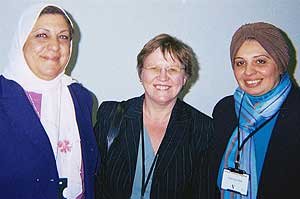
The new constitution has recognised women’s rights in relation to equal opportunities, it prohibits tribal customs that contravene women’s human rights, it makes reference to domestic violence following lobbying by Iraqi women’s groups and it guarantees 25% female representation in Parliament.
However, as in many other countries, Women’s Rights remain a sensitive issue. Reports continue to emerge of abuse of or social stigma attached to victims of rape or resistance to forced marriage. I was told of one example in the Basra area where a woman was recently forced to marry her rapist.
The UK Government is providing funding to support women, including projects in isolated rural areas, which address concerns such as health care, child development, women’s rights, education and economic development.
Back in the UK
Back in the UK, the Foreign Affairs Select Committee will continue to examine the War on Terror but our deliberations will be better informed and more insightful for having been to Iraq and having seen the situation for ourselves.”


