|
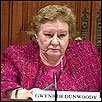
Gwyneth Dunwoody - Labour parliamentary candidate
Question: You famously criticised Labour's campaign slogan 'Forward not back'. Why was that?
Gwyneth Dunwoody: I think the present trend for thinking of fairly anodyne phrases is one that we could probably lose.
The electorate are more impressed by what you say to them that not only makes good English but also makes good sense.
Question: Have you got a picture of Tony Blair on your election campaign leaflet?
Gwyneth Dunwoody: No, but I didn't have one in 1997 and I didn't have one in 2001 either. It's me they're voting for.
The sad thing about this campaign is that it has shown perhaps more clearly than ever before how terribly divorced the media and some of the politicians are from what's going on in the country.
Those of us who are out on the doorstep feel that we are in a different election campaign. The Islington dinner party circuit issues don't play very well in Crewe.
Question: What issues do matter to the people on the streets of Crewe and Nantwich?
Gwyneth Dunwoody: People are talking to us about everything under the sun: about transport, about education, particularly about the health service - and even when you get criticisms, they're still very positive discussions.
I've only had one party member raise the business in Iraq with me, and we've had it a couple of times with the telephone canvassing.
But the bulk of things are the things that you would expect - developments in transport, the development in education, the need to sort out how people are likely to get jobs, and the hospitals and the local primary care system.
But when we turn on the television it's all about Iraq and legal opinions. Most ordinary people who have anything to do with lawyers know that they never give an opinion that is straightforward and clear. So when people are looking at all this they turn off.
Question: So do you think this focus on Iraq has hurt the Labour campaign?
Gwyneth Dunwoody: I think that what has hurt democracy generally is the inability of the London-based media to understand what is going on in the rest of the United Kingdom.
Here in the North West of England, ordinary people have proper priorities, and if you listen to the radio and watch the television you just think 'where are these people coming from?'
Question: The Conservatives might argue that the prime minister's integrity is a priority for most people.
Gwyneth Dunwoody: Well, I mean no-one believes the Conservative campaign - they've got the timing wrong, they've got the issues wrong, they're not having any impact.
Dunwoody on women
Question: How important do you think the women's vote will be in this election? According to some it will be crucial to any Labour victory.
Gwyneth Dunwoody: I have been quite impressed with the number of women who have quite openly come up to me and talked to me about the things the government has done that have benefited them.
They have children in Sure Start, or they've got responsibilities in the nursery sector generally, or they're benefiting from family credit.
People don't tell you these things during the course of a parliament because they just get the money and it's all going swimmingly, but they will actually come up and talk to you about it in an election.
Question: What has Labour achieved for women and what more needs to be done?
Gwyneth Dunwoody: The basic decisions we've made are very sensible ones. There are still some adjustments to be made here and there - for example there are problems where there aren't enough state school places, there are problems with the selection of schools, there's a problem of encouraging young people to stay on in school.
But in Crewe we've got a new university, MMU Cheshire, which is part of Manchester which is the biggest university in the United Kingdom.
We've got all sorts of very interesting developments with new apprenticeships. The atmosphere is very positive.
I've been surprised by how many women have made the connection between what's happening to them locally and our policy commitments.
In one case recently I had a husband speaking to me who was very angry about the war in Iraq, and his wife let him talk for a while and then said: "Ignore him, I'll still be voting for you and so will he eventually in the end."
Question: So women are looking past the Iraq war? It has been said that they are particularly angry about it, but you don't think that's the case?
Gwyneth Dunwoody: Women are very practical and know what they have to deal with.
Question: What about the question of women's representation in parliament? Recently a report from the Fawcett society pointed out that in half of the constituencies in the country, there is no female candidate from any of the three main parties.
Gwyneth Dunwoody: That's because women don't offer themselves to be candidates often enough.
Women are still at the stage where they are more prepared to take up council representation because it fits in with their lifestyle. We need more young women in parliament, but that takes a tremendous amount of organisation.
Question: Do you think the way the rules of parliament have been reformed has helped?
Gwyneth Dunwoody: No, that hasn't helped at all, it's barmy. If you're going to do the job, you will do the job, and you make that assessment no matter whether you're going to go and fill shelves in Sainsbury's or whether you're coming to London to do a job for four days a week.
Question: What do you think could be done to encourage more women candidates, then?
Gwyneth Dunwoody: Actually to give them some idea of what the job entails. The population as whole seems to be rather confused as to who's responsible for their grass cutting, and who's responsible for their education system.
I think a lot more general education for everyone would be helpful, including adults. When people make the connection between who makes the decisions, and whether or not they're people like themselves taking those decisions, then they get involved.
Dunwoody on transport
Question: Have you been disappointed that transport has not featured as a major campaign issue?
Gwyneth Dunwoody: Yes, there are a lot of major decisions to be taken in transport, and the Labour government has put an enormous amount of money into it.
It's a very interesting case study in privatisation, where the taxpayer pays a fortune and gets extremely little in return. The challenges are quite straightforward: value for money. That's a slogan they should have used in their election campaign, and it's one people can connect to.
Private companies are taking the taxpayer to the cleaners. It doesn't matter whether that's in cleaning, or contracts for railway services, or whatever thing it is.
It knocks the basis of any PFI deal straight out of the window because the taxpayer is seeing it just doesn't work.
It is also becoming very clear that there are going to be some very harsh decisions taken in the next session which will be governed by the fact that we're not getting value for money.
Question: The Road Safety Bill is likely to be reintroduced very soon in the next parliament. What are your feelings and concerns with that?
Gwyneth Dunwoody: The Bill is essential, but there are bits of it we have problems with. Some parts of it are sending the wrong signal - this suggestion you could be flexible about road speeds.
It's terribly important that whoever is talking about road safety is not influenced by a very vocal road lobby.
Question: What about speed cameras? Do you think there are too many?
Gwyneth Dunwoody: Frankly, people are totally ambivalent. I have had discussions with people where they object to the use of speed humps, but people are still driving extraordinarily fast along the roads and ignoring all the rules.
I have discussions on the use of speed humps, where I say 'if you want the humps removed, are you prepared to have speed cameras instead to enforce the limits?' and I get a long silence in response.
They want the right to drive at the speed they like wherever they like, and frankly that's fine if you have a racetrack to yourself, but not otherwise.
Dunwoody on the Labour leadership
Question: You have born the brunt of Labour's leadership style that some have described as effectively presidential. Would you have any hopes for a change to a more consensual style in a third term?
Gwyneth Dunwoody: It's not 'effectively' presidential, it is presidential, there's no doubt about it.
I think that the Labour Party has always benefited from listening to its members and the public who may have different ideas from those in power.
Question: Do you think that could possibly arise from a smaller Labour majority?
Gwyneth Dunwoody: I think we need to get the most people voting Labour so we can get things done.
Question: But with a smaller majority, the Labour leadership would be forced to listen to its own backbenches more, surely?
Gwyneth Dunwoody: The government will take its tone from the lessons they've learned on the doorstep and I think that's very useful.
Dunwoody on the next parliament
Question: How do you think the role of select committees has evolved in the past eight years?
Gwyneth Dunwoody: It's been very useful because the select committees have the time and expertise to delve in greater detail into policies than people can do in the chamber.
But that doesn't mean to say that it undermines the chamber, in fact it should strengthen the chamber because when people debate the reports they have detailed information available to them.
Question: Do you think they will remain important challengers to the government?
Gwyneth Dunwoody: They must remain that way because they have a important task to do.
Question: With that in mind are you planning to remain a thorn in the side of a new Labour government?
Gwyneth Dunwoody: I am never a thorn, I have never been a thorn. I am a beautiful rose, and I will grow gently through the next parliament.
Question: But you will still be fearless in holding them to account?
Gwyneth Dunwoody: Put it briefly; you do not get to my age and change your habits.
Question: Would you consider re-standing for the committee chair?
Gwyneth Dunwoody: Yes, I'm never confident of winning any election, but since I'm such a good candidate I'm sure that I'll do well!
Question: Are you expecting any further efforts to make that difficult for you from the government?
Gwyneth Dunwoody: I didn't say that.
Question: Do you think that Labour are on course to get a third term?
Gwyneth Dunwoody: You can never be confident that we are on course for a third term until the votes are counted on Friday morning. I'll tell you then whether we're on course for a third term.
Question: But do you think the campaign is going well?
Gwyneth Dunwoody: I think it's been very positive on the doorstep. If you talk to the real people on the streets and in the factories, it's been very encouraging.
|