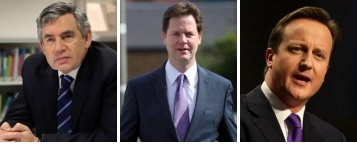
Nick Clegg's strong performance in the first leaders' debate triggered a surge in support for the Liberal Democrats according to all opinion polls.
If this Lib Dem rise can be sustained, the party will be confident of ending the two-party dominance of power at Westminster and Whitehall that has lasted for nearly nine decades.
However the Lib Dems, and their forebears, have been here before.
Here are out Top Ten moments when the third party has appeared set for a breakthrough. Will it be different this time?
Hung out to dry
Before a dog called Rinka took centre stage in the increasingly bizarre life of Jeremy Thorpe, the charismatic Liberal leader stood closer to power than any of his successors have yet managed.
After a string of high profile by-election victories, Thorpe's Liberals enjoyed a pulse-raising poll rating of 30 per cent during the run-up to the 1974 general election.
His party eventually secured just 14 seats, a small tally but enough to leave Thorpe in the position of kingmaker, after the Tories amassed 297 seats to Labour's 301.
A weekend of secret negotiations – Thorpe left his Devon constituency home wearing his country jacket and Wellington boots in order to throw loitering hacks off the scent – with Conservative prime minister Edward Heath, foundered on electoral reform, and despite Thorpe's willingness to enter into coalition his party resisted Heath's overtures.
The following October the aforementioned Rinka was shot dead, and Thorpe's life began its spectacularly unravelling.
Going back to nowhere
David Steel's contribution to the Oxford Dictionary of Quotations began and ended with the following instruction to the Liberal Party: "Go back to your constituencies and prepare for government."
A gaffe, a wild exaggeration, or just a great moment of party political myopia, Steel's proclamation at the 1981 Liberal Party conference was prompted by poll ratings of 50 per cent for the Liberal/SDP Alliance.
Party activists salivated at the prospect of power, but in just over a year's time Mrs Thatcher was wresting the Falkland Islands back from the Argentine invaders with one hand and squeezing the life out of the Alliance poll rating with the other.
The Alliance won 25.4 per cent of the popular vote – a share which the warped British electoral system rewarded with just 22 seats.
In the end, as ever, it was a case of go back to your constituencies and prepare for more of the same.
Seduced to death
Knowing observers talk of Tony Blair's "insurance policy"; to others it looked like a severe case of jilting at the altar.
But if Paddy Ashdown was left feeling let down by Blair on his big day, the ex-Lib Dem leader would never say so.
He had admitted, during the run-up to the 1997 general election, that he had been handed the "best opportunity any leader of Britain's Liberal Party had had for the last 50 years to do what all of them wanted to do": namely constitutional reform and a realignment of the centre-left.
However, despite Ashdown and Blair first engaging in talks as early as 1993, once Labour had accumulated a thumping 179 majority, visions of a coalition began to fade.
Ashdown kept trying, however, and Blair kept coaxing. Perhaps Lord Richard Holme, the late Lib Dem peer, put it most accurately when asked by Ashdown if Blair had meant it. "Yes – but then the best seducers always do."
Once in a lifetime?
Moons in perfect alignment, cards set carefully in place, weather declared as perfect: 2005 was meant to be the breakthrough election for the Lib Dems.
A popular leader, Charles Kennedy, with an established media presence; a twin unique selling point in a strident opposition to an unpopular war, and a student-friendly financial support package; an unpopular and increasingly tired Labour government on the one side, and an official Conservative opposition led by a man associated with their darkest days in government.
Some talked of a post-election tally of 100 Lib Dem seats, while grand 'decapitation strategies' set out plans to kick further a Tory party well and truly down.
Somehow, it didn't quite happen like that, despite the party's 62 seats representing its highest post-war tally. Conditions would never be so ripe again, surely?
A Sixties swing to liberalism
When a by-election is called, the Liberal Party, in its various incarnations, can't seem to help becoming a little weak at the knees.
It all goes back to the Kent town of Orpington in 1962.
Perhaps, on reflection, the election of a party's seventh MP shouldn't be a cause for wild predictions of a new dawn, but when number seven's election is accompanied by a jaw-dropping 22 per cent swing and the first defeat for the Conservative Party in three years, then it's a little easier to get carried away.
Eric Lubbock, the now Lord Avebury, was the Liberal pin-up at the 1962 Orpington by-election, with his success prompting talk of a Liberal revival.
However, the party's grand tally of nine seats at the 1964 election kept such grandiose visions on ice. Again.
Singh when you're losing
Parmjit Singh Gill made a bit of history in 2004 after becoming the Liberal Democrats' first ethnic minority MP, but a year later he was gone, losing his seat at the general election and returning to a slower pace of life in Leicester.
But at the time of his by-election victory in Leicester South, Singh Gill, who overturned a 13,000 Labour majority, stood briefly as a figurehead for the Liberal Democrats' opposition to the Iraq War.
"The people of Leicester and of Birmingham have said that they want the government to change their ways," crowed triumphant party leader Charles Kennedy.
"And when they are ready for a change of government, it is not the Conservatives they will be turning to; the Liberal Democrats are the real alternative now."
The general election result suggested otherwise, but for Singh Gill the story may not be over – he's standing again this year.
Casualty of war
Was the Liberal Party destined for more success before the outbreak of World War I in 1914?
Its 1906 majority of 130 may have been wiped out during the two general elections of 1910, but the party, now propped up by Labour support, was still moving in the right direction.
Herbert Asquith was showing himself to be a reform-minded PM, as was Board of Trade president Winston Churchill and his chancellor David Lloyd George – who brought in the 1911 Parliament Act to overturn the Upper House's attempts to veto his redistributionist budget.
It remained on course for further election success – and reforms to follow – in 1914; two years later, as the war dragged on, Asquith was ousted by Lloyd George, the man he appointed as chancellor, and the party's slow limp to oblivion had begun.
Tactical rise
By 1993 the Liberal Democrats' then campaigns director Lord Rennard, a man with a copyright on the term 'number-crunching guru', introduced a new weapon in the art of winning elections: tactical voting.
The unpopular Conservative government was to feel the brunt of the strategy, and after a string of by-election wins, the Lib Dems scaled new heights with the 1993 seizing of Christchurch from the Conservatives.
The result saw the largest swing against any government since 1918, with the Tory tally falling by a colossal 32 percentage points.
The Lib Dems leapt above the Tories in the national poll ratings, and premature breakthrough talk began once more.
Merger was the case
How different would the 1987 election have been had the Liberal Party and the SDP managed a more peaceful official merger?
"I believe that had we been able to fight in 1987, as two parties totally united in purpose and planning, to come together formally in the next Parliament, we should have got that vital step ahead of Labour and subsequent history might have been different," is the line from Lord Holme, but David Owen, the SDP leader, refused to play ball.
"When he gets obstinate, by God he gets obstinate", recalled Shirley Williams, one of Owen's co-founders of the SDP.
And, with Owen's resistance, the SDP ended up less popular than the Monster Raving Loony Party and the Liberal Democrats began the 1987 Parliament firmly on the back foot.
Parroting success
After Paddy Ashdown's leadership began with a disastrous fourth-place finish in the 1988 European elections, the party tried a bit of brand reinvention.
Its new logo – the bird of liberty – was dismissed as being "as dead as John Cleese's parrot" by Mrs Thatcher, who allegedly had to watch the famous Monty Python sketch three times before seeing any value in the comic reference.
But 1990s by-election success at Eastbourne, caused by Ian Gow's assassination by the IRA, seemed to cure the parrot of its lingering ill-health.
A 16,000 Tory majority turned into one of 4,500 for Lib Dem candidate David Belotti.
"The parrot has twitched!" declared the Evening Standard, and by the end of the year the Spectator had named Ashdown their politician of the year.
It was, of course, yet another false dawn, with the party's seat total falling at 1992's general election.
Sam Macrory is features editor of The House Magazine, where this article first appeared.