Figure 1
Figure 2
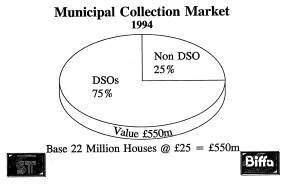

Figure 3
Figure 4
Introduction andSummary
Municipalrefuse cleansing services form a vital and significant part of the overall UKwaste collection and disposal business. Itshistory reaches back longer than the private sector and its role places it atthe forefront of public awareness of the ways in which waste impinges on ourdaily lives. In the past 6 yearsthe sector has undergone substantial organisation and upheaval - a process whichcontinues on a variety of fronts. Considerationof this area is best dealt with in the following broad categories:
(a) market tonnage;
(b) market value;
(c) the political dimension;
(d) operational implications;
(e) current market characteristics.
(a) Market Tonnage
An accuratebenchmark figure is in the region of 26 million tonnes (see ENDS Report 267 -April 1997).
This figure is based on detailed investigative work carried out by Warren Springs and DrJulian Parfitt of the University of East Anglia, suggesting a household yieldfactor of around 620kgs to 650kgs per household. Given that there are 22.6 million households in this country it suggestsa total backdoor figure in the region of 12.5 million tonnes.
In addition tothis total there are significant volumes of arisings of yard waste. Little formal accurate data is available on this but a level of 8 milliontonnes (140kg per head per annum) does not appear unreasonable.
Additionallymunicipal refuse contracting organisations traditionally undertake a proportionof industrial and commercial waste collection.
Underlyingvolumes of domestic backdoor arisings are generally reckoned to be increasing ataround 3%-5% per annum. Internationalcomparisons do point to a link between increasing prosperity and the volume ofdomestic waste.
Increases inpackaging volumes arising in households represents a transfer in response to theremoval and light weighting of in-transit packaging.
(b) Market Value
Figures 1 and 2identify the total contract value and the relative share occupied between DirectService Organisations and conventional private sector contractors.
|
Figure 1 |
Figure 2 |
|
|
|
|
Figure 3 |
Figure 4 |
|
|
|
Theturnover of Waste Disposal Authorities (WDAs) is a direct function of domesticcollection volumes. Figures in thisare weak. then the cost of domesticrefuse disposal is of the order of 500m per annum.
This gives anoverall turnover figure for domestic waste arisings in this country in theregion of 1bn per annum.
There aresignificant cost profile differences between urban and rural applications.
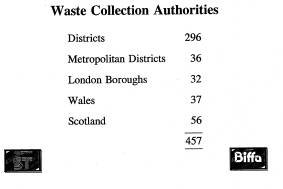
A feature ofthe market is the level of concentration - there are 27 significant contractorsbut only 4 have more than 20 contracts in their portfolio.
| Figure 5 |
 |
(c) Political Background
As the industryevolved and economies of scale became obvious, a number of these functions weregradually contracted out.
The first majorcrystallisation of this process was enacted in the 1988 Local Government Act.
|
Figure 6 |
Figure 7 |
 |
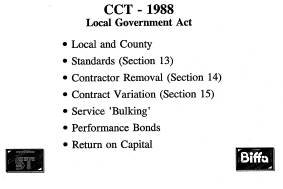 |
As can be seen from the main headings on figure 7, this act covered muchmore than refuse contracting.
Flexibility wasgranted to Waste Collection Authorities on the tendering date for suchcontracts. Contracts are nowtendered for - most often - 5 yearly periods although some councils operate 4yearly timetables. By law, districtcouncils have the ability to extend contracts. Such extensions are normally undertaken which make alignment of variouscontracts a sensible option.
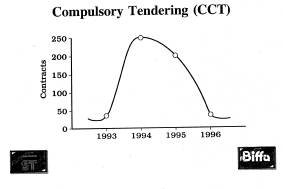
Compulsory competitive tendering is now undergoing significant challenge. The pace of change in logistics handling systems, the introduction of recycling targets, Agenda 21 and other issues means that a partnership approach offers far greater flexibility to all parties.
| Figure 9 |
 |
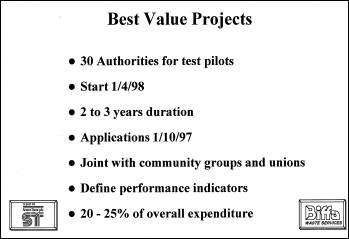
Contemporarycontracts are tending to extend with greater emphasis on disputes resolutionprocedures and emphasis on methods whereby new systems of change can be adaptedinto the working arrangement. Thisconcept of best value embraces the following key areas for discussion:
Bench markingagainst external performance criteria.
Greater freedomfor operation to cover seasonal and geographic variations.
Equity stakesby public sector bodies.
Private financeinitiatives.
The sale ofassets.
Extendedcontract renewals.
Recycling andreclamation matters.
It is generallyaccepted that in real terms the cost of waste collection services to the counciltaxpayer is now between 10% and 20% less than would otherwise have been the casehad the 1988 Act not been introduced.
The next majorlegislative change impacting on local authorities was the 1990 EnvironmentalProtection Act (EPA).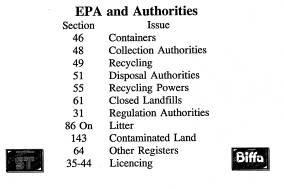
Litter was aparticularly significant issue in the 1990 Act.
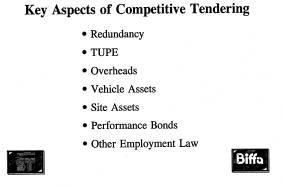
The other majorissue which surfaced in recent years relates to the Transfer of Undertakings onProtection of Employment (TUPE). This forms part of the EU Directive on Acquired Rights.
In practicalterms the effect on contracts is for contractors to abide by the previouspayment and pension requirements of the former public sector employer. The onus for defining whether full transfer of undertakings to employeeswill operate is thus in the hands of the Waste Collection Authority.
(d) Operational Issues
In simple termsthe optimum method for operating a contract is a function of:
(ii) population size and mix;
(iii) community type;
(iv) collection methodology;
(v) local disposal options.
|
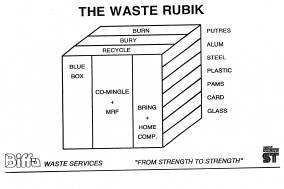
Figure 10 - the waste rubik - sums up the issues. |
 |
Figures 11 and12 indicate the approximate variances in productivity available depending on thehousing density and concentration. Clearly the higher number of houses per square mile, thehigher the labour productivity factor. Flatsdo not conform to the same rules, however, for obvious reasons.
|
Figure 11 |
Figure 12 |
 |
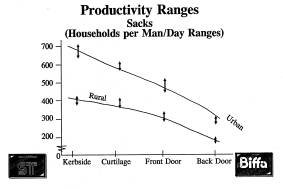 |
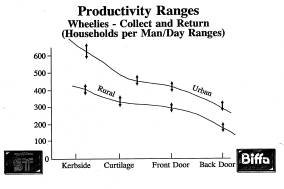
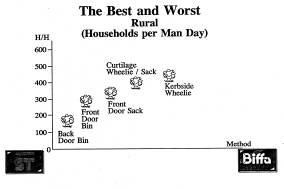
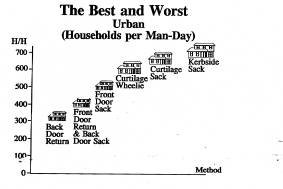
Figures 13 and14 indicate the range of productivity levels available depending on thecollection methodology employed. Inessence the 2 major issues are.
|
Figure 13 |
Figure 14 |
 |
 |
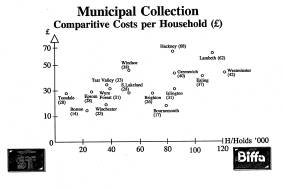
Contractprofitability is a function of labour and asset productivity. Figure 15 demonstrates the wide range of costs per household for domesticrefuse removal in this country today.
(e) Future Developments
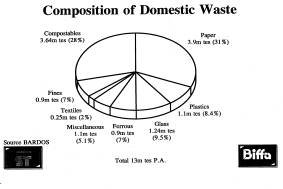
Recycling is akey aspect and figure 16 indicates some cost characteristics of resultantoperational changes. The followingissues are emerging as key features for developments beyond the millennium:
|
Figure 16 |
 |
Contractual Aspects. CompulsoryCompetitive Tendering will come under assault and much wider flexibility inpartnership contracts will emerge around the concept of best value. Contracts will tend to expand in value and cover longer periods with morediscretion being given to the use of flexible financial instruments.
Public Finance Initiative (PFI). This shift to a best value approach implied that tendering councilsshould have greater flexibility on the quality as well as the quantity ofservice provision. The intention isto create a clustering approach to these comparitors in such a way that benchmarking can be developed between roughly equivalent authorities.
Operational Issues. AsProducer Responsibility and other fiscal instruments from government impact onthe manufacturing sector, the compositional flow of domestic refuse may alter. Producer Responsibility is likely to become a reality in the area ofpackaging, electrical goods and automotive components. In consequence the flow of these materials may be determined by thoseindustry sectors who will put in their own retrieval options to minimise costsof retrieval.
These developmentswill accelerate along with innovative technology.
(i) Onboard vehicle weighing systems which will permit household chargingabove (say) an allowable quantity of 10kgs per week.
(ii) Weight related charging systems on a household by household basis.
(iii) The integration of industry and commercial collections with municipal systems for selective materials.
(iv) The development of mobile material reclamation facilities
(v) The separation of recoverable materials from landfill borne materials.
Bibliography
Commercial/Financial
TheContracts Handbook CDC Publishing Ltd (0171 490 3204)
CompetitiveTendering - The 20% Solution
Modelling CCTwith Spatial Dependence Imperial College Management School 97
Law of LargeNumbers - Bidding and CCT for Refuse ESRC Paper W97/9
The Journal ofDevelopment Studies Vol 36, No 5 June 2000 pp30-58
Published byFrank Cass, London
VariableCharging for Refuse Collection Waste Management April 1997
Data
CIPFA WasteCollection and Disposal Statistics CIPFA (yearly)
The Impact ofCCT on Collection Services Stefan Szymanski Fiscal Studies
(1996) Volume 197
Cheap Rubbish- CCT and Tendering Out Fiscal Studies (1993) Volume 14 No 3
Garbage In,Garbage Out Economist June 7, 1997
Recycling
34 KerbsideRecycling Schemes Jonathan Surridge
PO Box 289
Leicester LE2 3GF
StandardisedCosting for Recycling DoE January 1996
Monitoring andEvaluating Recycling and Composting DoE Summer 96
(basedon Coopers & Lybrand work)
Divertinglightweight C&D waste from landfill
byIan Roach BSc (Hons) a graduate of the School of Conservation Sciences,Bournemouth University Wastes Management January 2001
|
Centre for Waste and Pollution Research |
University of Hull Tel: 01482 465371 |
TowardIntegrated Solutions for Local Authority Waste
This paper is framed with the intention of mapping outhow the challenging targets established in the Waste Strategy for localauthorities can be delivered by leveraged funding initiatives.
The overall programmeincorporates the following key proposals/features:
I Whilst substantial funds have been confirmed for recycling initiativesthere is no firm ring fencing proposed which guarantees that such funds aredelivered transparently to kerbside recovery initiatives. Such transparency can be better demonstrated by earmarking around 100mper annum of current Landfill Tax funds to unitaries and joint committees ofWCAs and their constituent WDAs specifically for funding audited kerbsiderecycling initiatives.
II The current structure of recycling credits should be abolished andreplaced by an equivalent amount made available by WDAs as an average of years1998/99 to their new joint WCA/WDA committees. This is in the region of 100m nationally.
III To accelerate shifts in waste disposal practices Landfill Tax should beraised for tonnage rates on mixed streams to around 30-35 per tonne. It is proposed that the Treasury take from the tax should belimited to 12-15 2001-2004 but that the proposed excess of 15-20 pertonne be made available to unitaries and WDA/WCA committees at a rate of 20%proportionate to their direct tonnage tax levies in those years.
IV The current proportionate burden of the Landfill Tax on local authoritiesis increasing. In 1998 totalinflows to landfill were around 95 million tonnes of which 20 million tonneswere local authority. Tax yield was450m gross of which LAs contributed 140m (35%).
Today totalinputs are 75 million tonnes, gross yield is estimated at 540m and LAcontribution is 28 million tonnes for 308m (60%). This shift reflects the way in which industry and commercehave diverted waste from tax zones but equally demonstrates that public fundsare merely being recycled from local authorities into NIC reductions at a fasterrate.
V Whilst WDAs see no direct financial benefits in redirecting recyclingcredits into common local pots they do have a vested interest insignificant landfill diversion initiatives such as this package because they cantrade permits where they underscore their landfill disposal targets.
Response byBiffa Waste Services Limited to Limiting Landfill
(i) Whist acknowledging the relatively narrow focus; on municipal and a fewselected industrial wastes, we welcome the thrust of the Landfill Directive.
(ii) Endof pipe regulatory or fiscal instruments in the form of taxes, bans ortargeted reductions should be developed in the context of an integratedframework of policies appropriate to materials and products.
(iii) We agree that careful thought is needed on percentage compositionanalysis.
(iv) Datacollection is of central importance to this issue. Yet again effective policyformulation is being thwarted by a failure on the part of the Environment Agencyto develop a national infrastructure for waste flow reporting involving landfilloperators and Local Authorities.
(v) Anoutright ban on all organics into landfill at whatever date is impracticable incurrent circumstances and would bring legislation into disrepute. We prefer the phased introduction of progressive reductions of 25%, 50%and 65% by the extended dates specified.
(vi) At levels of 15 pertonne (by 2004) the Landfill Tax alone will not achieve this objective. It needs to operate at levels at least double that to provide effectiveincentives for material diversion.
(vii) We support the introduction of a Tradeable Permit regime between LocalAuthorities based on targeted reductions by specified dates against starttargets based on population and per capita average arisings.
(viii) Consultationdwells obsessively on municipal refuse. Governmentshould not underestimate the volume of organic material arising in commercialsources and should take note of the probability that costs of organic collectionfrom the municipal stream can be reduced if municipal and commercial strategiesare integrated.
(ix) Thekey operational factors we perceive are:
planning strategy for new processing operations,
composting standards,
health & safety issues in organics processing,
process technology investment relief,
interaction with other organic sectors (sewage, brewing,packaging, etc),
home composting monitoring and standards/measurement,
data collection and management,
information technology protocols,
financial/pricing drivers,
additional Landfill Tax classifications,
Tradeable Permit regimes,
process equipment investment write-off,
tax treatment of landfill derived compost/soil conditioners.
(x) Implementationof the Landfill Directive should form a keystone focus for the wider integrationof budgetary, fiscal and regulatory policies involving more joined upthinking between EA, DETR, DTI and the Treasury.
(xi) We believe poor management of CA sites is a key contributory factor inreported increases in (so called) domestic waste tonnages. It is ludicrous that these - largely unmonitored - flows from commercialsectors might possibly underpin a strategy which justifies knee-jerk investmentin large scale EfW schemes without deeper study and analysis.
The contents of the site are protected under copyright - Biffa Waste Service Ltd 2001 No reproduction is permitted without prior permission