JOINT UNION EVIDENCE TO THE SENIORSALARIES REVIEW BODY
The unionswelcome this annual opportunity to provide evidence to the Review Body. Although the revised performance managementarrangements have nominally been in place since 1 April 2001, the new pay system was onlyimplemented from 1 April 2002. As wenote below, guidance was only issued by the Cabinet Office to Departments aboutthe new pay system earlier this year and it is noticeable that there has been alonger than usual delay in determining and informing Senior CivilServants of their pay award. The unionshave also not received data as yet from the Cabinet Office about the outcomesacross each Department and it is not yet easy to gauge the impact of the newpay system. However, we have conductedour annual survey as well as receiving comments from individual members. Our evidence highlights issues that haveemerged in the light of the limited experience to date of how the new systemimpacts on Departments and individuals.
1. THENEW PAY SYSTEM
Payband Structure
1.1 TheFDA wrote on behalf of the unions on 21 November 2001 to Sir Michael Perry inthe light of the Review Body Report on indicative pay ranges and target rateswhich had been made available to the unions prior to its final publication inDecember 2001. In that letter we drewattention to our concerns at progression through the new pay system, whilstwelcoming the indicative pay rates being proposed by the Review Body. It will not come as any surprise to theReview Body to learn that the unions were extremely disappointed at theGovernments failure to implement the Review Bodys recommendations. Frankly, given that the Government simplyimplemented the paybands that it had already published as illustrative figures,it made a mockery of the exercise that it requested that the Review Bodyundertake, which was led by Towers Perrin.ThusIf the Government had no intention of implementing rates other thanthose it had originally proposed, it should not have allowed has encouraged the Review Body to waste itsown time and that of the unions in conducting a spurious exercise. Further, it would have allowedit has detracted from the time the departmentsmuch greater timehad to plan implementation of the new paysystem; as it was, most departments were not able to begin work on the newarrangements until at least January 2002.
1.2 TheGovernments refusal to fund adequately the new pay system has meant that thepay levels to be achieved by most members are significantly lower than thosewarranted by objective evidence presented by the Review Body. Further, the introduction of the premiumzone as a result of this refusal can only complicate a pay system one originalselling point of which was that it would simplify the previous system thatpeople did not understand, an issue that we return to below. As one member commented the new system isanother complicated fudge. It is tryingto make the SCS feel better paid without spending any more money.
1.3 We therefore urge the Review Body torecommend to the Government that it implement the rates proposed in the Reportuprated as appropriate on the indicative pay ranges. Further, that the target rate should be set above the middlepoint of the payband, as favoured by Towers Perrin.
Assimilation
1.4 With pay systems for more junior staff, allwould have received assimilation increases in being allocated to a new paysystem. Moreover, unions are continuingto improve progression rates for more junior staff, with seven or eight yearsbetween minimum and maximum now becoming common. We believe that the inadequateprogression rates for the SCS are further evidence for the bias displayedagainst the SCS by the Government. Thisbias is evident in the increasingly common situation whereby members of the SCSfind themselves with worse terms and conditions than more junior staff,entitlement to overtime payments being a further obvious issue, or what hadbeen more beneficial terms, for example annual leave entitlements which to someextent compensated for long hours working also now being available to morejunior staff.
1.5 TheReview Body recommended a sum of 0.4% for assimilation. Our perception is that the impact of thishas been marginal. Only 9% of membersbelieve that they benefited from the assimilation arrangements, andinterestingly, 22% were unable to say and less than 30% of members confirmedthat they had received an adequate explanation of how their departmentalassimilation budget was allocated.
1.6 Aparticular problem remains that of individuals who in being allocated to thenew payband structure found themselves in the zone above the target rate. In other words, their pay at 31 March 2002was higher than the target rate of their new payband. The Cabinet Office has informed the unions that some 15% of theSCS are in this position. Theseindividuals were able previously to progress to their range maximum. Now, unless they are allocated to tranche 1,they will only receive the payband revalorisation, in effect remaining static withinthe payband. The Cabinet Office refusedto allow any dispensation for these members (for example, to have automaticaccess to the higher performance target rate) and assuming therefore that 25%are in tranche 1, some 11% of the SCS will in future remain at a staticposition in their payband having previously been entitled to progress to amaximum higher than their current salary.The unions believe that this is an unsatisfactory and unfair treatmentof individuals, and contrary to the avowed motivational intent ofthe new scheme.
1.7 Afurther problem of the failure to allocate sufficient funds for assimilation isthat individuals who were paid at 31 March 2002 just above the new paybandminima are now earning only a little more than colleagues who may have hadsignificantly less service in the SCS.Given that in many departments the maximum of the payband immediatelybelow the SCS remains significantly higher than the payband 1 minimum, suchindividuals are likely to be overtaken rapidly by people promoted in the comingmonths and years. As one member notedafter 4years in the SCS, despite a top tranche assessment last year, I amstill on the SCS pay band 1 minimum.
1.8 The unions suggest that the Review Bodyconsider a further allocation of money to be used to rectify remaining problemsof assimilation.
Progression
1.9 In preparing this evidence, the unions havenot yet received data from the Cabinet Office to illustrate the impact of thenew system upon progression through the pay ranges. We may wish to comment further when this evidence is available.
1.10 Whilst the level of awards for those in thetop tranche was higher than many would have previously received, anomalies arealready emerging because of the structure of the paybands. For example, one member pointed out thatbecause at 31 March 2002 they were 156 above the Mid Point (the cusp of thelower zone and upper zone), their award was 734 less than it would have beenfor the same level of performance had they remained just below the MidPoint. Their 4.5% award has left themworse off than someone previously earning less, not just for this year, but foreach remaining year of their employment in the civil service. Future pay awards will increase the paydifferential between that member and their comparator with the slightly lowerexisting salary and the same performance marking, and averaged over 10 yearswill amount to more than 7000 which in turn will have an impact on pensionentitlement. These kinds of anomalies,which would equally happen to an individual in the top tranche, are systematicof poor system design.
1.11 It is also clear that the Cabinet Officeintends that the proposed progression rates of nine to ten years to the targetrate for tranche 2 performers and three to four years for tranche 1 performersonly start from April 2002, with previous service not counting against thisaim. This may well be a further factorin the strong scepticism being expressed towards to the new system andcontinuing dissatisfaction at the rate of progression is evident from thesurvey.
Bonus Scheme
1.12 Theunions do not yet have the Cabinet Office data about allocation of bonusesalthough half of members responding have received a bonus and an equal numbernot. Until the scheme is fullyimplemented, it will be difficult to assess the impact of bonuses. However,we would urge the Review Body to ensure that any higher bonus payments do notundermine the present, already inadequate, progression, and make SCS even less competitive withequivalents elsewhere in public sector, or in private sector.
1.13 We will be studying the data when it becomesavailable to examine whether there is evidence of any discriminatory affects,including on the basis of gender, ethnicity, and location. We will also be working with the CabinetOffice on the equality audit that the Review Body has recommended, with the aimthat this is available to the Review Body in time to inform the 2003 Report.
1.14 Wealso suggest that the Review Body seek detailed information about the level ofbonuses paid given that members responding to the survey received bonuses of900 upwards, which contrasts with the Review Bodys recommendation in the 2002Report that the minimum bonus payment should be 3% or 2,000, whichever is thehigher.
Appeals
1.15 The unions have not yet received any dataabout the number of the appeals that have taken place. However, there is evidence that Departmentshave sought senior staff from other Departments to help adjudicate in appeals.. However,we suggest that the Review Body considers the detail of such cross-Departmentalappeals to satisfy itself about how such appeals work and that there is not atendency for mutual support across Departments rather than impartiality as thesystem requires.
Training
1.16 Wefurther suggest that the Review Body seeks evidence as to the level of trainingthat has been delivered by Departments to support the new system and the extentto which Departments are more generally linking the new competences to trainingnot only within the SCS but also for those in feeder grades. Without a concerted approach to suchdelivery, those in feeder grades or in the lower pay bands of the SCS arelikely to be less successful in competing for promotion opportunities, and thusthe SCS as a whole not being at its most effective in delivering theGovernments objectives.
2. SETTINGOBJECTIVES
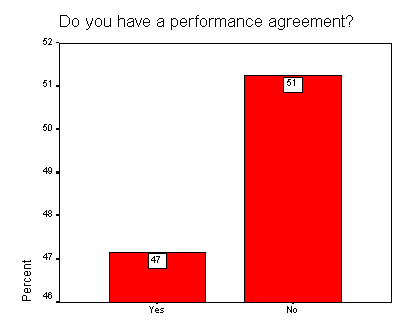
2.1 Theunions acknowledge that Departments and individual members are still adjustingto the new performance management arrangements in effect since April 2001. That said, these are a revision notrevolution of the arrangements previously in place. We are, therefore, concerned that some 30% of members did notreceive a mid-year development review in 20012002 and that by late July 2002less than half of members had drawn up a performance agreement for the2002-2003 appraisal year (which commenced on 1 April). It is also a concern that some 30% ofmembers did not think that their Department considered their particular post tobe central to its activities and PSAs targets.These members were less likely to receive a tranche 1 marking (and weremore likely to be aged between 50 and 60).They were also less likely to have received notification of a bonuspayment and to consider that their performance objectives adequately reflectedtheir actual performance. This mayreflect a trend in Departments to allocate in tranche 1 staff who held postsperceived within the Departments as more critical to the overall delivery ofPSA, and disadvantaged those who hold posts which may beless high profile but are nonetheless important to the overall work- including for example statutory obligations -of the Department. The Review Body may wish to consider looking at the award of markingswithin each Department to assess whether there is any preponderance of tranche1 awards to certain areas of work.
3. ATTITUDE TOTHE NEW PAY SYSTEM AND COMMUNICATION
3.1 As noted above, the new pay and performancemanagement arrangements were implemented in a very rushed manner in alldepartments given that guidance was only issued by the Cabinet Office todepartments in January 2002, with additional guidance at an even later date,for implementation with effect from 1 April.One consequence has been that at the time that the unions conducted oursurvey in July, many members had still not been notified of their likely payaward this year. We believe that thisprobably accounts for the lower participation in the survey than in previous years; it wasnoticeable that only 58% of members, compared to 70% at the same time lastyear, had been notified of their annual increase.
3.2 TheFDA separately conducted a snapshot survey inearly July which asked two questions.Firstly, members were asked were you properly consulted by the CabinetOffice and your department about the new systems, and 60% responded that theyfelt that they were. The secondquestion asked whether In your opinion have the new systems fulfilled the aimsstated by the Cabinet Ooffice that they would offer timelypaid progression, subject to performance, to a target rate which is linked tothe market; and better transparency and perceived fairness in paydecisions? Some 84% members answeredno.
3.3 Theresponse to the FDA survey was confirmed by the later joint survey in askingwhether members believed the new pay arrangements have encouraged you toimprove your performance in your job.As the survey results show, 88% believe that the system does notmotivate compared to only 10% who believe that it has encouraged individuals toimprove their performance.
3.4 Theunions accept that a factor in this very high negative response may be thatmembers were not yet in a position to take a more reflective view of the newsystem given the delays in its implementation.However, as the joint union survey demonstrates, 68% of members saidthat they understood the new pay arrangements (compared with 30% who did not),and 74% understand the new performance management system. In other words, people feel that theyunderstand the system and do not believe that it will fulfill the aims that theCabinet Office has stated that it will deliver. The refusal of the Government to adequately fund the new systemmay be a factor in this level of dissatisfaction. The Governments very public refusal to apply the levels of funding recommendedby SSRB cannot but account for at least some of the dissatisfaction.
3.5 There is a contrast between the level ofunderstanding about the system and members understanding about how theirindividual pay level and annual pay rise has been calculated, as the surveydemonstrates. One conclusion may bethat whilst the generic material issued by Cabinet Office has been relativelywell understood, the departments have not adequately explained to their own SCSstaff how decisions about individuals have been taken. Equally likely, and more disturbing, wouldbe the perception that decisions are not being made on the basis of objectivecriteria but rather, gut feelings. Inother words, the process is clearly understood but it is not seen as beingproperly applied.
3.6 Webelieve that greater clarity is required on the part of the departments aboutthe working of the new system for individuals.A member commented tranche placings are decided in secret without anyfeedback. Another member remarked thatthe SCS pay process takes too long there is a lack of explanation andclarity behind pay awards of non-consolidated bonuses. This is particularly concerning given theemphasis by the Cabinet Office on introducing a system that would be more openand transparent.
3.7 Some Departments, particularly those with arelatively smaller number of staff in the SCS, have put all staff in the SCSwithin the same pot. This is alsoleading to a perception of possible unfairness. As a member commented the Grade 5s and Grade 3s are competingfor pay. This is unfair as the Grade 3smake recommendations about Grade 5 pay.The unions suggest that theReview Body pay particular attention to the outcomes in those Departments whereSCS staff at different management levels have been grouped together for paypurposes.
3.8 Paragraph6.14 of the Cabinet Office guidance states that a manager will normally theninform you of the pay recommendation that is being put forward to the SCS paycommittee. Clearly this is beingbreached in many cases; in the survey, only 47% of respondents confirmed thatthey had been told of their line managers recommendation on performancetranche and level on bonus before it was put to the Pay Committee, equallymatching those who had not been. Thesurvey also found that only 36% of people considered that the decision of thePay Committee had been adequately explained to them, compared with 49% who didnot.
3.9 This is clearly counter to the CabinetOffice guidance issued to all members of the SCS which states in 16.1 that thepay decision will be explained to you both personally and in writing. Where your line managers recommendation hasbeen changed by the SCS Pay Committee the reason for the change will beexplained to you. Less than half ofmembers knew whether or not the recommendation of their manager had beenaltered by the Pay Committee, and for some 30% of these members an alterationwas made. However, as one membercommented I have had no feedback from the Pay Committee, except that my linemanager says that both he and my second reporting officer were over-ruled bypeople who do not even know me!.Another commented I object strongly to be told of the line managersrecommendations for bonus and subsequently being told none would be paid. This is a lousy way to do things.
3.10 This is clearly an issue not simply ofnotification but also as to whether or not the Pay Committees themselves areoperating on any basis that can be seen as objectively fair. Practices are already developing inDepartments which may not be perceived by members as fair. For example, in one Department seniormanagers at Grade 3 equivalent level met together and agreed rankings to beaccorded to their Grade 5 equivalents, at least in some cases before reportswere completed and the member of staff concerned had the opportunity to offerany views (formally at least) on how they had been rated. On the one hand, it could be argued that atleast this pre-ordaining of the Pay Committees work was undertaken by peoplewho arguably knew better the work of the individuals concerned but reportsquickly circulated of territorial fighting as people battled to have theirrecommendations agreed but see others bumped down. One danger of this is that individuals away from the centre ofthe Department, or in more isolated posts, may lack senior managers to fight ontheir behalf. There is also thepossibility that each small area of a Department tries to match the tranchepattern, rather than an overall comparison of performance across the Departmentas a whole taking place. Further, inone major department members were only notified about their pay tranche whenthey opened their pay slip which showed the level of pay increase. Clearly, this is poor practice and unlikelyto motivate. We urge the Review Body todo what it can to ensure that departments implement the guidance alreadynotified to the SCS.
3.11 Many Pay Committees also have a non-executivemember of the Departmental Management Board present at meetings.The unions suggest that the Review Body seek information about the rolethat such non-executives have played.
4. WORK LIFE BALANCE
4.1 Theunions have over several years raised concerns about working hours for SeniorCivil Servants and work life balance more generally. The Review Body has been unwilling to address this issue. Paragraph 2.34 of the 2002 Report rejectedthe unions proposal for overtime payments to Senior Civil Servants andcommented that while hours of work are not in themselves directly within ourremit, we would comment that we are not convinced that the SCS suffers morefrom long working hours than other staff at similarly senior levels. Theunions once again urge the Review Body to reconsider this approach.
4.2 TheGovernment has made clear that it believes that work-life balance is animportant issue. The Secretary of Statefor Trade and Industry, the Right Hon Patricia Hewitt MP, in a speech to the TUCConference Flexibility for All on 5 February 2002 stated that Working time and how we organise it is central to three of the biggest issues confrontingus today. How can we improve theconditions in which our children grow up by strengthening family life? How can we achieve greater equality betweenmen and women? How can we raise productivity at the workplace in other words,make our businesses and public services more effective and more successful?
4.3 Shefurther commented what we need is a fundamental change in Britains workingculture. And if we leave it tovoluntary effort it will take too long.
4.4 TheSecretary of State drew specific attention to issues of the public sector,commenting that we need a new push for working time reform in the publicsector. I have also written to Cabinet colleagues inviting them to share bestpractice on family-friendly working, and to create partnerships with theirtrade unions to tackle any long hours culture.
4.5 Shealso emphasised the role of trade unions in helping implement change,explaining that I want to see every union negotiating agreements onworking time. Thanks to the changes wemade in our first term, far more large work places now recognise tradeunions. That means far more people atwork who can look to their unions to take a lead in culling excessive workinghours and creating flexible working patterns that suit people as well asproductivity.
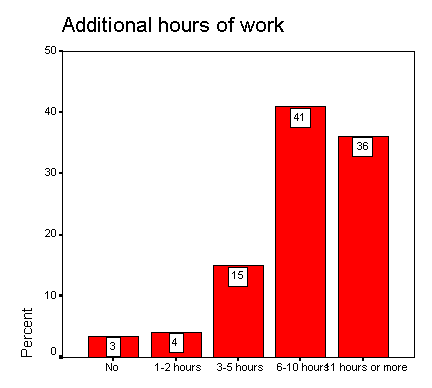
4.6 Clearlythere is an onus on the unions in the civil service to raise issues of longhours working with the Cabinet Office and departments, and we are doingso. However, the Review Body has acritical role in helping to set a framework in which departments address theseissues. As the Survey resultsdemonstrate, there remains considerable work to be done for the SCS. As we pointed out last year theintroduction of the Working Time Directive has made little difference to thoseworking very long hours. The number ofmembers working an extra six or more hours has risen from 74% in 2001 to 77%currently. This includes some 36% ofmembers working 11 hours or more extra each week; in 2000 29% of members workedsuch hours. Again, as the survey pointsout, 78% of members believe that their department or agency has takeninsufficient steps to reduces excess working hours, and that this is felt moststrongly by those working the longest hours.At the heart of the problem appears to be the sheer volume of work forthe SCS. A member commented work loadon senior managers is out of control and another nobody cares how much youneed to work.
4.7 Thisyear we asked three new questions on work-life balance. Importantly, more than half of membersdisagree or strongly disagree with the statement that the culture at myworkplace supports good work-life balance, and only a quarter agree orstrongly agree with the statement that my department/ agency provides goodinformation on work-life balance options.
4.8 Working timewithin the SCS is also a critical issue, not only for members within the SCSbut in more junior grades. In 1998 theGovernment commissioned Schneider-Ross to undertake research into theunder-representation of women, ethnic minorities and people with disabilitiesin the Senior Civil Service. One aspectof their Report was the focus on long hours working which pointed out thatworking long (and specifically late) hours is regarded as the key enabler forsuccess. This increasingly presentsdifficulties for both men and women under 50% feel they can balance home andwork without hindering career progression.The Report pointed out the importance of senior managers walking thewalk as well as talking the talk. Amember responding to this recent survey also commented reducing excess hoursand achieving better work-life balance will not happen until Ministers and topofficials really behave as they preach.In other words, if the Review Body and Departments are not prepared totackle the problem of long hours working within the SCS, the signal it sends isthat long hours working is what is required to gain promotion and this in turnwill continue to act in a discriminatory way as well as undermining theopportunities for highly capable, more junior staff who are not prepared toaccept this prevailing culture. Putsimply, what the boss does is a major factor in determining the behaviour ofthe staff they manage.
4.9 The unions believe that the overall rewardpackage for an employee is not simply made up of salary and pension. Our proposal for overtime payments for theSCS was meant as a lever on departments to take seriously the issues of workingtime and work-life balance. Given theview that this is not appropriate, weurge the Review Body to endorse the comment of the Secretary of State that achange in workplace culture is essential and make alternative proposals as tohow this problem can be tackled. At the very least, as we suggested in aletter to Sir Michael Perry on 21 November 2001, we urge the Review Body toask departments to provide rigorous and comprehensive data on hours worked bysenior staff. We do not believe that it is goodenough to simply argue that workplaces outside the civil service are just asbad at senior levels.
APPRENDIX 1
SSRBSubmission 2002 Private Sector Pay Comparisons
Details of salary increases for seniormanagers in the private sector are set out in the paragraphs below andsummarised in Table 1. It should be noted that Table 1 reports basic payincreases only, excluding bonuses. Although bonuses can vary considerably, accordingto level of seniority and company size, it is clear that they are an importantcomponent of remuneration for senior staff in the private sector.
Table1 Summary of private sector pay increases
Survey |
Group |
Increase in basic salary |
|
Management Rewards Reward Group |
Managers Senior managers |
4.5% 7.4% |
|
Directors Rewards 2001/02 Reward Group |
Chief Executives |
5.0% |
|
National Management Salary Survey Remuneration Economics / CMI |
Directors Managers |
7.1% 5.5% |
|
UK Survey of Executive Salaries and Benefits Inbucon |
Chief executives |
5.8% |
|
Study of Directors Remuneration in FTSE 100 Companies Inbucon |
Directors |
12.0% |
|
Management Pay UK Monks Partnership |
Directors Senior managers |
7.1% 5.0% |
|
Boardroom Guide Hay |
Directors Function heads |
9.1% 5.0% |
|
Executive Remuneration Review Bacon and Woodrow / New Bridge Street Consultants |
Executives |
6.7%+
|
2002Management Rewards Reward Group
Management Rewards shows that median basicpay for managers increased by 4.5% in the year to January 2002. The median increasein managers total pay was 5.3%. Senior managers enjoyed a higher increase inmedian basic pay, of 7.4%. Increases were also higher in the financial andtechnical services sectors, at 15.6% and 9.1%, and in electrical and mechanicalengineering. In functional terms, advertising managers enjoyed the highestincrease (8.3%), followed by R&D / scientific managers at 7.8%. Acrosscentral London, the median increase in managers basic pay was 9.7%.
DirectorsRewards 2001/02 Reward Group
The reward groups survey of companychairpersons and chief executives shows a median salary increase of 5% for theyear to September 2001. The median salary increase for managing directors was4.9%. These findings are towards the lower end of salary surveys for similargroups. This is explained by the fact that this survey aims to reflect practicein SMEs and focuses exclusively on companies with financial turnovers of lessthan 500 million.
2002National Management Salary Survey Remuneration Economics / CharteredManagement Institute
The National Management Salary Surveyreports on salaries at 1 January 2002 for 634 directors and 24,425 managersfrom 455 companies. It shows a 7.1% increase in the average basic salary ofdirectors and of 5.9% in average earnings. For managers, the average basicsalary increase was 5.5% compared with an average earnings increase of 6.2%.This is the first year that RE has reported a higher earnings increase formanagers than for directors, reflecting a fall in the incidence of bonuspayments to directors at the same time as a slight increase in the value andincidence of bonus payments for managers. The average bonus payment formanagers was 4,180, an increase of 20% on the previous year.
The survey presents data on salary levelsaccording to the following functional hierarchy:
ChiefExecutive Primary responsibility for the companyas the undisputed chief executive. Always a full-time member of the board orexecutive operations committee.
OtherDirectors Overall responsibility for mattersacross a function, region or defined activity as a member of the board orexecutive operations committee.
Senior Function Head -Full responsibility for a complete function or activity below board level.
Table 2 - Directors' and senior managers' pay
|
Total Annual Earnings |
Lower Quartile |
Median |
Upper Quartile |
Average |
|
Chief Executive |
100,000 |
160,034 |
218,530 |
196,836 |
|
Other Directors |
75,681 |
100,859 |
141,014 |
115,268 |
|
Senior Function Head |
59,478 |
77,089 |
95,387 |
80,817 |
|
Basic Annual Salary |
Lower Quartile |
Median |
Upper Quartile |
Average |
|
Chief Executive |
97,700 |
151,920 |
203,502 |
173,951 |
|
Other Directors |
72,100 |
90,602 |
120,000 |
100,592 |
|
Senior Function Head |
56,200 |
70,000 |
83,000 |
71,626 |
Source: NationalManagement Salary Survey 2002
Earnings aresignificantly higher in larger organisations, as shown in Table 3.
Table 3 - Directors' and senior managers' average payby size of organisation
|
Earnings by Sales Turnover |
Under 25 million |
60 - 125 million |
250 - 600 million |
Over 1250 million |
|
Chief Executive |
93,678 |
171,617 |
215,446 |
332,202 |
|
Other Directors |
70,576 |
86,857 |
101,612 |
130,708 |
|
Senior Function Head |
54,055 |
59,230 |
72,910 |
84,118 |
|
Earnings by No of Employees |
Under 250 |
501 1,000 |
2,501 - 5,000 |
Over 20,000 |
|
Chief Executive |
103,929 |
158,378 |
- |
- |
|
Other Directors |
74,402 |
98,856 |
110,847 |
165,744 |
|
Senior Function Head |
54,553 |
64,104 |
76,734 |
90,619 |
Source: NationalManagement Salary Survey 2002
UKSurvey of Executive Salaries and Benefits 2001 Inbucon
Inbucons survey covers just under 7,000executive posts in 257 organisations with an effective date of 1 July 2001. Itshows that chief executives benefited from a 5.8% median increase in basicsalary compared with an increase of 3.4% for junior managers. Inbucon foundthat whilst company size did not influence the size of salary risessignificantly, it does impact on salary levels see Table 4. Bonus levels,eligibility and entitlement were also influenced by company size. 61% of thechief executives of small companies were eligible for a bonus compared with 99%eligibility in the largest companies, where bonus eligibility generally alsoextends to a wider group of managers.
Table4 Average Management Salaries By Company Turnover
Responsibility level |
Under 20 million |
50m-100m |
500m & over |
Chief executive |
83,355 |
174,550 |
465,508 |
Main board functional director |
63,944 |
92,412 |
161,035 |
General manager (head of major division) |
52,061 |
66,244 |
85,415 |
Source: Inbucon, reported in IDS Management Pay Review 250
StudyOf Directors Remuneration in FTSE 100 Companies Inbucon
In its separate study of directorsremuneration Inbucon reports a median increase in basic pay of 12%. Theincrease at the lower quartile was 6% and the upper quartile increase was 25%.Examples of pay levels are given in Table 5. According to Inbucon, topmanagement salaries have been primarily driven by the competition for talentrather than inflation. Remuneration packages designed to attract and retainkey individuals commonly include share options and long-term incentive plans.Deferred bonus schemes and share matching schemes are also increasing inpopularity.
Table5 Directors Remuneration
Job |
Median base pay |
Median total cash |
|
Chief executive officer |
513,917 |
813,000 |
|
Finance director |
307,500 |
462,129 |
|
Other divisional directors |
285,000 |
459,000 |
Source: Inbucon, reported in IRS Employment Review 748
ManagementPay Uk Monks Partnership
Monks Partnerships survey covers 1,078parent companies and 356 subsidiaries for the year to 1 April 2002. It reportsa median basic rise for parent board directors of 7.1% and an increase inmedian total earnings of 8.2%. At subsidiary company board level, directorsmedian basic increase was 4.8% and the increase in median total earnings was4.9%. For parent company senior managers there was a median basic increase of5% compared with 4% for managers working in subsidiary companies. Median totalearnings for managers in parent companies increased by 5.6% compared with a4.8% increase in subsidiaries.
Monks report also shows that topexecutives in both parent and subsidiary companies participated in a range ofincentive schemes. The most common was annual bonus plans, with 90% of parentcompany chief executives and subsidiary managing directors covered by sucharrangements. The actual median bonus received by parent company chiefexecutives was worth 33% of salary and for their counterparts in subsidiarycompanies the median value was 24% of salary.
BoardroomGuide: A Survey Of Director Remuneration Hay Group
Hay Groups survey provides salary data forthe year to May 2001 for 207 main board directors and 1,465 other directors. Itreports a median basic salary increase for directors of 9.1% and median totalcash movement of 11.1%. The median basic salary increase for directors ofsubsidiary companies and head of major functions was lower, at 5%. Overall, 94%of main board directors participated in annual bonus schemes, receiving amedian actual bonus of 27.5% of salary.
ExecutiveRemuneration Review Bacon and Woodrow / New Bridge Street Consultants
ERR reports on the salaries of 1,341executives in 82 organisations in the year to January 2002. It shows a mediansalary increase in parent companies of 6.7% and a corresponding increase insubsidiary companies of 8%. A summary of median basic salary and actual totalcash figures for parent company chief executives and selected other managementpositions in parent companies is shown in Table 6.
Table6 Pay in parent companies
Job title |
Lower quartile |
Median |
Upper quartile |
|
Chief executive BS TC |
316,500 322,200 |
430,000 487,600 |
548,900 604,100 |
|
Head of human resources BS TC |
102,900 109,000 |
141,000 155,300 |
196,400 215,500 |
|
Head of R&D BS TC |
112,600 116,200 |
140,500 164,100 |
183,600 188,000 |
|
Company legal adviser BS TC |
98,000 109,500 |
125,000 131,600 |
147,000 169,200 |
|
Company secretary BS TC |
103,500 107,300 |
120,000 137,800 |
169,000 186,500 |
Source: ERR, reported in IDS Management PayReview 256
APPENDIX 2
SURVEY OF MEMBERS IN THE SENIOR CIVIL SERVICE
FDA AND PROSPECT
AUGUST 2002
Sample
This analysis is based on 563 returns fromapproximately 2000 questionnaires mailed to members of the FDA andProspect employed in the Senior Civil Service (SCS). This represents a responserate of 28%.
The respondents are employed in a widerange of Departments, Agencies and NDPBs, though the biggest group of returnswas from the main Departments. Annex A sets out a full list of theorganisations from which responses were received. There were 15 or more returnsfrom:
- Department for Environment, Food and Rural Affairs (DEFRA)
- Department of Work and Pensions (DWP)
- Department of Health (DH)
- Department of Trade and Industry (DTI)
- Health and Safety Executive (HSE)
- Home Office (HO)
- Inland Revenue (IR)
- Ministry of Defence (MOD)
- Scottish Executive (SE).
70% of respondents were male, 93% werewhite and 3% had a disability. 35% of respondents were in the 40-49 age groupand a further 35% were aged 50-54. 20% of respondents were aged 55-59 comparedwith just 5% in the 30-39 age group and a single respondent under the age of30.
One third of respondents reported thattheir post requires a professional specialist skill. Males were much morelikely than females to identify such a requirement.
JESP and SCS Pay Band
Question:How long have you been in the SCS?
The median length of service was 9 yearsand the mean length of service was just over 10 years. 25% of respondents hadbeen in the SCS for 5 years or less and 25% had 13 years or more service.
Question:Which SCS pay band were you in pre-April 2002?
Prior to the introduction of the new SCSpay system in April 2002 70% of all respondents were in the three lowest SCSpay bands, as shown in Chart 1. Most respondents had been in this pay band for6 years i.e. since the inception of the SCS.
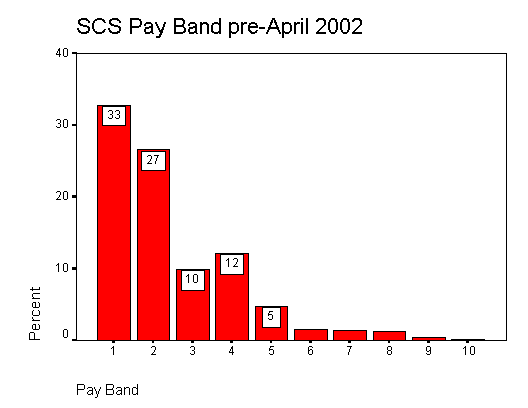 Chart 1
Question: Which SCS pay band are you in now?
By comparison, under the new pay structure,over two thirds of respondents were in pay band 1 and a further 20% are in payband 2 see Chart 2
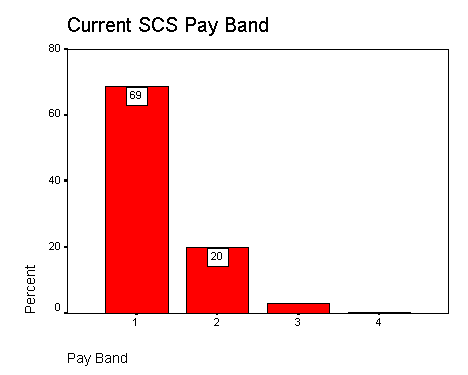
Chart 2
Question:Please state your salary immediately prior to April 2002?
Prior to April 2002, respondents earned amedian of 65,000. The lower quartile for pay was 58,450 and the upperquartile was 73,000. Chart 3 shows the distribution of earnings, grouped inbands of 5,000.
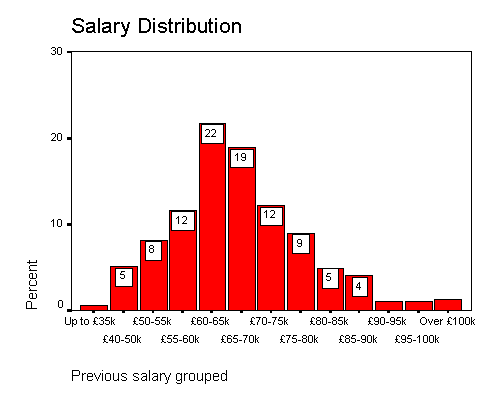 Chart 3
Question: Have you received your 2002 pay increase?
Just 58% of respondents had received theirpay increase for 2002, down from 70% who had received their annual increasethis time last year. 40% had not received their 2002 increase and 2% did notknow whether they had received it or not.
Question:What is the JESP score for your post?
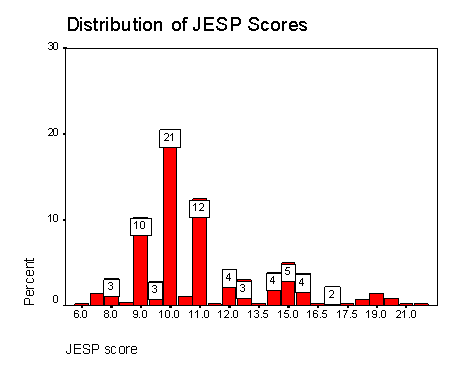
Just under half of respondents posts (47%)scored in the range of 9-11 JESP points, down slightly from the proportion inthis range last year (55%). Overall, however, the distribution of JESP scoresremains very similar see Chart 4.
Question: Has the JESP score for your post beenevaluated within the last year?
This is not surprising since just 18% ofrespondents reported that their post had been evaluated within the lastyear.
Chart 4
 |
Question: Into which performancecategory did you fall?
24% of respondents were in the topperforming tranche and 59% were in tranche 2. This is broadly in line with therecommended distribution of 25% in the top tranche and slightly below therecommended 65-70% in tranche 2. Just 3% of respondents were in tranche 3(recommendation 5-10%) and a single respondent was in tranche 4 (recommendation5-10%). Respondents who indicated that their post required a specialist skillwere significantly more likely to be in tranche 1 and non-specialists morelikely to be in tranche 2. However, at the time of responding to the survey 14%did not know their performance category.
Question: Have you been notified that you will receivea bonus payment?
Half of respondents had been notified thatthey would receive a bonus payment. 47% had not and 3% were did not know. Ofthose who had been notified of their bonus entitlement, payments ranged from990 to 5,600. The median bonus payment was 2,500.
Question: Were you told ofyour line managers recommendation on performance tranche and level of bonusbefore it was put to the Pay Committee The proportion of respondents who had been informed of their linemanagers recommendation (47%) was exactly matched by the proportion who hadnot. The remaining group of respondents were unable to answer the question, asthey had not been notified whether or not they would receive a bonus payment.
Question: Was this recommendationaltered by the Pay Committee?
Of the 47% of respondents who were able toanswer this question, seven out of ten said that their managers recommendationwas not altered by the Pay Committee.
Question: Do you considerthat the decision of the Pay Committee has been adequately explained to you?
36% of respondents considered that they hadreceived an adequate explanation of the Pay Committees decision compared with49% who did not. The remainder were unable to make a judgement as the time ofresponding to the survey.
Question: Did yourdepartment / agency explain how it was allocating the 0.4% provided forassimilation arrangements?
Less than 30% of respondents were able topositively confirm that they had received an adequate explanation of how the0.4% assimilation budget was allocated see Chart 5.
Question: Did you benefit from theassimilation arrangements?
Just 9% said that they had benefited fromthe assimilation arrangements. 69% said that they had not, and 22% were unableto say.
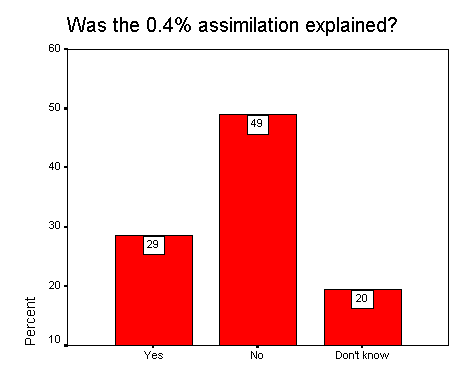 Chart 5
NewSCS Pay and Performance Management System
Question: Do you understand the new pay arrangements?
68% of respondents said that theyunderstood the new pay arrangements compared with 30% who did not understandthem.
Question:Do you understand the new performance management / appraisal system?
The level of understanding of the newperformance management system was slightly higher, at 74%, but around onequarter of respondents said that they did not understand the new system.
Question: Do you understand the new SCS competence framework and how itrelates to your personal development?
Fewerrespondents understood the new SCS competence framework (67%), though this isan improvement on the position in 2001, when 55% of respondents expressed anunderstanding of the competence framework and how it relates to their personaldevelopment.
Question: Are you clear about how your new pay level has beencalculated?
Respondentsunderstanding about how their pay level has been calculated is considerablylower. 56% said that they did understand how this calculation had been made,but 39% did not and 5% were unable to say.
Question: Are you clear about how your annual pay rise has beencalculated?
Similarly,57% of respondents said that they understood the calculation of their annualpay rise compared with 38% who did not and 5% who were unable to say.
Question: do you think that your department / agency considers yourpost to be central to its activities and PSA targets?
66%of respondents said that their post was considered to be central toDepartmental activities. 30% did not think that this was the case. Respondentswho replied positively to this question were more likely to be in the topperformance tranche and most likely to be between the ages of 30 and 49. Theywere also more likely to have received notification of a bonus payment and toconsider that their performance objectives adequately reflect their actualperformance.
Question: Did you have a mid-year development review during 2001-02?
69% of respondentsdid have a mid-year development review compared with 30% who did not.
Question: Have you met with your line manager anddrawn up an annual performance agreement for 2002-03?
Chart 6 shows thatless than half of respondents have drawn up a performance agreement for thecurrent year, down from 55% who had agreed an annual performance agreement byAugust 2001.
Chart 6
Question: Do youconsider that your objectives are sufficiently comprehensive to reflect yourperformance in the year 2002-03?
61% of respondentsconsidered that their objectives are sufficiently comprehensive to reflectperformance. 21% do not consider this to be the case and 17% were unable tosay.
Recruitment and Interchange
Question: Haveyou worked outside your current department in the past 6 years?
36% of respondentshad worked outside their current Department in the past 6 years.
Question: Wheredid you work?
The most commonexperience was work in another Civil Service department, as shown in Table 1,but 7% of respondents had worked elsewhere in the public sector and 3% hadworked in the private sector.
Table 1- Interchange
|
Type of organisation |
% of respondents |
|
Civil Service department |
25% |
|
Local government |
1% |
|
NHS |
2% |
|
Other public sector |
7% |
|
Voluntary sector |
1% |
|
Private sector |
3% |
Question: Wereyou satisfied with the arrangements for secondment / interchange?
Of thoseparticipants who had participated in an interchange arrangement, two thirdswere satisfied with the arrangements made by their Department. Thissatisfaction level is unchanged from 2001.
Question: Wereyou satisfied with the arrangements to keep in touch with your parentdepartment?
59% of thoseparticipating were satisfied with the arrangements to keep them in touch, animprovement on the 51% who declared themselves satisfied in 2001.
Question: Wereyou satisfied with the overall handling of the secondment?
73% of thoseparticipating were satisfied with the overall handling of the secondment, againan improvement on the 54% satisfaction level in 2001.
Question: Wouldyou recommend a relative or friend to take a job in the civil service?
Only 30% ofrespondents said that they would recommend a relative or friend to take a jobin the Civil Service, an even lower proportion than the 37% last year who saidthat they would make such a recommendation. Respondents in posts consideredcentral to Departmental PSA targets were most likely to make a positiverecommendation. Those in pay band 1 were less likely to do so.
Motivation and Development
Question: Do youconsider that the new pay arrangements have encouraged you to improve yourperformance in your job in 2001-02?
The response tothis question was overwhelmingly negative see Chart 7. Just 10% said that thenew pay arrangements had encouraged them to improve performance compared with88% of who said that they had not.
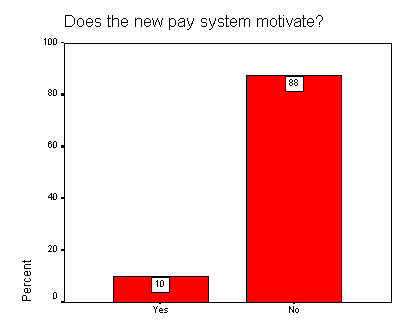 Chart 7
Question: Do youregularly work for longer than you are contracted to work?
As was the case in2001, just 3% of respondents said that they do not work for longer than theircontracted hours. 4% work for 1 or 2 extra hours compared with 3% in 2001, and15% work an additional 3-5 hours compared with 19% in 2001. The proportion ofrespondents working an extra 6 or more hours has risen from 74% last year to 77%currently, as shown in Chart 8. Respondents in posts requiring a specialistskill were more likely to work between 1 and 10 hours extra whereasnon-specialists were more likely either not to work for longer than theircontracted hours or to work very long hours i.e. 11 or more per week.
Chart 8
Question: Do youconsider that your department / agency has taken sufficient steps to reduceexcess hours working?
The pattern ofresponses to this question, set out in Chart 9, is very similar to last yearwhen 14% of respondents said that their Department had taken sufficient stepsto reduce excess hours working, 78% said that this was not the case and 5% didnot know. The respondents who worked the longest hours felt most strongly thatinsufficient steps had been taken to reduce excess hours working.
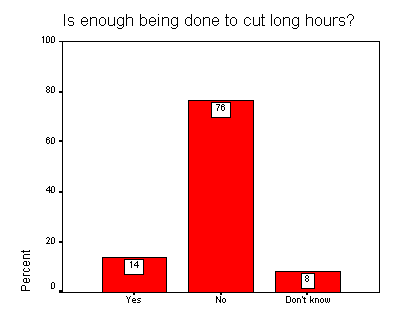 Chart 9
Question: Howmany days training did you receive in 2001-02?
Less than 1% ofrespondents reported that they had not received any training in 2001-02 and, atthe opposite extreme, a small minority had received 25 days or more. 16% ofrespondents said that they had received 1 or 2 days training, 34% had received3-5 days, 18% had received 6-10 days, and 4% had received 12-20 days.
Implementing Equality Policies
Question: Hasyour department / agency introduced measures to facilitate work/life balance?
61% of respondentssaid that work-life balance measures had been introduced, 35% said that theyhad not and 4% were unable to say.
Question: Whichmeasures have been introduced?
By far the mostcommon measure was flexibility in working patterns, as shown in Table 2. 5% ofrespondents said that no work-life balance measures had been introduced.
Table 2 Work-life balance measures
|
Measure |
% of respondents |
|
Flexible working patterns |
84% |
|
Assistance with child care |
38% |
|
Enhanced family leave |
24% |
|
Career breaks / sabbaticals |
53% |
|
Other |
4% |
Note: Percentagesdo not round to 100 due to multiple responses.
The other mostcommon measure mentioned by respondents was homeworking. Other measuresincluded distance working, job share and play schemes. One respondent reportedthat new posts had been created to relieve overburdened posts.
Question: Haveyou taken advantage of any opportunity for flexible working?
24% of respondentssaid that they had taken advantage of flexible working opportunities but 74%had not. Female respondents were much more likely than males to have takenadvantage of such opportunities.
Question: Do youunderstand how the duty to promote good race relations in the Race Relations(Amendment) Act affects your own goals/objectives?
83% of respondentsreported that they did understand how the duty to promote good race relationsimpinges on their own objectives compared with 16% who did not.
Question: Do youexpect that senior civil servants will benefit in practice from the new rightsto enhanced maternity leave and the new statutory rights to paternity andadoption leave and pay with effect from April 2003?
60% of respondentssaid that they did expect senior civil servants to be able to benefit from thenew rights, but 30% did not and 10% were unable to say.
Satisfaction at Work
Questions:Respondents were asked about their level of pay satisfaction.
As shown in Table3, almost half of respondents were either dissatisfied or very dissatisfiedwith their rate of progress through their pay band compared with one in fivewho were either satisfied or very satisfied. Over half were either dissatisfiedor very dissatisfied with their pay increase relative to staff in privatesector organisations. This compares with less than 15% who were eithersatisfied or very satisfied.
Table 3 Pay satisfaction
|
|
Very dissatisfied |
Dissatisfied |
Neither satisfied nor dissatisfied |
Satisfied |
Very satisfied |
|
The rate at which you are progressing through your pay band |
17.8% |
30.9% |
24.3% |
17.8% |
3.6% |
|
The increase in your pay relative to increases paid to staff in private sector organisations |
25.9% |
31.4% |
22.0% |
12.8% |
1.6% |
Note: Percentagesdo not round to 100 due to missing responses.
Questions:Respondents were asked for their views on a number of statements relating toorganisational practices to support work-life balance.
Responses aresummarised in Table 4. This shows that over half of respondents did not agreethat the culture at their workplace supports work-life balance and just underhalf disagreed that good information is provided on work-life balance options.However, over 40% of respondents did agree that at line management levelflexible working arrangements are supported.
Table 4 Views on work-life balance practices
|
|
Strongly disagree |
Disagree |
Neither agree nor disagree |
Agree |
Strongly agree |
|
The culture at my workplace supports good work-life balance |
12.6% |
38.2% |
22.0% |
19.4% |
2.7% |
|
My Department/Agency provides good information on work-life balance options |
13.3% |
31.4% |
24.9% |
22.7% |
2.3% |
|
My line manager supports flexible working arrangements |
5.7% |
15.8% |
29.7% |
36.8% |
6.6% |
Note: Percentagesdo not round to 100 due to missing responses.
Further Comments
Respondents wereinvited to make additional comments. A number took the opportunity to do so andthese are set out at Annex 2.
Annex 1
Organisations from which responses were received
BTI
Cabinet Office
Central ScienceLaboratory
Child SupportAgency
CompetitionCommission
Court Service
Crown ProsecutionService
Crown Office
Procurator Fiscal
Customs and Excise
Department forEnvironment, Food and Rural Affairs
DARD (Agriculture,NI)
Department forCulture, Media and Sport
Defence Scientificand Technical Laboratory
Department forInternational Development
Department forEducation and Skills
Department ofenvironment (NI)
Department forWork and Pensions
Department ofEducation (NI)
Department ofFinance and Personnel (NI)
Department ofHealth
Department ofTransport
Department ofTrade and Industry
DHSSPI (NI)
ECGD
English Nature
Foreign andCommonwealth Office
Food standardsAgency
ForestryCommission
Government Offices
Health and SafetyExecutive
Highways Agency
HM Treasury
Home Office
House of Commons
Inland Revenue
Job Centre Plus
Land Registry
Medicines ControlAgency
Ministry ofDefence
Met Police Service
National Assemblyfor Wales
National Museum ofWales
Northern IrelandOffice
Office of theDeputy Prime Minister
Office of theFirst Minister (NI)
Office forNational Statistics
Office of FairTrading
Office of the RailRegulator
OFGEM
OFSTED
OFTEL
Ombudsmans Office
Ordnance Survey
Patent Office
Postal ServicesCommission
Prison Service
Privy CouncilOffice
Public RecordOffice
Scottish Executive
Strategic RailAuthority
TreasurySolicitors Department
Valuation Office
Wales Office
Youth JusticeBoard
Annex2
Respondentscomments
New pay system
The new pay system is too complex, and thebonus system is inadequate.
The new pay agreement is totally counterproductive.
I am unhappy that new pay scheme is basedon relative performance.
I disagree with the pay committeesdecisions and explanations
The new pay arrangements are a shambles.
The new pay system is bureaucratic, timeconsuming and demotivating.
At the outset of the new pay scheme, wewere told of special arrangements for those retiring in the early years ofscheme. This promise has not been met.
The new system makes for worsetransparency. I am appalled at the MOD introducing a similar arrangement.
People in old pay band 6 seem to beparticularly disadvantaged by the new system.
The new pay system is a mess.
The complexity of the new pay system hascaused a log jam in the completing of annual reports.
My line manager does not understand the newsystem - and working the full annual leave allocation is a difficult task.
At the top of the 1a pay band with a middletranche performance assessment I receive only 0.6%. This seems unfair.
The new system is another complicatedfudge. It is trying to make the SCS feel better paid without spending any moremoney.
The G5s and G3s are competing for pay. Thisis unfair as the G3s make recommendations about G5 pay.
It has taken me over a year to resolve apay dispute and despite good performance my pay rise was limited to 2.9%because I have only been in post one year.
I am dissatisfied that my consolidated payrise reduced to below the previous maximum rate for payband 2.
The SCS pay process takes too long thereis a lack of explanation / clarity behind pay awards of non- consolidatedbonuses.
The pay system is total lottery dependantupon individuals relationships with their line managers.
I am very disappointed that after 11 yrs inold SCS pay band 2, due to JESP scores I am now back in the new pay band 1.Very demotivating!
The basic pay deal is better but bonusesare too demotivating if you dont get any.
The increase in the pay minimum was great,but progression now is poor. Performance management of the system is very weak.
I have had no feedback from the paycommittee, except that my line manager says that both he and my secondreporting officer were overruled by people who do not even know me.
Pay arrangements are complex and slow todeliver. Pay levels at the bottom end of bands are too low compared to grade 6level and private sector.
Management has done nothing to explain thechoice of performance tranches. They seem whimsical and not based on actualperformance because of perfunctory appraisal reviews and bias!!!
After 5 years I am still on the pay bandminimum. There is no incentive to improve performance as that is where I alwaysend up.
The current pay arrangements arede-motivating, not transparent and slow.
I am told that we are unlikely to hear whatour pay award and performance mark is before the end of September.
The new pay arrangements are verydemotivating for those in professional grades as the premium for professionalsis being eroded.
The new pay system is over complex and itrewards the few at the expense of the pensions of the many - hardly just. Allthe evidence is that performance pay is not a motivator.
I do not understand why after 3 years ofgood performance I am still so close to the minimum level for my pay band.
Let us have an end to personal contractsand a return to collective bargaining.
The level of my pay is still well belowthat of my counterparts in the private sector.
The new pay system contains some real cliffedges if you fall slightly to one side of the line.
After 4 and a half years in the SCS,despite a top tranche assessment last year I am still on the SCS minimum paylevel.
I am now at a point that my salaryincreases are capped on the basis of a JESP marking relating to 3 posts ago!
12 years of box 1 and 2 upper and still notat the top of pay band!!
Motivation / workload
Workload on senior managers is out ofcontrol.
Manager - staff relations suffer due tolack of money for pay awards.
I feel that I am part of an uncoordinatedsomewhat directionless change process that convinces few people as to its basisor continuance after time - a poor basis for a career.
Nobody cares how much you need to work.
The new SCS pay system will rewardmediocrity and demotivate people like myself whose salary is above the PTR.
The job is like nailing jelly to the walland my pay has suffered as a result.
I am far from convinced that the system isa good way of expending senior time or energy, for so little gain. Literallyeveryone feels dissatisfied.
Central initiatives / targets are thesingle worst influence on SCS working life and are eroding morale, jobsatisfaction, creativity and work-life balance.
I object strongly to being told of linemanagers recommendations for bonus and subsequently being told none would bepaid. This is a lousy way to do things.
The system of tranches is fundamentallymisconceived. In smaller organisations it can be unfair. The Civil Service hasno idea how to deal with specialists.
Overall I think management skills are verypoor compared with local government. I still have no date for a performanceanalysis meeting with my manager. I filled in my part of the form in May!!
I regard the pay process as only marginallyless random than the lottery. The new system is demotivating.
Reducing excess hours and achieving betterwork-life balance will not happen until Ministers and top officials reallybehave as they preach.
I shall walk away with considerableresentment at the way I have been treated.
The continuing reductions in SCS posts andmilitary equivalents is placing more and more work on those remaining.
My motivation has dropped. I feel my careerhas come to an end. There is too much emphasis on spin.
The new pay system is de-motivating.Tranche placings are decided in secret without any feedback.
My major concern is the pressure anddemands we all face - increase in responsibilities that appear to gounrecognised, and require extra working hours.
Equalities issues
I am working part time 30 hours a week,however I havent signed a SCS contract yet. I asked if I could claim extrahours if I had to attend the office 5 days a week and the Cabinet Office saidno. I think this is a barrier to flexible working.
I feel that ageism is now a key factor inmy department in determining pay rises and bonuses.
The new pay system discriminates againstpart time workers; promotion is very limited.
I think the new pay arrangement are discriminatingwith respect to long serving or older senior members of staff as pay awards arenot consolidated.
If you are on a fixed term contract even ifyou are performing well you are unable to gain from the performance related payscheme.