  |
A holistic approach to care and treatment SANE has always advocated a holistic approach to care and treatment which takes account of the person's whole needs. We have always made it clear that whilst medication, properly administered and monitored, can play an important role in helping people to cope with mental health problems, it is only one element of what constitutes a comprehensive package of care and treatment. Our experience over nine years of running our national helpline SANELINE has shown that people who are distressed or in crisis need information to make choices and that information should be targeted to meet their needs at that moment in time. No caller has only one problem at a time and our aim is to be able to give highly specific and local information relating to services in any part of the United Kingdom in the course of one call. For example: We received a call from a very distressed young man. He had recently left a supported accommodation project in Oxfordshire, which he had been in since receiving in-patient treatment for depression and self-harm. He was travelling to some friends in Manchester to ask if they would put him up for a while, but had only managed to hitch to Northampton. We were able to give him details of N.A.A.S.H Night Shelter in Northampton, which accepts direct referrals throughout the night. We also gave him details of 42nd Street, a project in Manchester for young people, including those who self-harm. A man called from Rochdale about his wife who has had manic-depression for some years now. He was finding it very difficult to cope on his own and felt embarrassed to seek help. We put him in touch with the local Making Space Family Support Worker and also the Richard Street Centre who run a group for people with manic depression. The aim of the helpline is to help to clarify the untidiness of people's problems and move them from the confusion and impasse at which they find themselves. The SANELINE volunteers are trained always to consider the whole person, to give callers information and help not only with medication, therapies and treatment but to suggest strategies to cope and enrich daily life. Like those with any other condition, people with mental health problems vary tremendously. Some do not respond to any form of medication or therapy, and may need longer term care; there are some whose condition is episodic. Assessment of the person's individual needs plays a crucial role in decisions on care and treatment. SANE wants to see more emphasis on the physical and mental wellbeing of the individual, with assessments not confined to snapshot judgements but taking a deeper and broader perspective, including where appropriate the views of families and carers. The need for better medication - the new anti-psychotics "I would rather be in a straitjacket than suffer the side effects of past medication" explained Mike, aged 27, who has a diagnosis of schizophrenia. Mike is now using complementary treatments in tandem with a new prescription of drug treatment which he feels he can live with. (Name of caller had been changed.) For many of those who do respond to medication, the side effects can sometimes be almost as distressing as the symptoms of their illness. In a survey of 340 people diagnosed with psychosis who called SANELINE between July 1998 and February 1999, almost half of the 202 respondents were dissatisfied with their medication, and almost all reported experiencing at least one adverse effect. Still, far too many people diagnosed with schizophrenia are prescribed with the old 'typical' medication as first-line treatment. SANE has campaigned for people diagnosed with schizophrenia to be offered the new 'a-typical' drugs as first-line treatment routinely. We are working with other mental health charities on initiatives by the National Institute for Clinical Excellence, which is currently reviewing a typical medications used in the treatment of psychoses. Marjorie Wallace, Chief Executive of SANE, said: "We need more acceptance that people with mental illness are no different than the rest of us; they are neither ill nor well; they can be ill sometimes and well sometimes. The least we can do for people already enduring a tormenting mental illness is to offer them the respect, hope and potential of the most up to date drugs and treatments." "It is not surprising that young people faced with side effects almost as distressing as the symptoms of their illness fail to take medication and resist future contact with professionals. We accept that all medications have some side effects, but if the most up to date drugs were combined with other forms of therapy, the need to force people to take medication could be reduced." One of the major problems for people coping with enduring mental illness is frustration and boredom. To help people find meaningful, rewarding activity SANE runs an Art Awards scheme which since its launch in 1994 has helped more than 100 artists including painters, sculptors, craftsmen and photographers with schizophrenia and other serious mental illness. The awards are not competitive and do not depend on skill, however, the scheme has uncovered a wealth of creative talent, and several of those who have received grants have since embarked on promising careers in the arts. "Really I am not looking so much for money as for some kind of faith in the validity of my work and therefore my life which also attempts to fire on other cylinders. But please can you buy me a 'self-esteem' easel?" asked Eric, a recipient of SANE arts grant in 2000. (Name of grant applicant has been changed.)
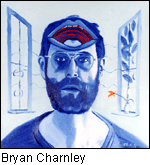
Self Portrait, 23 May 1991 (above) is part of a unique series of images painted by artist Bryan Charnley, who had a diagnosis of paranoid schizophrenia. Over the summer of 1991 Bryan made a deliberate attempt at self-investigation by using his art to express his changing state of mind under the influence of three different drug treatments prescribed for his condition. Sadly, Bryan died in July 1991 but he left us with an incredible insight into his thoughts and feelings. |
