
A caring community? The plight of Britain's mentally ill
by Marjorie Wallace
First published in The Sunday Times Magazine 3 May 1987
It was a startling idea: to release the mentally ill from asylums and put them back into the mainstream of life, a caring community. It was a plan born out of compassion, optimism and the discovery of new drugs which controlled some of the most crippling mental disorders. It started 30 years ago and it has been pursued, as a policy, by every government since. At first it worked. But now, 25 years later, the optimism has run dry, the compassion looks threadbare and in too many instances the forces of commercialism are all that is being brought to bear upon the problems of progressively sicker people as they are uprooted. So far, 60, 000 patients have been returned to the community and more continue to be as the old asylums like Liverpool's Rainhill Hospital are demolished. For many people, as our investigation shows, the concept of a caring community amounts to little more than a sick joke.
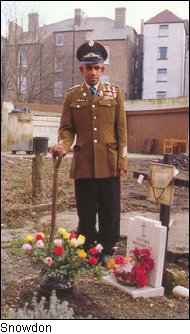
Mohammed sits on his bed in an unheated basement room in the Keswick Hotel, Southsea, a labyrinth of dark and dank and squalid rooms filled with more than a hundred of society's outcasts. He was discharged over a year ago from St James's mental hospital in nearby Portsmouth, not because he was cured but because it is Department of Health policy to reduce the number of long-stay patients in mental hospitals.
"The nurses told me it would be good for me to live out of the hospital. They drove me to a building. Told me to sign on. But St James's is my home," he says.
His room is about 12ft by 6ft, more depressing than any prison cell I have visited. A bare electric bulb hangs from the ceiling and on the wall is a single-bar heater with a coin-in-the-slot meter.
Mohammed seems confused about the meter and does not appear to use it. There is a table with mug and an electric kettle, a cupboard and a rotting chest of drawers. He opens them to reveal no personal possessions, no change of clothing, only an electric light bulb, and two damp army uniforms adorned with "medals" - a few badges and a glass brooch from a cracker.
Mohammed believes the Second World War is still on, but cannot remember on which side he is fighting. "I was chauffeur to the Sultan of Zanzibar," he says, grinning broadly through toothless gums. "I came to this country when I had a breakdown."
"I worry about him", says Vicky, his landlady. She came to the Keswick seven years ago as the cleaners and some time afterwards moved in with the manager. "Mohammed sometimes says he wants to kill himself. He believes if you die by fire, God will forgive. There's always the risk he will try it out - and there are mothers and babies in this hotel. He can't manage his money and he's not eating. No one visits him regularly."
The Keswick is not the most welcoming hotel. Warning signs are fixed to the gates: BEWARE GUARD DOGS. Two Rottweilers are barking savagely in the mud and rubbish of the back garden and gnawing at giant bones. A marble headstone in the wasteland is a memorial to a deceased Rottweiler. Posies of plastic flowers decorate the mound. "We had a lot of problems with people coming over the wall and that," explains Vicky. "There'd be people sleeping in the lavatories and disappearing without paying. Now they don't." As if to make a point, a dog barks loudly. "I'm fond of the dogs. I prefer them to some of the people we get here."
Vicky is conducting the interview in her cluttered room. The centre-piece is a four-poster bed, ornately curtained. Two enormous pink and yellow teddies sit on the lace bedspread. More than 20 brass statuettes of alsatians and many photographs of dogs are grouped on the tables. One wall is strung with the manager's collection of weapons, mainly knives. Around the room in glass cases and wall cabinets are dolls; row upon row of them, china, plastic, cherubic, crinolined, their wide-eyed painted faces staring across the room at the steel blades.
"They're turfing them out of the hospital and it's not right," says Vicky in a depressed monotone. "Sometimes they'd ring and ask us to take a patient and tell us what was wrong. Sometimes the patient would come straight from the ward and we'd be told nothing. We had about 15 of them two years ago. They'd seems all right when they came. Then they'd go a bit funny." Vicky gives a quick rundown on her clients. There was Ronald, who failed to go for his injections and became violent. Vicky says she rang St James but no one came for a week. Another man jumped out of an upstairs window soon after he arrived. And an ex-solicitor spent his days standing like a statue on the street corner.
"When these people leave you've got to gut the rooms - they wee the beds, leave dirty clothes. The smell is awful. To be honest, I'm refusing people from the hospital," Vicky confides. "This isn't the place for them. It doesn't help them. If they don't wander the streets, they sit on their beds and stare at the walls all day. It's not a normal life. I've dealt with dozens from the hospital. Some of them we've asked to leave. I don't know where they go."
The Keswick Hotel is only one of 900 houses in Portsmouth registered for multiple occupation. They once catered for holiday-makers but the number has multiplied almost five times during the last seven years as landlords have discovered the attractions of a new clientele. The most unwanted - the homeless, unemployed, ex-prisoners, drug addicts - have now become favoured currency in bed-and-breakfast land. The DHSS pays their rent regularly by giro-cheque, the business is not seasonal, and the customers have neither status nor the credibility to complain.
To this assorted flotsam of society has been added, in recent years, mental patients discharged from hospital according to the philosophy that they should be returned to the community. Village communities always tolerated their mentally ill. Surely in our enlightened times we should do the same?
The move back to the community started in the Sixties. At that time, too, the most distressing symptoms of mental illness could be controlled with new drugs, so that sufferers, after a short spell in hospital, would become stabilised and return home. New psychiatric units were planned in district hospitals so that mental illness could be treated like any other, without stigma.
At first it looked a humane and progressive idea. Those who were least ill succeeded in holding their own in the community. But what started as a welcome release of people, many of whom had been put away solely for the convenience of society and relatives has taken on disturbing dimensions. The vast social engineering experiment in which an estimated 60, 000 or more mental hospital patients have been returned to the community has become a problem of human disposal, involving the uprooting of progressively sicker and more dependent people.
The operation is not yet complete. Only one of the old asylums, Banstead, has finally shut its doors. Between 30 and 60 more will close in the next 10 years, decanting at least another 10, 000 patients. The Department of Health admits that it can only guess at the figure. Nobody can foresee the scale or difficulties of this final chapter in the exodus.
So where have all the patients gone? And where will the thousands still to be discharged find a place in the community? Lord Snowdon and I set out to discover what happens to them. We visited resorts like Southsea, deprived inner cities, a northern seaside suburb, a rich farming area and London itself.
We heard from hospital managers about the problems they face in reducing beds; we talked to social workers and community psychiatric nurses; and we saw ambitious blue-prints for rehabilitation hostels, sheltered flats, day centres, crisis intervention units and a complex range of multi-disciplinary services which, given enough money, could be provided around local hospitals and health centres.
Hopes for community care run high and the drive to demolish the Victorian "cities of madness" suits everyone; the Department of Health will be relieved of the escalating costs of running them and will benefit from the sale of the buildings and parkland, local authorities will have their funds boosted and the libertarians will succeed, they believe, in transforming the quality of life for the mentally ill.
The brochure language of the community care enthusiasts does not, however, reflect much of what we saw. A few (we suspect very few) ex-patients were flourishing in model schemes, such as group homes supported by the health and social services. Others were living in a neglected kind of independence in flats and bedsitters. Many were at home, destroying not only their own lives but those of their families around them. The rest were in bed-and-breakfasts, dismal lodging houses, night shelters and on the streets. Most had never seen - and were hardly likely to see - the proposed "place of excellence".
"No one should be discharged from hospital before a satisfactory pattern of living is awaiting him," says Norman Fowler, Secretary of State for Health and Social Security. But such thinking does not take account of human nature. A "satisfactory pattern of living" often means bed-and-breakfasts run by "caring landladies". Some indeed may be caring but the majority do not fit the department's images of motherly figures dedicated to their guests. They do not want their homes to be used as rehabilitation centres for people whom the most skilled nurses may have found difficult to help. They are simply letting rooms to anyone with a DHSS giro. (In some hotels, the proprietor is not even on the premises. They are owned by syndicates of absentee businessmen who find the most convenient person, such as a resident, to act as manager.)
Few landladies have been informed about mental illness or how to handle it. Joan Brown, who owns two Southsea guest houses, makes her own curious assessments. "If they're mentally handicapped in the arms, they're all right on the first floor. But if they're mentally handicapped in the knees we give them a ground floor room."
"We're not nurses, you know," Alan Lloyd, her manager, joins in. "But we take their pills from them and give them out. We don't know what they are. We just read the labels."
Joan, whose features reflect a harsh and defeated life, is a divorcee in her forties. Recently she has had four serious kidney operations. Alan, about 10 years her junior, was a resident sent to her by the probation office. He has now moved in with her and helps run the two houses. They charge up to ú55 a week for full board. They try their best, but the place is sad and inadequate.
"We're not getting many referrals now," says Joan. "But we had St James's on the phone last week wanting us to take someone. I refused straight away. Within half an hour Queen Alexandra's Hospital was asking us to take back a mental guest. He'd been sleeping rough."
Joan and Alan admit they open some of the giro-books sent to their lodgers, taking what is due and returning the rest. "It comes through the post, so indirectly it comes to us," says Alan. "We don't give the awkward ones all the money at once, because they stir up the others." The commandeering of giro-books by landladies seems to have been a common practice until the social security offices clamped down on it last year.
Max Millett, general manager of Portsmouth's mental health services, denies that people are being directly discharged into places like these, but admits the nature of mental illness means that disturbed people leave or are evicted from the better homes. "We have a clear policy of discharging only into places we consider adequate," he says, "but we have no powers to deal with the standards of accommodation. If people exercise their right to leave what we have found and drift to the cheaper end of the market, we cannot stop them."
Portsmouth was one of the first places to move into community care and there are only 360 patients left in St James's. Two hundred of them are elderly and will be rehoused in new buildings on the site. The rundown is almost complete, and Millett is proud of the record.
"There are between 750 and 1000 people who need or have needed psychiatric nurses, the highest number per head of population in the country."
Planners like Millett envisaged a range of accommodation, appropriate to the ex-patients' needs. The most dependent should go to small hospitals or to mental nursing homes which can charge high fees for 24-hour care. For the less sick there would be residential care homes, registered with the social services. These homes require, depending on the number of guests, between two and three care staff, one of whom must have a years' experience. They must be open to inspection every six months and can charge up to ú130 per week per guest.
Such homes have become popular investments for psychiatric nurses who see little future in the hospitals. "We realised our jobs were on the line," says 26-year-old Sue Goward, who set up in business in Whitehaven Court, Southsea, with Ian Firmin. Both were psychiatric nurses at St James's. "We decided to do something on our own. They were having a massive turn-out at the hospital so we said to some of the patients: "Come and see if you like it.' They did and we've never had a spare bed."
They need a full house to make a profit after paying for food, staff, laundry and maintenance, plus the repayment on a £74,000 mortgage. The 13 ladies, all from the same ward, provide an income of just under £90,000 a year, Sue Goward says she draws only £75 a week and works more than 100 hours. Guests also help out. "We try to make them do things for themselves and help with the cleaning and washing up," said Sue. "We have a reward system. If they help they get cigarettes or a pair of tights."
There is considerable rivalry between the ex-nurses to acquire the better-behaved patients. "There's quite a lot of poaching going on," says one of the first nurses to leave St James's. She has run a nursing home for 24 ex-psychiatric patients for the past 11 years. "It's getting difficult to find residents. One man who lived with us for six years went to stay with another nurse who was opening a new home. Not long after," she adds, "he committed suicide."
"The trouble in the private sector is that it is unstructured and unsupervised," says Terry Hammond, manager of a night shelter and former director of Stonham Housing Association. "There is no way of anyone knowing what really goes on."
Neighbours also worry about the private "mini hospitals" being set up in their midst. They complain that the Whitehaven ladies look unkempt and can be seen wandering about the seafront at all hours. "There's one woman comes in with a summer dress and canvas shoes in the freezing weather," says the local landlady at the one pub which does not ask the Whitehaven ladies to leave. "She picks up people's glasses and fag-ends and mutters away to herself."
Sue Goward defends what she believes is an improvement in the lifestyle of her residents. "In hospital they'd have to ask to go out. Now they just go," she says. "They become more independent and integrate with the community."
But the community does not always agree. As we talked to the locals in the pub, Vera (not her real name), whom we recognised as one of the Whitehaven residents, walked in. A timid, middle-aged woman, she bought an orange juice and sat down. The others edged away. "You can't really talk to her," they warned. It was indeed difficult to hold a conversation. Vera whispers like a scared child, nodding, smiling, but making no sense. We left her sitting staring at her orange juice, as isolated from the community around her as if she were in a locked ward.
The trouble is that independence may simply mean loneliness. No matter what facilities there may be, the onus is always on individuals to seek out ways of occupying themselves. Even for healthy people, this requires an effort of will and motivation. For the mentally ill, the black dog on their shoulders and the daily struggle against the voices and hallucinations is often too draining for them to be able to get out of bed, let alone to go to a day centre or health clinic. Some make the effort, but most roam the streets aimlessly, or sit lined against the wall in dreary sitting rooms, mindlessly gazing at the television - just what the reformers most condemned in the old institutions. A few, like Mohammed, return to their former hospital homes, now like ghost towns, to wander about the grounds, haunt the corridors or take advantage of some companionship in the cafeteria.
* * * * *
In the more genteel seaside resort of Southport, on the Lancashire coast north of Liverpool, the National Schizophrenia Fellowship has tried to combat the loneliness of discharged patients by running a drop-in centre, funded by grants from health and social services. Janet Williams, a cheerful woman who is herself handicapped by multiple sclerosis, manages it. "We get about 20 to 30 sufferers every day. But we are only open in the afternoons, Monday to Friday. The rest of the day and at weekends they have nowhere to go."
Southport has 2000 homes registered for the care of the elderly but only 60 residential beds for the mentally ill. The rest live in bed-and-breakfasts. "I get so depressed, I don't get up for days," says Linda, a pretty 23-year-old who has been in and out of hospital after a succession of suicide attempts, including setting fire to herself.
Loneliness, especially of "difficult to place" young people, is not one of the factors taken into account by the new breed of mental health services managers, appointed in the past two years as a result of an inquiry conducted by Sir Roy Griffiths, whose report recommended the introduction of general manages instead of teams at regional and district level.
"We are a sickness business and should be directing resources to the treatable end of the market," says Roy Williams, unit general manager of Rainhill Hospital between Southport and Liverpool. "The National Health Service should not need to make long term provision for young chronically mentally ill. They should be provided for in the community."
Williams has the task of emptying the hospital by 1992. Rainhill was the largest asylum in Europe. In it's heyday it contained 3000 patients and its sturdy brick villas and imposing towers dominate 300 acres of parkland. But as it has emptied, the grandeur has faded.
Already the bulldozers have moved in, demolishing two wards. Patients, now transferred to other wards, wander among the rubble. Staff morale is low. "It's more like a transit camp than a hospital," says Gordon Beirne, the hospital representative of the National Union of Public Employees.
As in Lincoln and other areas where wholesale closure of a hospital is being planned, the nursing staff are running pockets of resistance. "The social workers come and say they are opening a new home and ask us to give three of our best," says Vivien, a staff nurse. "But on our kind of ward we have no "best'."
"We are talking about the final chapter," says Williams. "Our first step was to find out where patients had originally come from and to return them to their own communities. Already those patients that could be resettled easily have gone."
The remaining 850 are elderly or have severe behaviour problems, and 180 are displaced persons with no traceable roots For them a series of small hospitals, hostels and sheltered flats are being planned in conjunction with the local authorities, housing associations and charities. But so far, scarcely a brick has been laid.
Many of the patients are being transferred with a "dowry" attached to them. As they close the bed, the hospital hands over some of the cost of keeping the patient in hospital (around £400 a week) to the local authority. Each district makes its own deal, offering from £7000 for a limited period to £15,000 a year in perpetuity for each discharged patient. "In order to release the funds, I have to reduce beds. I can only work within cash limits," says Williams.
Whatever his pressures, Williams claims that patients will not suffer. "We will not discharge people into private accommodation or anywhere that is not a demonstrable improvement in the quality of their lives."
Despite Williams' firm assurance for the future, we found numbers of patients already diffused into the community, in lodging houses, hotels or worse.
Other complaints are that once a patient is discharged it is very difficult to get help, or even return him or her to the hospital. Ron Wareing manages the Turner Memorial Home in Liverpool, a rest home for 52 men and boys including six patients from a long-stay ward in Rainhill.
"We have had problems with backup," he says. "Once the social worker has delivered them by car, that's it. The hospital refused to take back a man who sexually molesting one of my staff because they said we were out of their catchment area."
The home looks and feels wax-worky. The building, approached by a long driveway, is patrolled by three security guards. Inside, it is clean and quiet, with numbers of uniformed staff tending the guests. Rows of men, some senile, some prematurely old, some mentally ill, sit fittingly immobile alongside the marble memorial to the home's benefactor. But at least the place seems well-run and the guests tended.
Ron Wareing is worried about those patients who do not fit into a home such as his.
"They end up in places for the homeless or unsuitable hotels."
Aber House on the fringes of Toxteth looks run down, even by Liverpool standards. Plastic flowers here and there fail to divert the eye from the layers of dirt covering the dining-room tables and embedded in the chairs. Maureen King, who runs the hotel, has also learned to refuse patients from Rainhill. "The social worker from the hospital rings up and says: "We have a person here, can you manage him?' I ask the usual questions - Is he very ill? Is he on medication? Is he incontinent? - Then this fell is dropped off on my doorstep. Half the time when they come out of hospital they are so disorientated they can't cope. If they are on medication I dole it out, but I'm not a nurse. I don't consider it my job. I don't pretend to help them. They should be in proper rehabilitation places. We're just a private hotel."
Even more alone than those in hotels or lodgings are the ex-patients living in council flats, sometimes 12 or more floors up in half-empty blocks. Some of these blocks, like Logan Towers, are due to be demolished and are in the most desolated areas of Liverpool, rising over a wasteland of rubble and barbed wire, rife with muggers, vandals and drug traffickers.
The ex-patients may have been given their freedom; but there are no safe grounds to walk in, nobody (except an occasional visiting community nurse or social worker) who cares whether they ever go out, take their medication or eat properly. In high-rise blocks like Logan Towers or St George's Heights, neighbours have little time for other people's problems - especially if those people are aggressive or withdrawn. "We know dozens of them," says Lily Brumhill, who works at the Vauxhill Community Centre in one of Liverpool's poorest districts. "There's nothing more depressing than living in those high-rises. People with mental problems are just left to get on with it."
* * * * *
Tired with seeing the seedier results of the closure programme, I asked the Department of Health to show me places where the transfer from hospital to community care was working best. It gave me a list of eight areas. The top three district health authorities were Aylesbury, Kidderminster and Yeovil. They were followed by North Derbyshire, Brighton, North Devon, West Dorset and Harrow, Middlesex.
I chose Yeovil, a prosperous market town in Somerset where average incomes are among the highest in the country.
The Department of Health was reluctant to give away clues as to why Yeovil had been selected as a showpiece. "Go along and find out for yourself," was its helpful reply.
As suggested, I rang the local authorities and the manager of Somerset's mental health services. In many ways, Yeovil is well served. The nearest psychiatric hospital is Tone Taunton, so Yeovil has been among the first to build up facilities for the mentally ill within the town.
There is a 28-bed acute psychiatric ward on the ninth floor of the district hospital (known, since the adjoining ward is for gynaecology, as the "fruit and nut" floor). There is a luxurious home owned by a housing association and run by MIND, the National Association for Mental Health, prettily designed with duck-egg blue walls and seven bed-sits. Since no one wants to leave, there is always a list.
There are two more group homes on pleasant housing estates, and a conversion is planned for a four-bedroom semi-detached house.
There are two day centres: Penn House, which, although it officially caters for 40 people, limits the number to 25 for reasons of space; and MIND's Markwell Centre, which takes a further 20 people and runs a Good Companion Club. There are six community psychiatric nurses, four psychiatric social workers, two psychologists and a crisis intervention team.
Yeovil boasts the fewest admissions to Tone Vale hospital. Council flats are not too difficult to find and even home helps are used as part of the team.
It all looks just what the government ordered. Dr Hugh Koch, the unit general manager at Tone Vale and in charge of Somerset's mental health services - another of the Griffiths men - describes the shift to community care more in terms of the transfer of docile passengers from Concorde to the VIP lounge.
The strategists are confident; their language is full of ellipses and euphemisms: people are not being discharged but "normalised". Wards are not closed but "rationalised", facilities are "re-used", even suicides are referred to as "untoward deaths".
"All we are doing is a relocation exercise," says Koch, a self-assured 35-year-old former psychologist. "We would only encourage someone to leave hospital if they were not making proper use of the premises or if there were no real overt problem. They will not be pushed out in an inappropriate way".
"The clinical process would be deciding: Is this person ready to go out?" The standard questions the clinician would ask are: "Do you have thoughts of killing yourself?' We would never let them leave if the risk is too great."
Yet between July and August last year, five Tone Vale patients and ex-patients committed suicide, two on site and three within a short time after being discharged.
"They had outpatient follow-ups," explains Koch. "There is no evidence there is any problem of moving into the community." But there have been five further suicides in the last two months; four of them patients who had been discharged into the community.
"Suicide happens as part of everyday living," says Koch. "Two of the discharged patients had appointments for outpatient care. Others were felt not to need such care. Sometimes it's very important to let people have freedom rather than hovering behind their back."
There have been several clusters of suicides around other hospitals which are closing or running down. At St John's Hospital in Lincoln, for example, 15 current or discharged patients have committed suicide in the past 18 months. An inquiry is now being held. Part of the problem is the lowering of number and morale among the staff as well as the feelings of insecurity such changes create.
Even the most optimistic of mental health planners realise there is a problem with patients who are not deemed dangerous enough to themselves or others to be detained in hospital under the Mental Health Act, who do not think they need treatment and who do not fit into the schemes available in the community. "We would look to hostels or group homes run by social services," says Koch. "If those possibilities are exhausted, we would see if there were relatives prepared to offer accommodation."
It is among groups of these relatives that the bald patches in Yeovil's luxury mental health services show up. Research has shown that returning to the family caused maximum damage to patient and relatives alike. Their testimonies provide the most poignant indictment of community care.
* * * * *
One after another, I listened to stories of neglect, loneliness, even terror, as parents, many ageing and unwell, described how they were forced to provide the care the health service no longer sees as its responsibility. They are left to live in the same house or isolated farm with a disturbed son or daughter whose illness makes normal relationships impossible and who frequently lays siege to his or her own family.
"We live in fear of our children," says Marina, a lively, compassionate woman whose son came in while we were talking and threatened her with violence if she revealed her name. (We have changed the names of some relatives and sufferers).
A good-looking man of 27, her son has been in and out of hospital since his first breakdown at the age of 15. When he left hospital five years ago he was given one of the flats run by MIND but within nine months he had become so aggressive he was asked to leave.
"Everyone insists on treating his behaviour as a social problem, not a medical condition," says Marina. "He muzzles and blackmails us, but we can never get help.
"The crisis intervention team can do nothing. Their purpose is to defuse the situation, keep the patient at home and prevent a hospital admission. But it is precisely because we can't keep him at home that we have called them. Community care is as big a disaster in Yeovil as in the rest of the country."
I met a tough and spirited woman of 83 who drove over 20 miles at night to tell me her story. She dared not invite me to the home which she shares with her 80-year-old husband and their 43-year-old schizophrenic son. "I had to slip out of the front door while Michael was coming in the back. If he knew I was meeting you he would be very aggressive," she says. "He likes to grab my glasses and smash them into my face. Last time I left him for a night, Michael attacked my husband. Our son is 6ft tall and very strong," she says.
"The following day the social worker arrived. Michael fetched the tractor, lifted his car and wrecked it. That was nearly a year ago. He hasn't been back since." She recalls the story with some relish, as do the rest of the self-help group to which she belongs. So angry are these normally restrained middle-class mothers that they, too, would like to lash out against the services they feel have failed them. At the same time they are afraid: "We can't complain because the little help we get would be taken away," says another mother.
* * * * *
Tom and Jenny, a charming hospitable couple, were shocked when their son Robert, a gifted art student, first became ill. "At 23 he came home in a terrible state," says Jenny. "He is not rough by nature, but when he gets ill his behaviour gets unpleasant and frightening. He couldn't bear the light and would remove all the bulbs or hang his underclothes over them."
They have tried to get help for him over the past five years. Inevitably his condition worsened. The trouble is that the social worker and doctor are impotent in the face of someone who puts on a show of rationality when they arrive. Even when sufficiently disturbed to be detained under the Mental Health Act, Robert has been allowed by the district hospital to live in the community - and to play havoc with his parents' lives.
"He found himself an unregistered lodging house for boys on probation," says his mother. "The hospital knew he was there. Yet he was sufficiently ill to be detained under the Act. There is all this talk about rehabilitation. It doesn't exist. They tried to arrange cookery lessons, but we have seen no other attempts to help him."
"Tom and I found Robert walking down the road. One could see the fear mixed with heartbreak in Tom's face as he watched his once talented son slouching along, his shirt hanging out, a strange, faraway expression on his emaciated face. When we stopped the car and offered him a lift, Robert rejected his father with hostility and walked on from nowhere to his barren flat on a housing estate. "Thank heavens," said Tom with obvious relief. "He's in a good mood."
Brian Goodrum, senior psychiatric social worker and the local representative of MIND admits that while there are many who benefit from community care, there are some parents who are left with the burden. "If a person is determined to refuse our help, then I would suggest the family precipitate a crisis," says Goodrum. "In these situations we cannot intervene and the quickest possible help if the police. But even then, if no offence has been committed, there's nothing they can do."
It is not only the parents who need protection, but the sick people themselves. Their illness makes them vulnerable to exploitation, and they are often forced into companionship with less savoury members of society. Last year George was living in a bed-sit in Taunton, and met up with tramps and drug addicts who took advantage of him, broke in and stole his money. "He telephoned the landlord, who found him living in absolute turmoil, among broken glass with blood-stained clothes everywhere. He didn't seem to notice. He had called to say a washer was missing from the tap," says his mother.
"We are realistic about this illness," she wrote to her local MP, "but we do believe his suffering would be greatly lessened if he took the medication under strict supervision. How can we achieve this when he is denied the medical care he so badly needs because his right to refuse treatment even though he is insane and unable to make any sensible decision for himself?"
* * * * *
The relatives' cry is echoed by the charities and voluntary workers all over the country who are picking up the casualties of community care, the new vagrants who are "doing the circuit", roaming from one doss-house or resettlement unit to another, or sleeping in cardboard boxes.
The charity workers complain that not only are they getting direct referrals from the hospitals but that there is poor liaison and scant help when it is needed. "There is no one there in the evenings or at weekends," says John Macauley, a care worker from the St Petroc hostel for homeless men in Portsmouth. "We are getting more and more psychiatric cases. If there is a crisis I drive the man straight to hospital. The moment a doctor comes, I run. That is the only way a sick person will get help."
"The new hospital managers don't know or care about the failures who come to us. They are creating new ghettos for the mentally ill," says Emlyn Jones, director of the National Association of Voluntary Hostels. "The community is not ready for them."
The situation is becoming worse as night shelters, unable to cope, are closing their doors to psychiatric cases because they disturb other guests. With nowhere to go many find their way to the big cities.
Ken, a caring man with a gingery beard, manages the Queen Mary Hostel in London for 76 homeless women. "At least 70 per cent suffer from identifiable mental illness," he says. "Hospitals and social workers tend to use us as a way of clearing their books. Their vision of community care is a single women's hostel. It's not ours."
He is aware of the inadequacy of what he can provide. "Patients who have been in hospital are used to a clean, structured place and nurses to come when they call. This place is grotty and we don't have the staff to care for them."
The hostel was indeed grotty. In the enormous day room, more bleak and institutional than most of the psychiatric wards I visited, women were sitting backed in rows against the wall. "We can provide little to do in the day," says Ken. "We encourage them to go to day centres, but I can't march them there."
We found lily lying bed as she does most days. "She came from a psychiatric hospital two years ago," says Ken. "She is obsessed by the idea that she will never die. There's not much we can do for her."
There is almost no privacy and little comfort in the dormitory. Decaying lockers separate the 16 beds. The linoleum floors are stained and cracked, the net curtains heavy with dirt. A dormitory bed costs £31.85 a week, and there are a few cubicles which cost an additional £2.10 a week, but the hostel has to manage within the limits of what they can charge. An evening meal costs £1.85.
Downstairs in a sunless and greasy basement, Lydia, a well-spoken woman in her early forties, was muttering to herself over a cup of tea. "I've been ill for so long," she confided. "Come over to this table where they won't overhear us." I looked around the deserted canteen. "No, this table is safer." As we shifted around, fleeing her phantom pursuers, she told me strings of sad, incoherent tales of hopes and memories. "Can you help me?" she kept repeating.
Across London, in Endell Street, Covent Garden, the St Mungo housing association runs an equivalent hostel for 110 men. "It was originally a place for men in the catering business," says Mick Carroll, the committed young man who runs the hostel. "Now more than 60 per cent are former patients or currently ill. We have only two staff on duty at night. We can't take them to hospital and we can't keep them. One ex-patient recently set fire to his mattress. But if we turn them out, they will probably end up on the Embankment."
It is easy to lose sick people in this way as they move round the country unable, because they are homeless, even to register with a doctor. The Department of Health keeps no statistics on the numbers of mentally ill who become homeless; nor are records kept on many thousands who have left the asylums. They disappear between the boundaries of health areas and local authorities.
To be fair to the planners, this was not what was intended by community care. They blame the failures on lack of finance and planning, and insist it will all improve in time; and there are some places in which it does appear to work. But the basic flaw is that the whole social experiment has been undertaken without any evidence that it provides a better way of treating mental illness, and without any estimates of the numbers involved. Since the Department of Health can only guess at how many have been or will be discharged into the community it is impossible to ensure that adequate provision is made. A spokesman for the Department of Health said: "We would not expect evidence that the quality of life would be better outside hospital for all chronically severely ill people. A number of studies into welfare and happiness of discharged patients tend to confirm that after-care is badly co-ordinated and that the allocation of resources is often haphazard. But the studies show that even when the standard of community care is well below what we would wish, neither patient nor relative wishes for a return to hospital care."
We have been unable to trace these studies and the department has declined to be more specific. Professor Kathleen Jones, Professor of Social Policy at York University, says: "I know of no major study which has been undertaken which follows up the welfare of patients who have been discharged into the community; nor whether patients or families prefer this to hospital care. There is no evidence from the United States, Scandinavia, Italy or anywhere else that would lead us to believe that the closure of hospitals is the right policy for a country to adopt. It was a mish-mash of unproved theory with romantic ideas that patients would leave the hospitals and be borne aloft on a tide of goodwill."
As one distraught mother wrote to me: "With reference to the government policy of discharging patients into the community. Please, what community? I have a schizophrenic son who lives at home. I know that is the safest place for him. But the despair I feel at being so inadequate is almost unbearable. Am I supposed to be the community? Where do I go from here?"
