
By Marjorie Wallace
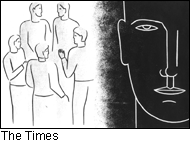
In the first of a three-part investigation into schizophrenia, Marjorie Wallace reveals the burdens placed on relatives who are forced to care for the victims.
First published in The Times, 16 December 1985
Schizophrenia, the forgotten illness, affects more that a quarter of a million people in Britain. It is not a 'split mind' as it is commonly and wrongly defined; a better definition is bouts of mental anguish or insanity. It is one the most frightening and disabling conditions that a human being can experience. We do not know what causes schizophrenia nor how to cure it. But attitudes towards mental illness have changed completely since the 1959 Mental Health Act. Before then, schizophrenics were regarded as mad, and conveniently locked away in the mental apartheid of the asylums. Since 1959 the doors have opened and 67,000 inmates have been sent into the community.
For many, especially those who were hospitalised for the wrong reasons, lives have been transformed. But some are too ill to fend for themselves and the community does not yet provide adequate facilities to care for them. It is a tragedy of our times that there is nowhere for them to go. Some lead miserable lives in sordid boarding houses. Some are on the streets. Others may be put back with their families, whose lives they destroy. It is not an illness that attracts either much public support or sympathy.
Should having a schizophrenic relative be a life sentence for the entire family? The Times investigates the tragedy of schizophrenia in a series of three articles starting today.
Imagine a disease that fills nearly a quarter of the hospital beds in Britain, an illness that strikes down young people, mostly in their late teens and early twenties and destroys their lives at the peak of their promise, and from which two thirds never fully recover.
Imagine a disease that afflicts one in a hundred people at some time in their lives, most of them trying to live in the community, on the streets, in hostels or bed and breakfast places. About a third of our prison population suffers from the illness; many are there for minor offences caused by the illness. Thousands more live at home, a desperate burden on their parents and relatives.
This disease is schizophrenia. It is not much known or written about because there is so much shame and guilt and misunderstanding that it is almost taboo, surrounded by a conspiracy of silence, as used to be the case with cancer. It is so unfashionable that medical science has passed it by and very little money is spent on research into its causes and cure.
During the past six months I have interviewed 75 families of schizophrenics and sufferers from all parts of the country: from Devon and Cornwall to Edinburgh and Stirling in Scotland, from the country-side of Hereford and Hampshire to cities such as London, Leeds and Birmingham.
Psychiatrists, general practitioners, hospital administrators, directors of social services, community nurses and social workers have talked to me about the problems they face, as have the charities who pick up their failures. And I have been shown the best and worst in the care offered to the mentally sick - form locked wards on the old asylums to modern cluster flats and landladies in the community.
But the most moving stories are those that I have been told by parents, husbands, wives, sisters or brothers who have spent twenty years or more in the daily anguish of watching a member of their family disintegrated in front of their eyes, realising that they can do nothing to stop it.
They get little comfort or support from the psychiatrist, whose main concern is with the patient. He is often reluctant to tell them, in the interests of the patient, the diagnosis or likely outcome. He may even add to the family's guilt, by saying they are to blame.
Nor is there much help from the social worker who regards the sick person, and not the family, as his client. Just as in recent child abuse cases, social workers have failed to visit, or make calls so superficial they have missed obvious neglect, so the families of schizophrenics have been given little worthwhile support. When matters become desperate and the victim becomes totally irrational, refusing medication, and threatening violence, social workers are still reluctant to sign a section order to have the sick person admitted to hospital compulsorily.
Many families live in terror of their schizophrenic relative. One professional family in West London leaves food out on the doorstep for their son who sleeps rough. They dare not open the door. A widow in Southampton stays in the dark every evening in case her 40-year-old son turns up, beats at the door and threatens her for money.
Another 70-year-old widow in Redruth in Cornwall is so terrified of her son's assaults on her that she has been forced to take out a private summons against him for 'grievous bodily harm', although the shame of doing so is as painful as the bruises he inflicts. He is then committed under court order to be hospitalised for six months. She has been granted two such orders and is now seeking a third.
People who suffer from schizophrenia are not always aggressive: the majority is gentle and mild, but their disturbed perceptions can turn them against those members of the family who are closest. Yet these caring relatives are the very people who receive little comfort, advice or help from the health services or social services.
The loneliness and horror of their experiences would make any one want to cry out in pity. As I visited homes around the country from the most privileged to the poor, it was like being a war correspondent in peacetime Britain, reporting on the heartbreak of the bereaved and displaced. The plight of the schizophrenics and their families is a major tragedy. If present plans for closing hospitals and 'dumping' people on their relatives or into scant or non-existent community care continues, it will be more than a disgrace. It will become the national disaster of the 1980's.
Ignorance about schizophrenia is profound. Almost everyone thinks of Dr Jekyll and Mr Hyde or of 'split personality'. It has nothing to do with that. It is better defined as periods of mental distress, so painful that the sufferers are unable to carry on normal lives.
They feel invaded by strange and terrifying experiences which distort the way they see the world and prevent them relating to people. They withdraw and become emotionally cold and isolated. They feel their whole personalities disintegrate and lose their ability to concentrate or work. Often they stay in bed all day long, too drained and blunted to move.
Schizophrenia seems to come in cycles. About one third of people who suffer a schizophrenic breakdown never experience another, but for the rest it is a lifetime's struggle against recurring attacks. Each one seems to take its toll, eroding the person's mind and character.
One third deteriorate so badly that they lose all touch with reality. A Dr Martin Roth, President of the Institute of Psychiatrists, says: Schizophrenia is a destroyer of the beauty and individual colour of the personality.'
The more bizarre symptoms experienced by some schizophrenics are hallucinations and delusions - patently false ideas which are held with total conviction. One person thinks he is Jesus Christ, another that she is an aunt of the Queen. Those suffering from a more paranoid type of schizophrenia believe people are conspiring to kill them.
Most schizophrenics hear imaginary voices that admonish, cajole or threaten them. Often they argue with the voices, shouting to tem to clear off. They believe sinister influences manipulate their thoughts and possess their consciousness. 'I feel I'm in terrible pain,' says Martin, a charming, intelligent young man of 30, who is persecuted by voices. 'They torment me, telling what a bastard I am. I don't dare sleep.'
Faced with this barrage of voices, many schizophrenics are irritable and given to sudden rage and occasional violence. But the majority are quiet, slow and withdrawn, with blurred speech, sometimes using made-up words. Usually they have flattened emotions and dull wooden expressions. They are the most pitiful cases, depressed, often suicidal: people who have lost their will and become fragmented as though some cancer had invaded their personalities.
Andrew, who broke down whilst taking his post-graduate degree, now wanders the streets much of the day and night. 'I feel a heavy black pressure as though one half of my brain is in darkness,' he says.
The symptoms of schizophrenia are most unpleasant for the victim, but he is often shielded by the nature of the illness itself from the full realisation of what has become of him. For the families, there is no protection. 'It's like continual bereavement,' says Andrew's mother. 'The loss of your son's potential, the pain he goes through and the way people lose interest when he doesn't get better.'
For many parents of schizophrenic children it is a lifetime's disappointment. John Blake has lived with his schizophrenic daughter for 30 years. She was 21 and a university graduate when she suffered her first breakdown. Now she is in her fifties and still lives a lonely, shattered life. 'I don't know if she knows what she suffers from,' her father says. 'If I ever say anything about her, she becomes angry and tries to start a row. She is normally so apathetic, it seems to help. She could have been a beautiful woman, she had such a pretty face. Now she looks so drab and disorderly. It's difficult to love someone whose feelings seem so dead.'
But even that is better than Ann Hill's ordeal with her son Angus. He had repeated breakdowns from the age of 16 and became increasing violent. 'He made us our prisoners in our own house and there was nothing we could do about it,' says Ann. 'Neither the doctors nor the social worker would put him into hospital against his own will. It was only after he had hurled me across the room and banged my head against the wall that the doctors believed me and he was admitted to hospital.'
But Angus was soon our again and started on the familiar 'revolving door' pattern. He would return home, become violent and be admitted to hospital again. Home was the one place he turned to for help, but once there, he could not bear it. Eventually, he moved into a caravan and met his mother once a week in a local McDonalds.
The family cannot win. If they seek help for their disturbed relative, they are often told by doctors that they are being over-protective and that unsatisfactory family relationships are to blame. 'When did you last sleep with his father?' is a standard question to mothers. But if they close the door on their son or daughter, not only do they risk his or her suicide, they are also accused of neglect.
Moira, a frail 71-year-old widow, lives in a gaunt house on the outskirts of Sterling. In the Scottish tradition, she is not a woman who likes to seek help and she has coped with her three sons' schizophrenia almost entirely single-handedly.
When one or other is desperately disturbed they are admitted to the psychiatric hospital. But the hospital, the only one in a large area, is over-stretched and they are discharged quickly. The only help Moira receives is a fortnightly visit from a community nurse who gives his injections to whichever brother is at home. The three men, in their thirties, sit in her living room. They are all shaking, ill, deluded and aggressive.
Moira looks afraid and beaten. She dares not talk in front of them. 'Why do you treat your mother like this?' I ask Charlie. 'Because I hate her.' 'Why do you hate her?' He turns the volume of his cassette louder. 'Because she flatten the earth.'
Back to top
