Joint Committee onMobility of Blind and Partially Sighted People Policy Statement on
Walking Strategies
Introduction
The JointCommittee on Mobility of Blind and Partially Sighted People is an independentbody consisting of representatives of all the principle organisations of andfor blind, deafblind and partially sighted people with a specific interest inmobility. The Joint Committee believesthat blind, deafblind and partially sighted people should be able to movearound safely and independently.
The JointCommittee believes that currently this is not the position and that blind,deafblind and partially sighted people experience enormous barriers to freedomof movement, seriously limiting their opportunities and choices. The Joint Committee believes that all blind,deafblind and partially sighted people should receive the support and skillsthey need to enable them to meet the challenges of the travelling environment.
For blind, deafblind and partially sighted people thewalking environment is fundamental to independent mobility, both for completelocal journeys and for accessing and interchange with public transportservices.
The improvements to the accessibility of public transportvehicles and infrastructure required under the Disability Discrimination Act1995 will be of limited value if disabled people can not access services.
This policy statement is intended to act as a referencefor local authorities, transport professionals and local organisationsconcerned with access issues on meeting the strategic needs of blind, deafblindand partially sighted people when developing walking strategies. It is intended to contribute to implementingthe Government advice to Local Authorities Encouraging Walking. Detailed technical information is outsidethe scope of this statement but can be found in publications like Streets andExternal Environments[i].
Why walking isimportant
Four fifths of all journeys under a mile were on foot
29% of all journeys in Great Britain were mainly onfoot, although on 3% of the total distance travelled
Walking is also healthy, sustainable and sociallyinclusive, available to nearly everyone.
Walking and blind,deafblind and partially sighted people
For blind, deafblind and partially sighted people asafe and accessible pedestrian environment is fundamental to independentmobility
Walking provides independent mobility in its own rightand enables access to other forms of travel, such as taxis and buses
Independent mobility of blind and partially sightedpeople is more restricted than that of the general disabled population. While 87% of the general population over 65had gone out alone in the previous week only 42% of blind and partially sightedpeople over 60 had done so[ii]
Further research shows that a quarter of blind andpartially sighted adults never go out of their home on their own rising tonearly a third of those over 65[iii]
The lack of available outdoor mobility training means 9out of ten blind and partially sighted people have never received any assistance,despite nearly all those who had saying it improved their quality of life andindependence.
Therefore, walking is a fundamental part of the overalltransport system for everyone and is crucial to the independent mobility ofblind, deafblind and partially sighted people.
The Government wants walking to be easier, more pleasantand safer than it is now, recognising it can help improve quality of life. [iv]An essential element of Local Transport Plans will be a Local WalkingStrategy. The purpose of this policystatement is to help integrate the needs of blind, deafblind and partiallysighted people in the development of these strategies. Advice on detailed implementation of accesssolutions is available elsewhere.
Analysis ofProblems and Opportunities
RNIB research Rights of Way[v]identified essential concerns of blind and partially sighted people in thestreet environment, these included;
A lack of mobility training
GDBA research states 88% of blind and partially sightedadults claim to never have received any outdoor mobility training despite 84%of those who had saying it gave them the skills and confidence to be moreindependent.
Obstacles and obstructions
There are a wide range of obstacles and obstructionsfacing blind, deafblind and partially sighted people every time they undertakea journey, including fixed items like street furniture and changing items likedparked cars or overhanging vegetation.Many blind, deafblind and partially sighted people have come to acceptcuts, bruises and scratches as part of being independent, the Joint Committeebelieves they should be able to expect to travel safely and independently.
Maintenance
Ten times as many people go to hospital due to pavementfalls than as a result of road accidents.Cars parked on pavements cause long-term structural damage to thefootway, leaving cracked and uneven surfaces.
Parked cars
More than three-quarters of blind and partially sightedpeople see parked cars as a problem where they live. Pavement parking in particular is a problem, often making itimpossible to pass on the pavement.However, parking by junctions also makes it more difficult forpedestrians to cross roads safely and independently.
Cyclists and wheeled hazards
Cycling on footpaths and footways is undoubtedly one ofthe greatest causes of concern to blind, deafblind and partially sightedpedestrians. The problem with cyclistsis that their silent presence is unnerving and potentially dangerous, theperception of the danger caused can reduce the confidence to go outindependently.
Crossing the road
Many sighted people feel they are taking their lives intotheir own hands when they cross roads.The increasing volume of traffic and high speed of vehicles is a seriousproblem for all pedestrians, and one that increases significantly for blind,deafblind and partially sighted people.
Road crossings
Even where there are road crossings using them may involvea significant detour and for blind, deafblind and partially sighted people thefacilities they provide may make them inaccessible, for example by lacking anyaudible and tactile signal.
These are only a selection of the common problems facingblind, deafblind and partially sighted pedestrians when they seek to undertakewalking trips. What they demonstrate isa need to consider the implications of a wide range of policies on the walkingenvironment and safe and independent mobility of blind, deafblind and partiallysighted people.
Local groups of and for blind and partially sighted peopleand local access groups can help identify the priorities and problems in everyarea. Every locality will have its ownproblems and opportunities. While thisdocument can identify common issues, consultation with local people isessential to ensure significant issues are included and addressed in the LocalWalking Strategy. Organisations likethe National Federation of the Blind have local branches, while the RNIBwebsite has a searchable database of organisations (http://info.rnib.org.uk/Agencies).
The Disability Discrimination Act 1995 will place dutieson service providers to ensure their goods, services and facilities areaccessible to disabled people. Atpresent, there is limited guidance on the implications of this duty for highwayauthorities and the pedestrian environment.
The development of Local Transport Plans requires theinclusion of the main elements of a Local Walking Strategy (LWS) and guidancewill shortly be forthcoming on the framework for such strategies. The Pedestrians Association has recentlypublished Taking the strategy step[vi]which gives advice on preparing a local walking strategy. This advocates Local Walking Strategiesincluding the five important elements:
Objectives
Analysis of problems and opportunities
A long term strategy
Implementation Programme
Targets and Monitoring
The Joint Committee hopes this policy statement willcontribute to a greater debate and actions to start delivering an accessiblewalking environment. Improvingaccessibility is an opportunity to improve the walking environment foreveryone. As stated in EncouragingWalking measures should not be thought of simply as facilities for disabledpeople. At one or another they willbenefit everyone.
Vision
The Joint Committees vision is of a world where blind, deafblindand partially sighted people are able to move around safely, independently andwithout undue restriction as pedestrians.
Objectives
In seeking to deliver its vision, the Joint Committeeidentifies the following objectives;
To make walking easier
To remove barriers to an accessible pedestrianenvironment
To equip blind, deafblind and partially sighted peoplewith the skills and confidence to use the pedestrian environment safely andindependently
Justification
For blind, deafblind and partially sighted people journeysare made up of a number of links in a chain.If any of the links in the travel chain present a barrier or risk ofpersonal safety then the whole journey may become impossible.
In order to develop a situation where blind, deafblind andpartially sighted people can travel safely and independently, it is necessarynot only to address public transport issues, but also each element thatcomprises a link or potential break in the travel chain.
Walking is sometimes the whole travel chain, even more significantly, most peopleaccess public transport by walking. Ineffect, walking is the glue that ties together all journeys, whatever themode. In accounts for a third of alljourneys and for some blind, deafblind and partially sighted people, it istheir only form of independent mobility.
Walking needs to be given a higher priority in transportplanning and the blind, deafblind and partially sighted people need to beintegrated. Too often the needs ofblind, deafblind and partially sighted people are only considered at thefacility level, which can lead to the well intentioned but ultimatelydiscriminatory situation where blind, deafblind and partially sighted peopleare invited into an environment, only to find they can go no further as a keylink is inaccessible.
Blind, deafblind and partially sighted peoples needs needto be considered strategically in developing Local Walking Strategies. Every decision should consider the impact onaccessibility and the potential barriers that are created or that could beremoved.
However, the detail is also vital when consideringaccessibility measures. Ill-informedaccess solution can and do create worse barriers than the problems they areseeking to involve. Accessibility needsto be considered at every stage in the process and involve people aware of theproblems and how to implement effective solutions.
The Joint Committee believes that encouraging walkingthrough meeting the needs of people will make a huge positive difference to theindependent mobility of many blind, deafblind and partially sighted people.
To make walkingeasier
Planning
It is easier to walk to facilities and destinations ifthey are available locally. At thestrategic level, policies to retain and provide local facilities for day to dayactivities should be promoted to make walking possible for more people, thiswould have particular benefits for disabled people.
Reducing the need to travel through land use policies willcontribute to overall sustainability objectives. For blind, deafblind and partially sighted people it will helpensure independent access to facilities like banking, primary health care,locally shopping and public transport services. The latest travel statistics from DETR show that there has been a10% reduction in the number of households within a six minute walk of a localfoodstore between 1998/91 and 1998.
Even if facilities can not be retained and deliveredlocally there should be access to public transport routes that will enablepeople to reach such facilities. Accessto public transport services should consider the routes all potential customersmay need to take, remembering many disabled people will have limited mobilityranges, perhaps as short as 50m, and ensure accessibility throughout the wholeroute.
Site planning is as important as overall locationplanning. It is important that anypedestrian route continues to be accessible even within the curtilage of thesite itself. The location of buildingswithin sites can influence the overall distance people need to walk to reachservices located within them. Carefuldesign can minimise the distance needed to walk, the number of potentialconflicts with other travel modes and improve linkages with public transportservices. There may also beopportunities to provide pedestrian routes across and around existing sitesthat offer shorter trips overall, making walking easier.
Key walking routes can be identified in walking strategiesthat show essential routes and linkages between different areas. This is not to imply that people will walkthe length of the route but that facilities for walkers will be linked togetherand co-ordinated within a strategic framework.
Transport planning decisions must take account of theneeds of pedestrians, including blind, deafblind and partially sightedpeople. Too often traffic schemesinclude measures that make it difficult for people to cross roads safely intheir local areas, for example with roundabouts, filter lanes or bus priorityjunctions.
Enforcement
Some of the hazards facing blind, deafblind and partiallysighted people are created by the actions of others and are a function of theuse of the pedestrian environment, rather than its design. Enforcement can be crucial to ensure thatsafe and independent journeys are possible.
Enforcement will be an issue for a number of differentauthorities and bodies. Increasingawareness and understanding of why enforcement is necessary should reduce anypotential conflict from greater enforcement.Making walking easier for blind, deafblind and partially sighted peoplerequires action on;
A-boards
Cycling on the footway
Lighting
Litter and dog fouling control
Footway maintenance
Parking restrictions
Pavement parking
Shared use facilities
Street cafes
Unnecessary street furniture and its location
Vegetation
Wheelie bins
To remove barriersto an accessible pedestrian environment
Basic dimensions
If blind, deafblind and partially sighted people are to beencouraged to walk more safely and independently then the design and managementof the walking environment needs to take into account the widths required bydifferent people.
Walkers are not a homogenous group, having differentneeds, abilities and desires. Aninclusive design approach seeks to meet as many needs as possible withoutcreating barriers for other people with different needs. Tactile paving and dropped kerbs is a clearexample of where the different needs of different people can be addressed throughcareful design.
It should not be assumed that blind, deafblind andpartially sighted people will only visit certain facilities, disabled peopleare not a homogeneous group and will want and expect to be able to use thewhole external environment.
For blind, deafblind and partially sighted people thefollowing dimensional characteristics usefully illustrate how even basicdimensional needs vary;
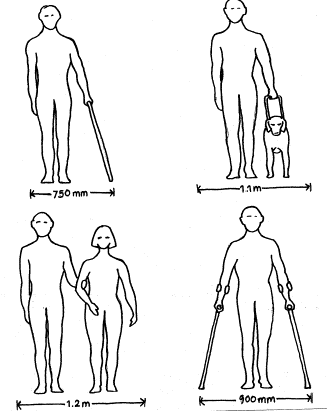 |
Access Standards
For blind, deafblind and partially sighted people even thesmallest barrier in a route can make the whole journey impossible. There is a need for a greater understandingof the access issues affecting blind, deafblind and partially sighted peopleand the solutions that make independent mobility possible.
There are increasing numbers of people offering to provideaccess solutions to meet the needs of disabled people. It is vital that those receiving advice areconfident it covers the needs of all disabled people, including blind,deafblind and partially sighted people, and represents best practice, based onresearched solutions.
Various references are available detailing accessstandards to meet the needs of blind, deafblind and partially sightedpeople. The JMU Streets & ExternalEnvironments specifically includes the needs of blind, deafblind and partiallysighted people.
Several local authorities have developed SupplementaryPlanning Guidance on Access Standards.Agreeing standards on accessibility criteria can help guide futuredevelopments and strategies to improve accessibility. The National Register of Access Consultants will identifycontacts that have met essential criteria in knowledge and experience inproviding access advice.
Walking and Cycling
Walking and cycling are distinct travel modes in their ownright, although some of the concerns may be similar the needs of each aredifferent. Increasing use of sharedfacilities and the increasingly illegal use of footways by cyclists is one ofthe greatest concerns of blind, deafblind and partially sighted pedestrians,limiting independent mobility.
In encouraging walking, and cycling, there needs to berecognition of both users needs. It isclear that the best facilities for cyclists are to make it safer and easier toremain on the carriageway, protecting pedestrian routes for walkers, who mayhave no other independent travel choice.The Government should make it easier to reallocate roadspace to allowthis to happen, and local authorities should be required to demonstrate whycarriageway solutions are not possible if there is any loss of pedestrianamenity.
Monitoring andauditing
Any strategy should also include information on theexisting walking environment in the area and how it is used. Information and data collection concerningwalking is generally poor but there is a need to ensure information is collectedso that the effect of policies can be monitored.
Access and mobility audits can be useful to assess theaccessibility of the pedestrian environment for people with disabilitiesagainst set criteria, either minimum standards or preferably good practice. There are many different ways to undertakean access or mobility audit ranging from an overview to a detailed assessmentwith recommendations on design.Auditing for accessibility could also be built into a more generalwalking audit.
Any audit can usefully involve the participation of actualusers of the environment. For aninitial overview this can help reduce the costs of collecting information andgive greater involvement to local people.It is important to ensure the information reflects the wide range ofneeds of all users including blind, deafblind and partially sighted people.
Some issues affecting accessibility for blind, deafblindand partially sighted people will become more or less important depending onthe time of day or season in the year.For example, concerns about fallen leaves or icy pavements will not beidentified in summer audits.
Audits should include issues like;
functional criteria, like widths and cross-falls
availability of facilities like seating and audiblesignals at road crossings
ease of crossing roads, such as the location ofcrossing points and any diversions, for example created by guard railing
other traffic effects on walkers, such as theprevalence of pavement cycling, parking and over-hanging vegetation
whether the walk is pleasant, such as the quality oflighting and clear sign-posting
Whether the route is well maintained, free of litterand clear of unnecessary clutter.
It may also include specific customer satisfactionsurveys with local blind, deafblind and partially sighted pedestrians tomonitor the effect of changes over time and highlight priority issues.
Information and standards are essential prerequisites todeveloping a strategy to improve accessibility. Once collected this information can be used to guide thepriorities for improving accessibility.Involving local blind, deafblind and partially sighted people inidentifying priorities and setting relevant local targets is essential.
Management
It is not only the physical environment that affectsaccessibility but also how that space is used and managed. Policies on enforcement were mentionedabove. Additionally, issues likemaintenance, street cleaning and waste collection and location policies can allaffect accessibility.
Within the context of the strategy, it is important tohave effective reporting of day to day problems and issues that affectaccessibility. Issues like how toreport defective streetlights or pavement obstructions should be clear,accessible and explained to all users of the pedestrian environment. Some local authorities have establishedtelephone hotlines to report defects and problems and town centre managementapproaches show what can be achieved.
Issues like ensuring drop off point from private hirevehicles are close to important destinations but not blocking public transportaccess is also important.
Promotion andmarketing
It is also important to promote the improvements to thewalking environment. New journeys maybecome possible now accessibility improvements have taken place or from thegreater priority given to walking issues.Promotional material on walking should include accessibilityissues. It should also be accessibleitself, available in a variety of media.
To equip peoplewith skills and confidence to use the pedestrian environment safely andindependently
Losing your sight can be a traumatic experience signallingmajor changes in your day to day life.Being able to get out and travel safely and independently becomes muchmore difficult.
GDBA research states 88% of blind and partially sightedadults claim to never have received any outdoor mobility training despite 84%of those who had saying it gave them the skills and confidence to be moreindependent.
Therefore, the majority of blind, deafblind and partiallysighted people are left to develop their own techniques for ensuring limitedindependent mobility. The JointCommittee actively promotes the greater availability of mobility training for thosewho request it because of the benefits in providing skills and confidence totravel safely and independently.
Mobility training and providing skills and confidence toblind, deafblind and partially sighted people should be an essential componentof a Local Walking Strategy.
Consultation andsupport
The Government wants full and effective publicconsultation and participation and that it should be an inclusive process[vii]. Blind, deafblind and partially sightedpeople are often excluded from traditional consultation methods and techniques,particularly those focusing on print media.Advice on contacting and involving blind, deafblind and partiallysighted people is readily available as highlighted above.
However, in some areas these organisations do notexist. There should be greater supportfor local access groups that bring together people with mobility impairments,including blind, deafblind and partially sighted people, and those with theability to address them to discuss problems, priorities and opportunities on anon-going basis.
Access groups can act as a forum for consultation and haveoften provided invaluable in preparing advice to developers and others on theneeds of disabled people. Targets & Monitoring
Targets are an essential part of a Local Walking Strategyas they can help provide a focus for the strategy and its implementation. Targets must be challenging but alsorealistic.
Taking the strategy step includes further guidance onthe role of targets and examples of good practice. The Joint Committee would advocate specific targets focussing onaccessibility being considered as a sub-set of wider targets.
For example a target considering improvements in publicsatisfaction with the condition of the pedestrian environment, as measured byopinion polls, should ensure the opinions of disabled people can be highlightedseparately.
Further Reading