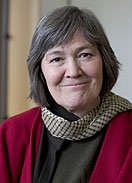
Since her stormy resignation from the cabinet, Clare Short has had a lot to think about. In the run-up to the general election, she tells Elizabeth Stewart about the dangers of a style of government that puts too much power in too few hands.
Diplomat
January/February 2005
Clare Short is in combat mode when we meet for a coffee break in Portcullis House. Listening to the raw frustration of the former development secretary as she catalogues her disappointments in the Labour Government, it strikes me as apt that this double detached extension of Parliament is linked to the old building, not by a bridge, but rather an underground tunnel used by backbench subversives.
Short joined the rebel ranks after her rancorous resignation from cabinet. Savaged by the press for her flip-flopping over the Iraq war, she has emerged defiant, spending her first year of self-imposed exile furiously writing a book to give her version of events – from No 10 blocking her access to intelligence at the time of the controversial September Dossier, and the fudged Attorney General’s opinion on the legality of the Iraq war, to what Tony Blair did to persuade her to stay on in the cabinet.
But the book, titled An Honourable Deception? is more than just an attempt to restore her own political credibility; Short also wants to express her deepening concern over what she sees as the sorry state of British politics in plenty of time before the election. Drawing on her diaries during the fractious period preceding and following the war in Iraq, the book is an insider’s account of the hijacking of decision-making by an inner circle in Blair’s cabinet.
“This very personalised, concentrated power is not just undemocratic, but it’s also error prone,” she warns. “We’ve seen it – spectacularly – in the strategy on Iraq, both in the rush to war and the failure to prepare for afterwards. But I think we’ve seen it in other British policy – from top-up fees to casinos.”
Part of the problem, she argues, lies with today’s voracious 24-hour media, where the telegenic politicians get elected, while their policy advisors concentrate more on massaging the morning headlines than on formulating good policy.
She sees a similar phenomenon in America, where in spite of constitutional checks and balances, power has been captured by what Short disparagingly calls “a little group of neo-cons”.
This concentration of power is even more worrying to her, “because I don’t think American foreign policy is rational. The rational forces in that country were swept aside in the emotion after 9/11 and then, tragedy of tragedies, Britain’s historical influence was just gobbled up into encouraging them into error instead of pulling them back in to rational policy…”
The sort of policy she would have preferred – and which she suggested time and again to Blair – was to concentrate on the Road Map to transform the atmosphere in the Middle East and then get rid of Saddam by indicting him for war crimes. Despite his repeated assurances to her, Short believes Blair came back from Washington empty handed: “I don’t think Blair influenced American strategy on Iraq or the Middle East one jot.”
She predicts that religious fundamentalism will become more of a problem during Bush’s second term, partly because of his new support base, evangelical Christians, who are in favour of a Greater Israel. “Without a big shift in American analysis I am not optimistic that we will get a two-state settlement on Israel-Palestine and that means more trouble and bloodshed and support for the idea of Al Qaeda will continue to grow.”
But for her the real shame is that attention has been diverted from really pressing problems – poverty, disease and global warming – which could have been addressed if the global goodwill following the shock of 9/11 had not been squandered.
It’s a bitter pill for somebody who dedicated six years to international development. “What drives me crazy about this period is that it isn’t all impossible, if there was the political will to concentrate and deal with underlying causes, in an international system that is based on justice and fair rules for all. I don’t think there is any other way to keep order in this complex post-Cold War world. The neo-con view – that might is right – will not create order.”
Part of the remedy is to make the UN more relevant, she says, and she hasn’t ruled out the idea of one day working for the world body. But for the time being, she hopes Britain’s general election this spring might precipitate change. Labour will still win, she says, if only because the electoral system is now heavily biased in favour of a Labour victory. But a hung Parliament is not out of the question either.
“The thing that cheers me up is that the British people are not fooled,” grins Short. The next election might just restore some proper debate to the debating chamber.