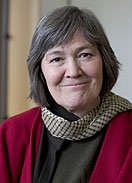
John Hinton meets the former Cabinet Minister who has re-embraced her faith
Article by John Hinton
The Catholic Herald
24 November 2006
Some think that Clare Short went a bridge too far - fearlessly “speaking her truth about Iraq” and what she sees as the authoritarian attitudes struck by the Blair Government. And then, last month resigning the Labour whip, attracting a written rebuke from the Chief Whip and much murmuring of disapproval from Government loyalists and sections of the media.
So, at just 60, she has rather scuttled her political career without the gasps of disbelief she might have hoped for either in the party or the country. But there’s no self-pity evident - the fiery former Cabinet Minister (Secretary of State for International Development 1997-2003) doesn’t go for that sort of thing - and is settling down to serve the remaining two years of this Parliament as an independent member for her inner-city constituency of Birmingham Ladywood which she’s represented for 23 years. As we meet in her office in Portcullis House, Westminster, the Irish-Catholic MP, never far from the spotlight or the television cameras, is clearly waiting for the curtains to start opening on the next act in her story.
“I’m not finished yet by a long way,” she predicts. “I still think there’s some big things in me. Just don’t ask me what.”
One thing there will not be is a return to a Labour Government. That bridge has been comprehensively torched. The socialist cause which she joined all those years ago has had a sea change. Deep down, she (and she thinks many others) have had their core beliefs snipped away, worn down and shredded by a Government that has lost its way in the pursuit of power.
“When I left the Government in 2003 I thought what had happened over Iraq – and it became clear there’d been so much deceit – was so serious that Parliament and the party would take it on board and have debates and discussions and sort out how it had happened and put things right. Instead, the Opposition supported the Government, the House of Commons was fairly crushed. Everything is guillotined and there’s less and less space for people to make speeches and bring up issues, and the Party is not the same Party. The conference is just a rally for the leader. And on the other side of the coin, the then Chief Whip was threatening me, saying ‘You can’t say that Tony deceived people’. And I’m saying, ‘This isn’t personal - this is historical record. This is terribly serious.’
“So I wouldn’t be silent and was therefore a bit of a pariah. And I thought of not fighting the 2005 election but lots of friends said: ‘Come on, Clare, you’ve got to fight and build things back. We need you. Go for it.’ So I did. But we get back; there’s no rally in the Parliament, there’s no corrective, Gordon Brown constantly waiting to take over, Iraq gets worse and worse.” She sighs. “So I thought, no, this is no good; I don’t want to sit around carping. So I said, I’m not standing again and I took this opportunity to say I’ve been under enormous pressure from the Whips and that means I’ll be free to speak my truth, which is that the system’s malfunctioning badly. I think electoral reform is the key to getting proportional representation in the House of Commons. Authority would then come back to the House of Commons and you wouldn’t then have so much power concentrated in No 10 and you wouldn’t have this arrogant, error-prone Government we’ve seen now under Blair.”
With views like that, to say she has become unpopular at No 10 would be an understatement.
“The truth is I’ve lost confidence in the Government. I’m not willing in my remaining time, after 23 years in the House of Commons, to be bullied and treated like a child. I’m just going to be free to spend my concluding time as well as I can, speaking the truth as I understand it and voting as I see fit. And that’s it. That’s my story. But something has gone profoundly wrong. If you can’t say what you think to be true, there’s no point in being in the House of Commons. So I’m not taking it anymore. It’s a sad thing for me because I’ve dedicated my adult life to the Labour Party”.
Indeed, it could be said that the Labour Party became her religion.
“I was a very dedicated Catholic and went to Mass every day – I throw myself into the things I believe in – but then I found out about the Church’s teachings on contraception and found it ridiculous and stopped being a practising Catholic for a time, having been brought up as a Catholic very thoroughly. The church where I was baptised and where my parents (from County Armagh) were married and where I made my First Communion and my Confirmation is in my constituency. And now I take my mum there every Sunday - she’s 86 - because all her other links have got too old. So I now attend Mass every Sunday in the church were I was baptised, which must be unusual in this day and age.
“Now my Catholicism seems to have come round full circle. There were seven of us in the family; I went to the local Catholic school, girls’ grammar school, Keele University and then to Leeds. I left home, then, when I was17 and the doubts were growing before that. I think this is one of the disadvantages of the teaching on, for instance, contraception. And then you begin to think that perhaps the Pope isn’t infallible. And then start to wonder whether God exists. This partly flows from the absolute clarity with which one is taught as a Catholic. I remember when we were children we used to disdain people who were Anglicans because they didn’t know what they believed in whereas we all knew what the teachings were. But now I think that to have an inclusive Church where people can have varying views is stronger than a very dogmatic set of rigid beliefs. I personally think that people are yearning for some spaces of spirituality, of reflection on what is right and removed from greed and materialism, competition and egos. And yet - and this goes beyond Catholicism to all religious traditions - the churches are so stuck with their dogmatic beliefs that it’s irritating people and driving them out of the churches. It’s amazing, there are all these adverts for spiritual weekends, retreats and meditation in former convents and monasteries, and people are going to those sorts of things. I’ve done it myself.”
If the Labour Party became her religion does she now feel badly let down? “I feel incredibly disappointed about what’s happened to the party but I’m not alone. I’ve had thousands of emails. The party is the product of 100 years of history, of people trying to get a more just social order. And Harold Wilson used to say: ‘It’s a moral crusade or it’s nothing.’ Well I think it’s become a power-seeking machine and it’s power for power’s sake. And in this day of spin in politics, truth gets sidelined. It’s very sad.”
She remains a firm social democrat, favouring the European model. “The model for many people is America which has some good things about it, but it’s very unequal and public services are poor. My model is the social democratic countries which have efficient economies, like the Scandinavians - less unequal, beautiful public services and they’re great internationalists; they support the UN and they’re good on the environment”.
“The mesmerising of our political leadership with the American model is very disappointing. My constituency is one of the poorer constituencies in the country. And there are things like tax credits and Sure Start for mums and kids, again taken from the American model. But this model seems to be to prop up the poor in an increasingly unequal country rather than to seek to reduce the inequality and make sure everyone can have a dignified life. So I think we’ve got that wrong. But I think a big corrective is coming. This era of mad consumerism - everything so cheap because of China - will come to an end because the planet cannot provide all this. And that’s right because I don’t think this way of life is making people happy. It’s selfish, crime-ridden and insecure. If we all had to calm down and share what we’ve got a bit more fairly and not be quite as greedy and be a bit kinder to each other and appreciate some of the poetry and music of nature then we’d probably all be happier.”
The chorus of togetherness. And join together in worship? “I like the ambience of Church and I like a lot of people who have struggled with the Church. Many of my friends in the Church have done fine, often radical things with their lives. My own concept of God becomes more and more abstract. I think God is goodness, beauty, truth- all that is fine. And humans have sort of made that into a man in the sky because it’s very difficult to adore an abstraction.”
Her own belief is strong? She smiles. “Yes, it is. I think the meaning of life is to try to be kind and fair and truthful. We’re all full of hubris and greed but in the end it’s beauty and truth and justice that have meaning and last, and make people fulfilled and happy.”
And after the tumult and shouting dies, what lies ahead? “Well, of course the Greeks thought that we all flow back into the ether and I agree with that. I don’t think immortality is the ego surviving. I think immortality is that we go on from generation to generation in our families and that every single person who’s ever lived leaves traces behind, for good or evil. My father’s dead but he’s such a big figure in my life, he’s still in me. As long as I’m alive, he’s alive — and that’s true of all his children. And I’m content with that — I don’t need to be floating around on a cloud. In fact, I don’t find that attractive. I think belief in heaven may be necessary for people who’ve had such an unjust and suffering life throughout history. I understand that completely.”
The MP who gained some notoriety in 1983 by accusing Alan Clark being drunk at the despatch box, takes a sip of water. Clare Short has not been immune from suffering. Briefly married to a fellow student after she became pregnant at 18, she gave up a son for adoption - they were reunited in 1996. Her second marriage to Alex Lyon, a former Labour minister, ended when he tragically died from Alzheimer’s disease in 1993.
“But life is hard for everyone,” she says about the loss. “If you believe that God shouldn’t allow this kind of thing to happen then you would have to blame God, which I don’t. My God is more abstract than that; there are lots of good things in the world.”
Which no doubt she will continue to celebrate as she waits for the curtain to rise on her next act – perhaps to lend her considerable voice to a new cause, relieved to be free from the embattled ranks of New Labour and what she fears it has become.