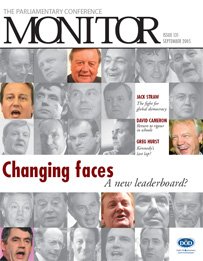
Regular features
 The Oakley Column
Robin Oakley
Voxpop
The government's post-election honeymoon may be continuing but that doesn't go for the prime minister, says Sir Robert Worcester.
Sir Robert Worcester
The year in review
Edward Davie
Party Conference 2005
Changing of the guard
While the Labour conference remains officially about policy, Steve Richards predicts that leadership discussions will dominate behind the scenes.
Steve Richards
Daring to be different
The Tory leadership contenders have been more reticent about their intentions than in previous years, reports Patrick Hennessy.
Patrick Hennessy
The long-haul leadership contest
Greg Hurst says Charles Kennedy's position as leader of the Liberal Democrats is safe for now.
Greg Hurst
The World
Vision and values
Promoting good governance is key to tackling terrorism, writes Jack Straw.
Jack Straw MP
Labour's foreign policy vacuum
Dr Liam Fox sets out Conservative foreign policy priorities.
Liam Fox MP
Time to mothball the gunships
The situation in Iraq demonstrates the dangers of marginalising the United Nations and other regional agencies, says Sir Menzies Campbell.
Sir Menzies Campbell
Divided we stand
Public attitudes towards the Iraq war are shifting away from the White House line, reports Julian Borger
Julian Borger
Casting a shadow over the legacy
It is for Iraq that historians are bound to remember Tony Blair’s premiership, insists Nigel Morris
Nigel Morris
Reaching across the divide
Now is a great opportunity for Britain to use its EU presidency to help guide warring factions in the Middle East to peace, says Lord Janner
Lord Janner of Braunstone
Repatriation: A Guantanamo death sentence
The government must act on behalf of British citizens in Guantanamo Bay, argues Clive Stafford-Smith.
Clive Stafford-Smith
Reporting for duty
Few recent defence secretaries have actually wanted the job but John Reid is an exception, writes Paul Beaver.
Paul Beaver
Out of step
Cuts in the defence budget have had an adverse impact on the training of the armed forces, warns Michael Ancram.
Michael Ancram
Army overstretch
Increasing army commitments while reducing troop numbers could compromise performance, warns Michael Moore.
Michael Moore
Alleviating Africa's agony
Tackling the HIV/Aids epidemic is key to achieving the millennium development goals, writes Gareth Thomas.
Gareth Thomas
Rising to the challenge
Andrew George MP explains why he does not believe the Millennium Development Goal on HIV/Aids is overly ambitious
Andrew George
Africa's forgotten Famine
Lack of HIV/Aids treatments in Africa turn it from a lifelong illness to a death sentence, writes Andrew Mitchell MP
Andrew Mitchell
The calm before the storm
Paul Wolfowitz and John Bolton may have been quiet in the first few weeks of their appointments to international organisations – but it won’t last, writes Ewen MacAskill
Ewen MacAskill
Je ne regrette
Je ne regrette? - Lord Tebbit
As a cabinet minister Norman Tebbit was caught up in the IRA bombing of the Grand Hotel in Brighton, and his wife was paralysed. He served as employment and trade secretaries as well as Tory party chairman under Margaret Thatcher. Now a peer, he was talking to Edward Davie
Home
Shot in the dark
Should there have been a wider public debate on police ‘shoot-to-kill’ procedures before July’s terrible events? Catriona Marchant reports
Catriona Marchant
Doing the terrorists' bidding
Liberty and security are not mutually exclusive, insists Gareth Crossman.
Gareth Crossman
Civil rights and wrongs
The last time mainland Britain faced a terrorist campaign it led to some ill-considered emergency powers, recalls Patrick Mercer
Patrick Mercer
The rhetoric of repression
The prime minister’s proposals for clamping down on extremists threaten existing human rights laws, argues Mark Oaten MP
Mark Oaten
Driving down the demand
Efforts to wage a ‘drugs war’ on suppliers have failed, says Dr Brian Iddon MP, and it is now time to focus resources on treatment programmes for users.
Brian Iddon
Mushrooms misjudged
The Drugs Act 2005 offers a key example of why parliamentarians should not pass laws in pre-election season, argues Paul Flynn.
Paul Flynn
Changing lives
David Cafferty of Merton Council outlines the success of its drugs intervention programme
David Cafferty
Voting with our feet
This year’s Labour Party conference needs to address the problem of declining turnout at elections, warns Geoff Hoon MP
Geoff Hoon
Time for change
The Commons needs democratisation as well as modernisation, says Andrew Stunell.
Andrew Stunell OBE
Custom made
Modernisation must enhance the work of parliament, says Chris Grayling, not just destroy its traditions.
Chris Grayling
Life
Beyond 16
GCSEs and A-levels are here to stay but the gap between academic study and vocational training needs to be narrowed, says Ruth Kelly.
Ruth Kelly
Wading through alphabet soup
Education ministers have experienced 'deferred success' in delivering improvements to the school system, argues David Cameron.
David Cameron
Grades and gimmicks
There is a chasm between ministers' claims and the reality in the classroom, suggests Ed Davey.
Ed Davey
Kelly's credentials
The jury is still out on Ruth Kelly’s stewardship of the DfES, despite a number of reforms she has introduced as education secretary, says Richard Garner
Richard Garner
The importance of early investment
Ministers have failed to make the prgressive case for top-up fees, argues Vidhya Alakeson
Vidhya Alakeson
Lost souls
The number of foster children who fall through the cracks of state care is truly scandalous, says John Blundell
John Blundell
Unseen and unheard
Despite recent improvements, some groups of children are still not adequately safeguarded from abuse, warns David Behan
David Behan CBE
A change of tack
Patricia Hewitt’s approach to the role of health secretary will be radically different from her predecessors, predicts Gaby Hinslif
Gaby Hinsliff
When choice cuts both ways
The NHS must embrace the choice agenda for suppliers as well as consumers, argues Patricia Hewitt.
Patricia Hewitt
Computers: The curse of the NHS?
Another major NHS IT project is experiencing difficulties, reports Richard Sarson.
Richard Sarson
A critical condition
Health professionals need to be freed from government bureaucracy, writes Andrew Lansley.
Andrew Lansley
Cherishing the cottage hospital
Steve Webb exprsees concern that some less successful hospitals may be allowed to close.
Steve Webb
The roots of infection
Tackling MRSA will take hand-washing, not hand-wringing, argues Dr Thomas Stuttaford
Dr Thomas Stuttaford
Down to the last drag
Amanda Diamond examines how Ireland has adapted to the smoking ban
Amanda Diamond
Lights, camera, inaction?
Charles Gant reports on the problems facing the British film industry
Charles Gant
On our marks
Work is already under way to prepare London for the 2012 Olympic Games, writes Tessa Jowell.
Tessa Jowell
Delivering the gold standard
Ken Livingstone explains the benefits Londoners will derive from the 2012 Olympic Games
Ken Livingstone
Under starters orders
Ministers must learn from the past if the 2012 Olympics are to be financially viable, says Theresa May.
Theresa May
Hits and misses
Securing the Olympics was a success but attention must not be diverted from other issues, argues Don Foster.
Don Foster
Curiosity and culture
David Hanson MP explains how the peace process in Northern Ireland has encouraged visitors to the province
David Hanson
A chain reaction
Progress in the peace process has led to a tourism boom in Northern Ireland, writes Alan Clarke
Alan Clarke
Keeping Britain on the move
Alistair Darling outlines the action ministers are taking to avoid gridlock in the country's transport systems.
Alistair Darling