|
Balance of power shifts to Brown
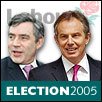
Tony Blair has returned to Number 10, but the influence of Gordon Brown is set to grow during Labour's third term.
The prime minister has begun the process of forming his next government.
And the chancellor will remain next door in Number 11.
But the outcome of Thursday's election will see an increasing degree of influence shifting to Brown.
Blair will seek to press ahead with radical reforms aimed at securing his place in history.
But with a difficult referendum on the EU constitution now looming next spring, defeat could see the prime minister making way for his long time friend and rival long before the end of the "full third term" he has pledged to serve.
Big question
The question of when Blair will step aside and hand over the reins to Brown has been simmering away throughout the election campaign.
Both the prime minister and the chancellor have determinedly avoided giving any kind of answer so far.
But now that the issue is up for debate in the public arena, it is certain to dominate a third Labour term.
Blair's popularity has waned, largely due to the Iraq issue, but also due to the inevitability of a series of niggles and strains after eight years in the job.
Brown, however, looks like being an extremely popular candidate for Labour leader amongst the party faithful and the electorate.
And Brown's central role in the election campaign - promoting the economy and supporting the prime minister - has buoyed the party's support.
Private Labour polling has shown that images of Blair brought a "hostile" response from voters and images of Brown brought "moderate warmth". Shown together however, they inspired greater enthusiasm.
And the chancellor is the darling of the Labour backbenches due to his perceived left leanings and closeness to the socialist core of the party - although as premier he would be unlikely to break radically with Blair policies.
In jeopardy
It is not so long ago that Brown's position in the top ranks looked in serious jeopardy.
With divisions in the Labour Party starting to overshadow the domestic agenda, it was widely believed that Brown would be moved away from the Treasury.
But as the election campaign began, Blair virtually guaranteed that Brown would remain chancellor in the post-election reshuffle.
Following the move, the pair came together to form an unlikely campaign double act.
In a bid to promote Labour's successful record on the economy and demonstrate party unity, Blair and Brown were almost inseparable on the campaign trail - all but holding each others hands at press conferences, poster unveilings, party rallies, and photo opportunities up and down the country.
Even on Iraq, Brown proved to be the ultimate ally.
During a particularly thorny press conference which saw the prime minister grilled over the legality of the war, Brown was steadfast: yes, the Cabinet was fully consulted; yes, the prime minister had his full support; and yes, he would have done the same thing.
The solid show of mutual respect and support has seen both men successfully bury their differences – for the time being at least.
Last term
This will be Blair's last term as leader of the party.
And following a recent interview in the Times, we know Blair thinks Brown "will make an excellent prime minister".
Political commentators are in no doubt that the handover will take place, but the question of when is another matter.
One school of thought is that the referendum on the European constitution could hold the key to the timing of the move.
The referendum could take place as early as spring 2006, and if the country fails to support the government and votes to stay out, this could be the trigger for Blair’s departure.
Conversely, even a result in the government's favour could be seen as a suitable moment for Blair to go out on a high - his promise of commitment to Europe signed and sealed.
It still possible, however, that Blair could stay in his role as premier for up to three years, only stepping aside to allow a sufficient transition period for his successor.
However, Blair and Brown's performance in the election campaign left a strong impression that the transition has already begun.
|