|
Labour to entrench reform and 'respect'
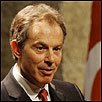 |
| Blair: 11th-hour move to entrench philosophy |
The government has put home affairs, education, health and welfare at the centre of a Queen's Speech based on "reform and respect".
The agenda contains upwards of 50 separate pieces of legislation - some old, some new and some in draft form.
Speaking in the Commons as the debate on the Queen's Speech opened the prime minister said the package was "quintisentially New Labour".
Home secretary Charles Clarke, education secretary Ruth Kelly and health secretary Patricia Hewitt will take charge of the lion's share of the government's forthcoming agenda.
Former home secretary David Blunkett also has a packed in-tray as he settles into the Department of Work and Pensions.
Crime push
Clarke will announce a raft of new measures to "tackle crime and disorder and increase security" at home and abroad.
The government's controversial ID cards legislation is back - along with a draft Counter Terrorism Bill which will be scrutinised by MPs and peers over the coming session.
A Management Offenders Bill will extend electronic tagging, and a new Violent Crime Bill will tackle the growing social ill of drink-related disorder.
Asylum reform will also feature heavily over coming months - with Clarke facing a potential revolt over measures to accelerate the speed of the asylum applications process.
Along with the respect agenda comes a new wave of public service reform.
As the prime minister seeks to secure a Blairite legacy within the UK's public services, the pace of reform will be stepped up over coming months.
Reform
Through a new education bill, parents will be given a "greater say" in their children's education. Local councils and Ofsted will be given new powers to tackle school failure - with successful schools being given powers to take over failing institutions.
Under the legislation, children will be given a pupil profile, to better assess their progress. The law will be changed to allow primary schools to follow secondaries in becoming foundation schools.
Health secretary Patricia Hewitt also secures several key pieces of legislation in this marathon session.
She will be responsible for a Health Bill which will introduce new measures to combat MRSA and make many enclosed public places smoke-free.
After several years of consultation and consternation, the government will also press ahead with new legislation to overhaul Britain's mental health laws.
Despite criticism the government says the legislation, which will give the authorities powers to force treatment upon those who pose a risk to themselves or others, will provide a "modern legal framework".
Welfare
David Blunkett, who has returned to government to seize control of the welfare reform agenda, also snatches a large chunk of the parliamentary timetable.
A new Housing Benefit Bill will target the long-term unemployed - with a new focus on "reducing the barrier to work".
Blunkett will also be charged with reducing the number of people on the long-term sickness register, with a new Incapacity Benefit Bill set to encompass the "rights and responsibilities".
However, in order to address fears among Labour traditionalists, the legislation will underpin the need to provide financial security for those with serious health problems or disabilities.
With a hardline reputation, Blunkett may be forced to find softer edges if he is to persuade Labour's backbenchers to back the most radical of the welfare reform proposals.
Speaking this morning he said the government wanted to create a consensus around the proposed changes.
"Don't believe for a minute that the reform of the welfare state for the 21st century is somehow punitive. It is not," said Blunkett.
"It is about 50 years on taking a real look at what people want in their own lives."
Other measures
Elsewhere in the bumper Queen's Speech, business is being wooed with the prospect of a reduction in red-tape through the Regulatory Reform Bill.
A Company Law Reform Bill will be brought forward, to reduce regulations on small businesses.
The Consumer Credit Bill, which fell as Parliament was dissolved, will also be reintroduced during this session.
Alistair Darling will introduce a Road Safety Bill, with Lord Falconer securing time to overhaul the legal aid system.
Following the Richard Commission recommendations, the government will also introduce legislation to enhance the powers of the Welsh legislative assembly.
An NHS Redress Bill will overhaul the burgeoning NHS compensation system and the Charities Bill will re-emerge this session.
But the long-awaited Corporate Manslaughter Bill does not appear in full, and Lords reform will be subject to further consultation through a new committee of MPs and peers.
Historic
Labour hopes the long list of bills will prove it has not run out of steam as it enters a historic third-term.
The prime minister also hopes that the speech will suggest he has much to offer the country as he begins his bid to serve a full third term in office despite a significant reduction in his majority.
However it will not be plain sailing for the government. Several bills will incur the wrath of rebel MPs and peers.
They will warn that Labour must remain true to its values, will be hesitant to back far-reaching public service reforms and will warn against draconian law and order measures.
Human rights groups have already spoken out strongly against the government's decision to reintroduce ID cards legislation.
Shami Chakrabarti, director of human rights group Liberty, has condemned the plan. "This rehashed ID card scheme is more about political machismo than rational policy," she said.
"It takes pride of place in yet another Queen's Speech; long on tough talk and authoritarian controls and pitifully short on positive ideas."
That position will be taken up by Labour rebels as they seek to keep the prime minister on the ropes over the coming session.
However government whips hope that the Conservative leadership election will act as a distraction from any internecine battles as the prime minister fights to push his plans through in what could be his last 18 months in Number 10.
|


