|
Education vital to economy, say Blair and Brown
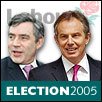 |
| PM and chancellor: United front |
Tony Blair and Gordon Brown have continued their joint election campaigning, launching the economic and education chapters of Labour's manifesto.
The prime minister and chancellor have made a series of joint appearances in recent days, seeking to boost the party's campaign and put reports of divisions behind them.
At a press conference on Monday, Blair said education and the economy were two sides of the same coin.
"These two topics are linked. A strong economy is an essential part of making investment in education in the future," he said.
The party published an economic pledge card, setting out five key promises.
Labour is promising a two per cent inflation target, one million more homeowners, one million more people benefiting from the New Deal, a rising minimum wage, education spending rising to £5,500 per pupil per year by 2008, and 300,000 apprenticeships.
British way
Brown said Labour had created "a British way to stability, employment and long-term investment".
"Now, facing the fastest and most far reaching global changes the world economy has ever seen, our task is to ensure security and prosperity not just for some, but for all the hard-working families of Britain," he said.
"Unemployment is, today, half that of France and Germany and lower than the USA as we advance to full employment for the first time in our generation.
"In the next parliament, one million more men and women will be helped by the New Deal for jobs and skills, as we both tighten up compulsion and widen opportunities for work."
Life-long learning
The chancellor also said that under Labour the "education leaving age" would rise to 18 - though he said this was not the same as the "school leaving age".
"To meet Asian competition and the China challenge, the task of government is to equip people to meet and master change not to stop the clock or walk away," he said.
"Most of all, to develop the skills of every person, we will create a total of 300,000 apprenticeships and introduce the first national employer training program for adults.
"No teenager should be without skills. Universal education from five to 11 was achieved in 1893. Universal education from five to 14 in 1918, to 15 in 1947 and to 16 in 1972.
"But for 30 years as the world has moved on, the span and reach of education have remained the same.
"In the coming parliament the education leaving age will rise to 18.
"With nursery education starting at three, and part time or full time education and training until 18, education is now on offer not for 11 years as before, but for fifteen years."
Education plan
Ruth Kelly, the education secretary, told the press conference that Labour would continue to invest in schools and universities.
There would also be reforms to drive up standards and give schools more freedom to take their own decisions.
"To achieve all of this, we need parents to have more power within the schools system; for parents to enjoy a genuine partnership with their children's school not just a passing acquaintance; to help drive up standards and make the system more tailored – more personalised - to the specific individual needs of each pupil," she said.
"Britain's future generations – of children, of parents, of teachers - can not afford to take a risk on the Conservatives."
Tax
However Labour's strong economic record has been hit by the crisis at MG Rover, and a MORI poll in the FT which found that nine out of 10 finance directors believe that taxes on business will rise if the party is re-elected.
More than half of respondents also feel the party would not improve the economy.
Of those questioned, 58 per cent said they would vote Conservative, compared to 26 per cent Labour and 14 per cent Liberal Democrat.
Tax pledges did not feature in the economic manifesto, with Brown promising they would be made clear in the full party policy blueprint set to be unveiled on Wednesday.
Criticism
Following the comments, the Conservatives said ministers have failed to match rhetoric with reality.
A rebuttal document from the Tories said that over a million children continue to play truant every year.
And it said there is an assault on a teacher every seven minutes, while one in three 11-year-olds leaves school unable to write properly.
"Mr Blair's claim to be putting 'parent power' at the heart of his manifesto contradicts his own measures which became law last week," added the Conservatives.
"The new Education Act takes significant powers away from parents, ending their right to be involved in the inspection process, and scrapping annual school parents' meetings and parents' school reports.
"Under Mr Blair, good schools are prevented from expanding, denying choice to many parents. In one year alone (2003), 93,000 parents made appeals against the school their child was allocated – only 24 per cent were upheld."
|


