|
Cabinet unveils third-term manifesto
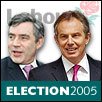 |
| Blair and Brown: United front |
Labour has unveiled its manifesto, promising a radical package of reforms and tax cuts for "hard-working families".
The theme of Labour's bid for re-election is "Britain forward not back," through the empowerment of parents, patients and the public as a whole.
Launching the document, Tony Blair said the manifesto offered a "big vision" for the people of Britain.
Flanked by Gordon Brown, John Prescott, Patricia Hewitt and senior members of the Cabinet, the prime minister said the document was "quintessentially New Labour".
"This manifesto has specific, detailed costed policy in it," said Blair. "I believe this country is better, stronger, fairer than the country we inherited in 1997."
The prime minister told journalists he wanted to establish a "progressive consensus" around core New Labour values.
The chancellor, tipped as Blair's heir apparent, said he was committed to "diversity of provision" across all public services.
A contract
In a preface to the 110-page document, Tony Blair hails "a contract delivered" between himself and the British people.
Bidding to be given a third and final term to deliver a lasting legacy, Blair added: "So now, I fight my last election as leader of my party and prime minister of our country.
"My call is a passionate one: let's together make irreversible the positive changes that are happening in our country.
"Let's make the values of social justice and a fair deal for all the governing ideal of our country not just for some time but for all time.
"People freed from barriers of class, building a better future for themselves and for the country. Self-interest and national interest together."
Economy
Following this week's rapprochement between the prime minister and chancellor, the economy forms the centrepiece of the manifesto document.
"We will never return to the stop go of the past. We can ensure rising living standards for all," Blair said.
Labour hopes it can contrast today's document, which runs to nine chapters, with the 32-page booklet published by Tory leader Michael Howard.
But tax commitments will come under close scrutiny following Gordon Brown's failure to rule out any increases after the election.
The manifesto confirms that there will be no change to either the basic or upper tax rate – leaving the chancellor room for an increase in National Insurance or other 'stealth taxes'.
Labour is also pledging targeted tax cuts for families and vows not to levy VAT on food, children's clothes, books and transport.
Through the careful management of the economy, the party claims it can deliver year-on-year increases in spending on public services.
Education features highly in the manifesto, with a pledge to divert savings from reducing the unemployment bill to schools and colleges.
Parents
The legislative blueprint gives parents more control over their children's education by offering them the ultimate sanction of ousting the management of failing state schools.
Parents would be given the power to demand an immediate Ofsted inspection, and Labour will mount a new push on school discipline through greater links between parents and teachers.
In one of the most radical third term proposals, parents will reserve the power to close their local school if it continues to fail pupils.
Labour also confirms there will be no real terms increases in student top-up fees beyond their current levels.
To tackle the skills gap, the manifesto includes a commitment to create 300,000 more apprenticeships across the country.
It also details plans to expand the network of city academies throughout England and Wales.
Measures to expand childcare will also form a key plank of Labour's bid for a third term in government.
Back to work
The manifesto also signals a renewed commitment to get people back into work – with a more rigorous programme for those unemployed for less than 13 weeks.
"In the next parliament, for those in their first 13 weeks of unemployment we will test and then extend widely a jobseekers agreement with new work search requirements and more regular signing on," the chancellor said.
Further reforms of the welfare state can also be expected early in any third Labour term.
The government has stopped short of offering any firm commitments on pensions reform – holding back any judgement until the review headed by Adair Turner is published later this year.
Despite the looming crisis, ministers are said to be unpersuaded of the need for compulsion in the pensions system.
"We need to forge a national consensus about how we move from a pension system designed for today’s pension problems to one that is right for tomorrow's," states the manifesto.
Surprises?
The manifesto contains few real surprises and, despite recent rhetoric, could fall short of the radical agenda some within the party were pressing for.
Amid claims of a divide between the chancellor and elections supremo Alan Milburn, senior sources have insisted the manifesto will accelerate the pace of reform.
Labour hopes it can now "go positive" after mounting a full-on assault on Conservative tax and spending plans over the last 48 hours.
Despite his initial opposition, the prime minister appears to have been persuaded to detail a commitment to further reform of the House of Lords.
A future Labour government will codify the key conventions of the second chamber, the manifesto says.
"We will remove the remaining hereditaries and allow a free vote on the composition of the house," it reads.
On health the government is pledging new measures to combat issues such as obesity through a public health bill – which will contain a watered down commitment to restrict smoking in public.
The prime minister said he wanted to deliver year-on-year investment to offer patients choice.
Iraq effect
Those who turned their backs Labour following the Iraq war are being wooed back with pledges to increase efforts to tackle HIV/Aids in the developing world.
The document also commits Labour to new moves to restrict arms exports and, a renewed commitment to end trade subsidies which damage the African economy.
The party HQ estimates that up to three million of its voters could defect in protest at the Iraq conflict and believes that global commitments to fair trade and development will be crucial in wining them back before May 5.
Union critics will also be placated by implementation of the "Warwick agreement" on workers rights, including extensions of paid maternity and paternity leave.
|


