|
Scottish campaign set to swing into action
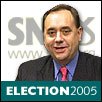 |
| Alex Salmond: Facing poll challenge |
Scottish Labour is preparing to fight the election on new boundaries but is confident that it will see off challenges from the Conservatives, the SNP and the Liberal Democrats.
Labour can expect to emerge from the election as by far the biggest party in Scotland although the Scottish Conservatives are pinning their hopes on a few seats.
While in 2001 the party clawed back a single seat with Peter Duncan’s victory, some fear the forthcoming election could see Scotland once again become a Conservative-free zone.
In the Tories' key battleground seat, Duncan and neighbouring MP Russell Brown are going head to head. Following the post-devolution reduction in Scottish constituencies, both MPs see their seats rolled into a new Dumfries and Galloway constituency.
On paper, Duncan is defeated - with the party admitting that, notionally at least, the new constituency is a Labour-held marginal.
Throw the nationalists' Douglas Henderson into the pot and a potent mix of electioneering is in prospect.
Pessimism?
But around the rest of the country, the Conservatives are less confident that they can reverse the trend.
The party secured three seats in the last Holyrood elections, but the new boundaries look set to work against them.
David Mundell has the hopes of his party on his shoulders in the new seat of Dumfriesshire, Clydesdale and Tweedale, although the MSP will have to overcome a 5,000 notional Labour majority to outpoll Labour hopeful Sean Marshall.
Labour, which outmanoeuvred the Conservatives when the boundaries were up for review, effectively holds 46 of the 59 new constituencies.
The only realistic way the Scottish political scene could shift significantly is if opposition parties successfully portray Labour as the ‘establishment’.
The logic then suggests that mobilisation of the anti-establishment movement could increase tactical voting and see Labour with problems in 12 ‘risky’ seats.
Of the dozen in the danger zone, the Conservatives rank second in five.
Labour marginals
Russell Brown is defending a majority of just 141 but it would take a more significant swing for Labour to see an upset in the Edinburgh South constituency where Nigel Griffiths is defending a majority just shy of 6,000 in the ‘three-way marginal’.
Elsewhere the Scottish Socialists hope to chip away at Labour’s West Coast fiefdoms - replicating their success at the Holyrood election. The combination of the war - and the Blair factor - could add momentum to their bandwagon.
The Liberal Democrats also pose a risk to their Holyrood coalition partners. The party’s five key targets are all Labour-held - with David Stewart defending a notional majority of just 1,100 over the Lib Dems’ candidate Danny Alexander in Inverness, Nairn, Badenoch and Strathspey.
But barring an upset of biblical proportions, Labour’s dominance will be maintained when Scottish MPs are sworn in after the expected May 5 election.
It is the future of the Scottish Conservatives and the SNP which are more curiously entwined.
SNP worries
Three of the Tories’ six target seats are currently held by the nationalists. Michael Weir (Angus), Angus Robertson (Moray) and Pete Wishart (Perth and North Perthshire) would lose out if the Conservatives are seriously on the march.
In Ochil and South Perthshire, now a Labour marginal, nationalist MP Annabelle Ewing has a fight on her hands to keep her Westminster career alive. The potential exists for Alex Salmond to become the sole SNP torch-bearer.
Conversely, if Salmond can muster an unexpected nationalist upturn, the party could win in Dundee East, where Iain Luke has a majority of under 500.
|


