|
Parties prepare for campaign battle
The key question of the election is: 'Can they can spin it to win it'.
Alastair Campbell is back, Tony Blair has been consulting Peter Mandelson, and the Conservatives have drafted in Australian PR guru Lynton Crosby.
Throughout this general election campaign, ePolitix.com will be looking at the ways in which all the parties are seeking to get their messages across to the public.
They face an uphill struggle in seeking to engage with an electorate which appear less and less interested in what Westminster's politicians have to say.
And those who do listen appear to be doubtful about the honesty and truthfulness of the claims and counter-claims that are made.
How to deal with this problem is something which has been taxing the brains of party officials ever since turnout at the 2001 general election collapsed to just 59 per cent.
But the tone of the campaign so far has been relentlessly negative, with accusations of lying and bigotry flying back and fore between Labour and the Conservatives.
The Liberal Democrats have stepped back from the rows, hoping that while they gain less media attention as a result, they will be rewarded with greater respect from the public.
Direct access
Given the importance of the media to modern political campaigning, the use of modern campaigning techniques could have a major impact on this election's outcome.
Much of the time, the words and policies of the parties are filtered through the media.
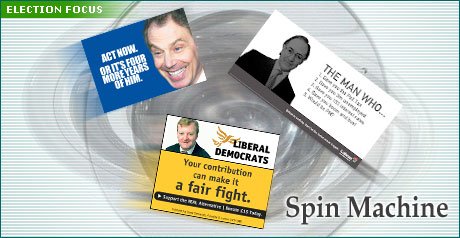
But at election time, the television broadcasts, the posters and newspaper adverts provide an opportunity to convey policies and positions directly to the public.
So far, the main outcome of these attempts at speaking directly to the public has been to simply stir up further controversy.
Labour got off to a bad start when one of its poster - showing Tory leader Michael Howard, who is Jewish, in an image with similarities to depictions of Fagin - led to accusations of anti-Semitism.
Elsewhere, the Conservatives have also been stirring up controversy with posters of their own.
And last week, the party took out full-page adverts in regional papers saying violent attacks had risen substantially in particular areas.
But several chief constables said the figures used were misleading because the way crime statistics were collated had changed, making reliable comparisons impossible.
Complaints
So the first signs are that during this campaign the election materials of each party are set to come in for particularly close scrutiny.
This is particularly important given that political parties are not covered by the usual rules which require adverts to be "legal, decent, honest and truthful".
Up to February 21, the Advertising Standards Authority said it had received nearly 40 complaints from the public about political advertising.
These complaints will not be investigated by the ASA, though the watchdog has said that after the election it will provide each party with a summary of any complaints received about their advertisements.
Members of the public wishing to complain about political advertising should lodge their objections directly with the advertiser concerned, recommends the ASA.
|