|
Blair and Brown woo business vote
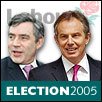 |
| Blair and Brown: United front on business |
Labour has launched its business manifesto in a bid to refocus the election agenda to the economy.
The prime minister was joined by chancellor Gordon Brown and trade secretary Patricia Hewitt at a press conference on Thursday to highlight their third-term plans for enterprise.
However the event was overshadowed by the latest revelations on the government's Iraq war legal advice.
Labour's manifesto claims the party wants to "make Britain the best place to do business", with a package of support for skills, small firms, science and manufacturing and £180bn investment in transport.
Tony Blair outlined the threat posed by rising economies such as India and China.
"Between them, these two countries produce 125,000 computer science graduates every year - more than twice the whole of the EU," he said.
However he added that: "British businesses can rise to these challenges, competing successfully in an ever more prosperous economy.
"Businesses, not government create wealth. However I don't accept the Conservatives' view that government has no role."
Stability
Blair and Brown promised to put economic stability first and maintain Labour's reputation as "the party of enterprise".
"It is not a reputation that we intend to lose. So unlike the Conservatives we will not put that stability at risk," the prime minister said.
"Unlike the Conservatives, we also know that the only way we are going to succeed in the future is to invest in education and skills."
The skills agenda is a key plank of Blair's offer to the electorate, with a commitment to keep all 17-year-olds in education or training and boost basic numeracy and literacy.
Brown announced a 50,000 increase in apprenticeships to 300,000 by 2008.
Science
He has also made science an economic priority, with research tax credits and legislative protection against animal rights extremists.
Amid criticism of the government's "excessive regulation" since 1997, the party has also pledged to "rationalise business inspection" and cut red tape, with one million fewer inspections.
"The path to economic prosperity is not to turn the clock back to the old short-termism, not to limit access to training and education, but to entrench stability and open up skills and opportunity so that tomorrow's workers are not only better equipped, but that Britain becomes the country with the best educated and best trained workforce in the world," Brown said.
"And the reason Britain faces a choice at this election is that these two central pillars of our economic future - the platform of stability and the role of investment in our economic future - would be put at risk by the Conservative plan to cut £35 billion from public investments such as training, science and infrastructure and risk economic instability by their immediate plans to spend more, tax less and borrow less."
Unveiling Labour's latest campaign poster on the economy earlier, Blair said: "The choice could not be clearer: between a Conservative Party with an economic plan which would return us to economic instability, higher interest rates, higher unemployment; and a Labour economic programme that builds on the stability of the past few years and delivers rising living standards for all and a stable economy with which we can meet the challenges of the future."
Subsidies
However, the government is also committed to extending free trade and opening up new markets for exporters, posing a potential risk to some manufacturers.
Labour is offering more regional development support in manufacturing areas, but has refused to bail out British firms such as MG Rover.
Speaking to the British Chambers of Commerce annual conference earlier this week, Brown said: "Britain's future success depends upon making the right long-term choices and the role of government is not to stop the clock against change or to subsidise loss makers.
"In a global economy, the role of government is to create and sustain the stability and competitive environment, in which the entrepreneurial, the talented, and the dynamic can rise and succeed."
"I want our government at all times to be on the side of businessmen and women as they start up, look for finance, look to set up their first payroll, hire their first employee, make investments and look to get equity into their company," the chancellor added.
|


