|
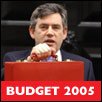
PM and chancellor stage show of unity
Tony Blair has joined Gordon Brown to unveil the latest Labour poster campaign as the election battle turns to the economy and public services.
Following Thursday's Budget Labour sought to regain the initiative with the latest show of unity between its two biggest hitters.
The posters contrast Labour's spending plans with £35bn in Tory cuts - although the prime minister came under heavy questioning about the veracity of his claims.
Brown insists that the Tories' spending plans would amount to the party "sacking every nurse, every teacher and every doctor".
In contrast the chancellor said he was offering a prudent and balanced Budget to the country.
"All my spending plans are affordable. We meet all our fiscal rules," he told GMTV.
Election focus
Following Wednesday's Budget, the election battle is continuing as political parties row over which has the best economic policies for the country.
After weeks of argument over issues such as the NHS, crime and immigration, Labour will be hoping that Wednesday's statement from the chancellor will mark the turning point in the party's so far lacklustre re-election campaign.
The Conservatives, meanwhile, are using statement to warn that Brown will have to put up taxes after the election.
And the Liberal Democrats have set out their own alternative agenda, promising fully costed spending commitments.
Budget details
The chancellor targeted pensioners, low-income families and young workers seeking a place on the housing ladder as the beneficiaries of his Budget.
Brown put his party on a pre-election footing by unveiling a populist but prudent blueprint for the economy and public services.
He told MPs that inheritance tax thresholds would rise from £260,000 this year to £300,000 by 2007, and announced a £200 council tax rebate to all pensioners.
The chancellor also boosted the take-home pay of low and middle-income families and pledged to help more young people enter the housing market, increasing the tax exemption on stamp duty from £60,000 to over £120,000.
He told MPs that Britain has experienced "the longest period of sustained economic growth in history" - meeting the forecast figure of 3.1 per cent in 2004.
Rejecting suggestions that he would need to put up taxes, Brown said he was on course to meet his "golden rule" on government borrowing.
"We are meeting both our fiscal rules, both in this economic cycle and next," the chancellor told MPs.
He said those who forecast recession and who questioned his spending plans had been "consistently wrong".
Pay later
Conservative chief Michael Howard urged voters not to trust the chancellor's figures.
"This is the vote now, pay later Budget," he said in the Commons.
Invoking the run up to Iraq war, the Tory leader said Brown's data was "dodgy".
"They hide the crippling tax rises for hard working families that are inevitable if Labour wins," he said. "They hide the huge burden of regulation of small businesses."
Howard argued that Labour could not be trusted on tax in the run-up to the general election.
"This chancellor has got form: 2001 was vote now, 2002 was pay later," he said.
"In his 2001 pre-election Budget this chancellor cut taxes by £1bn. In his 2002 post-election Budget he raised taxes by £8bn."
"This dodgy government, which brought us the dodgy dossier, is now passing a dodgy Budget based on dodgy figures," he added.
Appealing directly to voters, he said: "The only question is which taxes will go up under Labour.
"To fill the chancellor's black hole he will have to tax your income by three pence in the pound."
"Britain needs a government that will get a grip on spending, not a Labour Party that has let spending get out of control," Howard concluded.
"People will face a clear choice in the election: more waste and higher taxes under Labour or lower taxes and value for money with the Conservatives."
'Missing the point'
Charles Kennedy said the chancellor had "missed the point" with his council tax rebate for pensioners.
"This Dutch auction between the Labour and Conservative parties on council tax is missing the ticking bomb that is coming down the track which is council tax revaluation."
"The sensible thing to do is to introduce local taxation based on people's ability to pay," he said.
The Liberal Democrat leader also suggested that the chancellor was not being straight with people on tax and spending.
"If we want to tackle injustice and inequality you've got to be straight with people and say what it's going to cost and where it's going to come from.
"I'm not interested in a general election debate which is predicated on nonsense that people don't believe 'vote for us and tax will go down and spending will go down and the sun will shine 24 hours a day.' People aren't stupid. What they want to know is what your priorities are."
"The chancellor and the leader of the Opposition can be two ships that pass in the nights while the Liberal Democrats will actually address the agenda that matters most to people," he added.
|