|
Blair and Brown 'scorched' by Labour MPs
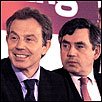 |
| Blair and Brown: Relations at all time low |
The prime minister and chancellor have been warned by Labour MPs that they must end their feud and get on with the job of winning the next election.
Both men appeared before a meeting of the parliamentary Labour Party on Monday night - where a string of MPs spoke out angrily against the latest round of bloodletting.
And today in a bid to present a further show of unity the chancellor will appear alongside Cabinet rival Alan Milburn at a poster launch.
The unity bid follows heated exchanges at the PLP meeting - where both Blair and Brown were given a dressing down by rank-and-file MPs.
Labour's Paul Flynn said the prime minister and chancellor were Tony Blair and Gordon Brown both given "a scorching".
"It was a Parliamentary Labour Party meeting like no other," he said.
A former minister said after the meeting: "They [Blair and Brown] looked chastened. The PLP was banging their heads together. Blair looked surprised by the intensity of the onslaught."
Dale Campbell Savours, a peer, called on the chancellor to deny a claim that he no longer trusted the prime minister - warning that it was likely to feature on Conservative election posters.
The Labour veteran Clive Soley said the people briefing on behalf of both the prime minister and chancellor should be named, while Angela Eagle said the splits suggested that Labour was taking victory for granted.
One MP said after the meeting: "The knives are out for the chancellor; one went between his shoulderpads tonight."
Rift
MPs are said to fear that the on-going rift could cost Labour votes at the looming general election.
Speaking on Monday morning, health secretary John Reid admitted that Labour had to focus on policy and not personality - warning that voters "won't easily forgive us" if ministers are diverted by internal splits.
"I just think that the government ought to be getting on with what we were elected to do," he said.
"I certainly know that is what the Labour Party members in the country, and the millions of people who depend upon us to have a decent way of life, that is what they expect us to do."
The peace bid comes after the chancellor rejected claims that relations had broken down between himself and his boss.
In a hastily convened interview with the BBC, Brown sent a peace offering to Number 10 following a damaging weekend of newspaper headlines.
"Nothing will distract us from the fundamental unity that is needed and the shared purpose that is imperative for both the future of the country and the future of the Labour Party," he said.
Claims
The intervention came after the prime minister denied fresh reports that he reneged on a deal to hand over the reigns of power to the chancellor.
A new book claims that Tony Blair last year backtracked on a renewed commitment to stand aside in favour of his chancellor.
Journalist Robert Peston, who is close to the chancellor's camp, argues that Blair agreed to hand over to Gordon Brown in November 2003 after conceding he had lost the trust of British voters.
It is reported that Blair wanted to pre-announce his decision - although he was persuaded against such a move by the chancellor who feared his colleague would become a "lame duck" leader.
Blair later reneged on the commitment to stand aside in autumn 2004, the Peston book asserts.
The claims, however, have been dismissed by the prime minister.
Speaking on the BBC's Breakfast with Frost, Blair said: "I am simply not going back over things I have answered many many times before.
"I have dealt with this six months ago. I said then that you do not to deals with jobs like this."
The book, serialised in the Sunday Telegraph newspaper, claims that the prime minister repeatedly misled the chancellor about his intentions.
Pressure
It is claimed he decided to stay on as Labour leader after the local and European elections last year and following pressure from key Blairite ministers including Lord Falconer, John Reid and Patricia Hewitt.
That decision, which followed a party conference clash between the prime minister and the chancellor, led Blair to incur Brown's fury when he announced he would serve a full third term last October.
The chancellor is reported to have told Blair: "There is nothing that you could say to me now that I could ever believe."
The prime minister, however, remains dismissive about "reheated" speculation surrounding his relations with the chancellor.
"You have got a choice in this situation. You can either go over the next explosive book before the next explosive book that will no doubt come in the next few weeks," he said on Sunday.
"Or you can do what both of us are doing, which is actually concentrate on the issues that concern the country."
But Blair also warned the chancellor and his aides that he intends to secure a full third term in office.
"I am fighting the next election. I am going to stand, and I have said this, for a full term. That is what I intend to do," he added.
Fighting it out
The renewed claims have led to fresh anger amongst Labour MPs who fear the crisis at the heart of government could undermine the party's electoral hopes.
Speaking on Sunday former Labour minister Frank Field said: "What sort of model does it give to the nation when the two most important political leaders do nothing but fight it out together or use their aides to fight it."
Meanwhile the Conservatives have sought to capitalise on the feud claims.
"We have Britain’s two most important politicians squabbling like schoolboys. It is the politics of the playground," Michael Howard told Sky News.
"If the government was a company, with the chairman and chief executive at war with each other, the shareholders would sack them.
"I hope that’s what the British people will do at the general election."
The Liberal Democrats also expressed disquiet about the rift at the heart of the Labour government.
"The personal ambition of Blair and Brown now seems to be getting in the way of good government," said party chairman Matthew Taylor.
"Either they need to grow up and put their squabbles to one side or they cannot expect the electorate to support a divided government at the next election."
|


