|
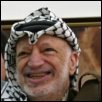
Tributes paid as Arafat dies
Following days of speculation about his health it has been confirmed that Yasser Arafat has died.
The 70-year-old Palestinian leader had been in a Paris hospital for over a fortnight. He suffered a brain haemorrhage and was reportedly kept alive on a life support machine over recent days.
Tony Blair expressed his sympathy with the Palestinian people - who will now begin the search for a new leadership.
"I would like to express my condolences to the family of President Arafat and to the
Palestinian people," he said.
"President Arafat came to symbolise the Palestinian national movement.
"He won the Nobel Peace Prize in 1994, jointly with Yitzhak Rabin, in recognition of their efforts to achieve peace in the Middle East.
"He led his people to an historic acceptance of the need for a two-state solution.
"That goal of a viable Palestinian state alongside a secure Israel is one that we must continue to work tirelessly to achieve.
"Peace in the Middle East must be the international community's highest priority.
"We will do whatever we can working with the US and EU to help the parties reach a fair and durable settlement."
Controversial to the end
Few leaders on the world stage have inspired levels of as much loathing and devotion as Arafat.
World leaders and the Palestinian public are now left to comprehend what it might mean for peace in the Middle East.
Depending on how the Palestinian Authority copes with the loss of its leader and figurehead, Blair may feel there is now a better opportunity to achieve his goal.
But without its figurehead Palestine may struggle to control terror attacks against Israel and scupper peace hopes.
Arafat has been blamed for prolonging the conflict by failing to sign the peace deal at Camp David as President Clinton tried to broker a settlement during his last days in office.
However without Arafat's constant pushing, and resorting to violence, it is doubtful whether the need for a viable and independent Palestinian state would have been as accepted as widely as it now has been.
Life and death
The man who came to symbolise the Palestinian cause was born near Jerusalem in 1929 to a successful merchant father and a religiously devout mother.
As a teenager in the 1940s, Arafat became involved in the Palestinian cause, smuggling weapons into the territory before the Arabs were defeated by Israel in 1948.
After the war, Arafat studied civil engineering at the University of Cairo in Egypt.
He headed the Palestinian Students League and, by the time he graduated, was committed to forming a group that would free Palestine from Israeli occupation.
In 1956 he founded Al Fatah, the Movement for the Liberation of Palestine.
He claimed to have fought for Egypt during the Suez crisis and the following Arab-Israeli war.
Certainly, his expertise in explosives and demolition held him in good stead as Fatah's operations grew increasingly militarily orientated.
By 1967, Israel had defeated its Arab neighbours and captured the West Bank and Gaza.
Fatah became the main opposition and Arafat became the leader of the Palestine Liberation Organisation.
Initially based in Jordan, Arafat and his fighters were expelled in 1970 and were exiled to Lebanon, and later Tunisia.
While his people launched an uprising, or intifada, on the West Bank in 1987, Arafat remained in exile for 27 years.
Isolation
He was politically isolated in the Gulf for supporting Saddam Hussein when he invaded Kuwait in 1990.
But in the 1990s he began negotiations with Israel's then prime minister Yitzhak Rabin, leading to the Oslo Accords that earned both men the Nobel Peace Prize.
Rabin was assassinated in 1995 and despite the efforts of President Clinton the situation slowly deteriorated.
When future Israeli prime minister Ariel Sharon made a provocative visit to holy sites in Jerusalem in 2000 it sparked a new intifada, backed by Arafat as an alternative to further talks.
Sharon accused him of instigating terror on Israeli streets, and Arafat was confined to his Ramallah headquarters for three years.
He was only allowed to leave when the Israelis agreed to let him visit Paris in his dying days.
As he managed a weak wave from his helicopter on his way to France many believed he would never return to Palestine alive.
His Palestinian critics have accused him of running a corrupt administration and making too many concessions, but most will find it hard to move forward without the iconic figure.
The Israelis and the Americans have viewed him as an impediment to peace, and will now hope his replacement is prepared to enter talks and make concessions.
Arafat's statement to the United Nations General Assembly of 1974 sums up the ambivalent nature of this complex leader.
He told delegates that he had come "bearing an olive branch and a freedom fighter's gun".
"Do not let the olive branch fall from my hand," he said.
|