|
Parties gear up for pre-election Queen's Speech
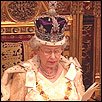 |
| The Queen: Set to announce government's plans |
The government is today set to put the country on an election footing with a Queen's Speech designed as a launchpad for a third successive Labour victory.
With just five months to go before the expected May 5 general election, ministers want to grab headlines on areas such as crime, transport and education.
It is thought there will be 37 bills - with several appearing in draft form.
Under a new parliamentary practice procedure three bills will be carried over from the last session.
Central to the government's plans will be the theme of security both at home and abroad.
That will put David Blunkett at the head of the pack with six pieces of legislation.
Commenting on today's speech, Commons leader Peter Hain dismisses claims that ministers are "legislative junkies".
He argues that it is "important that we defend the positive power for good that government can and should be".
The Queen will formally deliver the speech, which is written by the government, in the House of Lords shortly after 11.30am.
Following the pomp and pageantry, the political rough and tumble will take over this afternoon when Tony Blair and Michael Howard lock horns over the government's legislative agenda.
Election move
Central to today’s speech will be a drive to tackle crime and improve education.
But new measures to boost childcare and reform the education system may also feature in today’s parliamentary set-piece event.
The Home Office appears set to be the undisputed winner when the legislative time is handed out.
While controversial measures to establish special courts to try terrorists will be held over until after the election, David Blunkett will have a busy few months in parliament ahead.
Ministers are expected to unveil legislation to create safer neighbourhoods as they seek to step up their drive against anti-social behaviour.
Contained in the legislation will be new powers to extend fixed penalty notices and the remit of anti-social behaviour orders will be extended to cover drug treatment.
More controversial will be legislation to enact Blunkett’s plans for a system of compulsory ID cards. They are expected to come into effect in 2008.
Whilst the home secretary says the legislation will combat terrorism and identity fraud, civil liberties groups have already raised "big brother" fears about the plans.
New legislation to combat religious hatred is also likely to feature today. The government wants to combat the anti-Islam culture which has grown since September 11.
The Home Office will also pilot a charities bill through parliament, following the publication of draft legislation last session.
For the first time there will be a definition of what constitutes a "charitable" organisation – with some public schools set to lose their status as registered charities.
Education measures
Education will also be a central theme to today’s Queen's Speech ahead of the general election.
Whilst new measures to assist working parents will appear in the manifesto, schools will feature highly today.
Education secretary Charles Clarke has signalled that he will press ahead with new legislation giving more power to head teachers.
The role of local education authorities will be scaled back as power is devolved to the frontline.
The school inspection regime is set to become sharper, with the creation of a system of "no notice" inspections likely to be unveiled.
That follows fears that schools were rehearsing for inspections as a result of the long lead-in time given to head teachers.
A new offensive to combat knives in schools will also be detailed – with teachers being given power to stop and search pupils.
Winners and losers
Health secretary John Reid appears set to take a low profile, following the recent publication of the health white paper. Legislation to ban smoking in many pubs and all restaurants is likely to be held back until after the general election.
But fellow Scottish Cabinet minister Alistair Darling is expected to secure time for several pieces of legislation.
Reflecting the increased political importance of his brief, the transport secretary is likely to announce legislation to overhaul the structure of the railways, deliver the Crossrail project and increase road safety.
New measures to control drink driving and increase safety on the roads will be introduced alongside a new monitoring system to reduce uninsured drivers.
Other legislation likely to feature today includes DTI plans to create a new super-body to monitor equality issues.
The Department for Work and Pensions could also secure time to introduce the Disability Discrimination Bill.
Short session
However the government's business managers are acutely aware that this session is likely to be cut short by a May general election.
With the prime minister hoping that the January 30 elections in Iraq may accelerate the process of stabilisation and self-government, the scene will be set for a Spring poll.
But any deterioration of the situation inside Iraq could force the government to shelve plans for a May election.
That would then allow most of today’s bills to make it safely onto the statute book.
|


