|
Labour puts security at heart of re-election bid
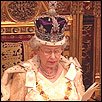 |
| The Queen: Setting out the agenda |
The government has put the country on an election footing with a Queen's Speech designed as a launchpad for a third Labour victory.
Central to the government's plans will be the theme of security both at home and abroad.
"The 2004 Queen's Speech focuses on making Britain more secure – within our national borders, our local neighbourhoods and own home – in a changing world," said the government.
With just five months to go before the expected May 5 general election, ministers want to grab headlines on areas such as crime, transport and education.
In total there are 37 new bills - with eight appearing in draft form. Under a new parliamentary procedure three bills will be carried over from the last session.
But with parliament set to be curtailed by the general electin, ministers will cherry-pick the high profile bills they want to see enacted - with the rest set to hit the cutting room floor until the new parliament.
Blunkett
David Blunkett is at the head of the pack with five full pieces of legislation.
Commenting on the plans, Commons leader Peter Hain dismissed claims that ministers are "legislative junkies".
He said that it is "important that we defend the positive power for good that government can and should be".
Speaking from her throne in the House of Lords, the Queen said the legislative plans would "provide more security and opportunity for all".
Following the pomp and pageantry, the political rough and tumble will take over this afternoon when Tony Blair and Michael
Howard lock horns over the government's agenda.
Election move
Central to the speech is a drive to tackle terrorism, combat crime and improve education.
"We are not complacent. We know the fight against crime and terrorism requires constant vigilance and continuing effort," said the government.
The Home Office is the undisputed winner of this year's Queen's Speech.
But controversial measures to overhaul the court procedures surrounding suspected terrorists will be appear only in draft form following fears of a human rights backlash in the run up to the general election.
Responding to the renewed threat the government warns that "modern terrorism and criminality cannot be defeated by traditional policing methods".
The most controversial Home Office bill will be legislation to enact Blunkett's plans for a system of compulsory identity cards. They are expected to come into effect in 2008.
While the home secretary says the legislation will combat terrorism and identity fraud, civil liberties groups have already raised "big brother" fears about the plans.
The Home Office has dismissed the fears, insisting the measures will tackle "terrorism, drug-runners, illegal immigration" and assist with the removal of failed asylum seekers.
Legislation will also be introduced in this session to establish the Serious Organised Crime Agency - dubbed the UK's FBI.
And ministers have unveiled legislation to create safer and cleaner neighbourhoods as they seek to step up their drive against anti-social behaviour.
Contained in the Clean Neighbourhoods and Environment Bill, which will be piloted by DEFRA rather than the Home Office, will be new powers to extend fixed penalty notices for anti-social behaviour.
The legislation will also wage a new war on graffiti artists and night-time noise.
A Drugs Bill will be introduced to tackle the effects of drug dealing, drug abuse and the crime which follows drug users.
A new drive against alcohol related crime will be pursued, although there will be no primary legislation in this area.
Further legislation will overhaul the management of criminals in a bid to reduce re-offending. This will result in new policies such as weekend sentences and hi-tech tagging to create "prisons without bars".
The Home Office will also pilot a Charities Bill through parliament, following the publication of draft legislation in the last session.
For the first time there will be a definition of what constitutes a "charitable" organisation – with some public schools set to lose their status as registered charities.
The government says the legislation will reflect the increased role played by the voluntary sector.
Education measures
Education policy, which has been the focus of a spat between the Prince of Wales and Charles Clarke, was also a central theme to the Queen's Speech.
"My government attaches the highest importance to extending educational opportunity so that all individuals can realise their full potential," the Queen told assembled MPs and peers.
While new measures to assist working parents will appear in the manifesto, schools also featured highly.
Education secretary Charles Clarke will press ahead with new legislation giving more power to headteachers. The role of local education authorities will be scaled back as power is devolved to the frontline.
"The Education Bill is about reducing bureaucracy in schools by streamlining the system of schools inspection and guaranteeing schools three year budgets," said the government.
The school inspection regime is set to become sharper, with the creation of a system of "no notice" inspections likely to be unveiled.
That follows fears that schools were rehearsing for inspections as a result of the long lead-in time given to head teachers.
A Child Benefit Bill will target 16 to 19-year-olds by offering cash incentives to remain in training and further education.
Winners and losers
Health secretary John Reid will take a low profile in parliament following the recent publication of the public health white paper.
Legislation to ban smoking in many pubs and all restaurants has been held back until after the general election.
But fellow Scottish Cabinet minister Alistair Darling has secured time for several pieces of legislation.
Reflecting the increased political importance of his brief, the transport secretary will announce legislation to overhaul the structure of the railways, deliver the Crossrail project and improve road safety.
New measures to control drink driving and increase safety on the roads will be introduced alongside a new monitoring system to reduce uninsured drivers.
The bill will also include measures to target foreign drivers who "escape punishment in Britain".
Other measures
Other legislation featured today includes DTI plans to create a new super-body to monitor equality issues.
The new law will also combat religious discrimination as the government seeks combat the anti-Islam culture which has grown since September 11.
Opposed by senior watchdogs including race equality chief Trevor Phillips, the Equality Bill will create a "single commission for equality and human rights".
The DTI will also introduce new measures to regulate consumer credit - with a crackdown expected on rogue lenders and firms which charge excessive interest rates.
The Department for Work and Pensions has also secured time to introduce the Disability Discrimination Bill.
The government says the legislation will introduce "major reforms to rights for disabled people". Under the legislation those with progressive conditions such as HIV or cancer will be given new rights against discrimination in the workplace.
New laws will also be introduced to establish a "Big Lottery Fund" which ministers say will give the public a greater say in the awarding of cash generated through the twice-weekly draw.
Margaret Beckett's department will rationalise existing laws by pursuing a new Animal Welfare Bill which the government hopes will increase standards of welfare whilst increasing the "penalties for abuse".
However several measures are kicked into the legislative long grass today, with bills to introduce a corporate manslaughter charge and to overhaul mental health laws appearing only in draft form.
Short session
Despite the scale of today's speech, the government's business managers are acutely aware that this session is likely to be cut short by a May general election.
With the prime minister hoping that the January 30 elections in Iraq may accelerate the process of stabilisation and self-government, the scene will be set for a Spring poll.
But any deterioration of the situation inside Iraq could force the government to shelve plans for a May election.
That would then allow most of today's bills to make it safely onto the statute book.
But the smart money still suggests a May 5 poll, which will mean some clever manouvering if the key measures announced today are to pass through both the Commons and the Lords over the next four months.
|


