|
Hunt supporters challenge ban
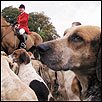
Pro-hunt campaigners have launched a legal challenge to legislation to ban fox hunting.
The Countryside Alliance made an application for judicial review at the High Court on Friday afternoon, arguing its case on human rights grounds and questioning the use of the Parliament Act to force the ban onto the statute book without the approval of the House of Lords.
The government has insisted that the legislation will stand up to any legal challenge.
"The legal advice I have had is that the Bill as it is complies satisfactorily with the human rights legislation. I am quite confident about that," rural affairs minister Alun Michael said.
But speaking to BBC Radio 4 on Friday, former top judge Lord Donaldson said the judicial review could succeed
"My personal view is that it is right, 100 per cent strength. Whether the courts will agree is a matter for them, and we will just have to see," said the former Master of the Rolls.
The court bid came less than 24 hours after Commons speaker Michael Martin invoked the Parliament Act, ensuring the Hunting Bill made it onto the statute book.
"I am satisfied all the provisions of the Parliament Act have been met," he told MPs.
Early ban
The Lords rejected a last minute bid to delay the ban until July 2006.
In a Commons vote on Thursday afternoon, MPs voted by 283 votes to 132 to delay the ban until the end of July 2006.
However, the Lords later rejected that change - and voted by 153 to 114 to allow licensed hunting.
That final decision left the door open for the speaker to approve the passage of the anti-hunting bill under the terms of the Parliament Act - for only the fourth time since 1949.
In addition to fox hunting, deer hunting and hare coursing with dogs will also be outlawed in England and Wales.
But MPs and peers on all sides have accused the government of playing politics with the issue by trying to delay the ban until beyond the expected election next year in order to avoid damaging protests.
Blair's regret
Speaking during a press conference on Friday, the prime minister signalled his regret that no compromise deal on licensed hunting had been possible.
But Tony Blair added that the issue of a delay to the ban would not make a difference to the election.
"This was always going to be an issue at a general election. It will be an issue because there are very strong feelings about it," he said.
"There are people who feel passionately that hunting is integral to their way of life. There are people who feel equally passionate that it is barbaric and cruel.
"I have been trying to find a way through, that is my job as prime minister. It has always been a free vote and I am afraid the views on both sides are very, very entrenched.
"We will now go to the courts and I have no doubt it will be an issue, but it always was going to be an issue."
Delay
And Commons leader Peter Hain said it was the Lords who had insisted on bringing forward a ban that it opposed.
"That's it. The ban will come into force in February," he told the BBC.
"And it is rather curious that those who most vigorously opposed a ban on cruelty to animals through this legislation actually voted for it to be implemented much more quickly.
"We proposed an 18-month or so delay until July 2006, beyond the last constitutional date for the general election, also to give the hunting community time to find alternative employment... and to put it as a general election issue, to say 'yes', if you want to vote Conservative and get the Act repealed before it possibly came into force, that is your right to do that.
"They chose not to extend the period in which these judgments could be made and a general election would intervene, and I just find it rather strange behaviour.
"The hunting cause has been very badly led, both in the House of Lords, where repeated offers to compromise were rejected, and out in the country, where their supporters have been betrayed, I believe, and led down the road in which actually a ban has come in more quickly, and it will be more difficult for them to adjust, instead of doing this in an orderly way and possibly compromising about how it might have been done as the government originally proposed but the House of Lords rejected."
|