|
Britain building 'shared national purpose', says Brown
Gordon Brown has said Britain can benefit from the best of both Europe and America.
Promising to invest in skills, science, manufacturing and housing, the chancellor told the Labour Party conference on Monday that activists should "have confidence in our values".
He pledged to fund the implementation of the Barker review of housing, which will massively increase the supply of affordable housing in the South East.
And he committed the government to paying for improved parental leave, childcare and the eradication of "family poverty".
Brown also announced that the full minimum wage will be paid to 16 and 17-year-olds in a speech that delighted union delegates in Brighton.
By combining "prosperity and justice for all" the chancellor argued that Britain could build a "shared national purpose" of patriotism.
"A patriotic vision learning from America whom I admire for its enterprise but where - with 45 million without health insurance - great economic success is not matched by great social justice," he said.
"Learning from the rest of Europe which has greeted social cohesion but where, with 19 million out of work, that social cohesion is not matched by economic dynamism."
Campaign
The chancellor also said that the economy remains "central" to the general election campaign, in a rebuke to those who have sought to sideline him from the centre of party power.
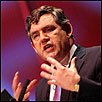
In his keynote speech to delegates he defended his position as a big player in the campaign.
With the conference season setting the battle lines for the looming election, the Treasury chief responded to claims that he has been sidelined in the Labour machine by the appointment of Alan Milburn as campaign co-coordinator.
The move was seen as a snub to Brown, who has been criticised for focussing too much on past economic achievements and promises of cash during the 2001 campaign.
Milburn wants the manifesto to be more forward-looking, detailing further radical reforms in the public sector.
However Brown said the economy will be "central to people's concerns at the next election, as at every election".
"That is the way to entrench and retain the trust of the people on the economy and pay for the much needed investment in public services," he argued.
The result will be a "British progressive consensus much more than a set of individual policy announcements".
Prudence
The chancellor also made his now traditional vow of prudence, promising no "inflationary" public sector pay deals, and boast of his record in office.
"Under New Labour Britain has had the lowest inflation for 30 years, the lowest interest rates for 40 years and the longest period of sustained economic growth for 200 years," he said.
Ahead of a trip to Washington later this week though, Brown warned that the worldwide recovery remains "uneven" and "fragile".
But the UK is well placed to avoid running into trouble, he said.
"Britain can lead by example as the first country of the global age where prosperity and justice advance together," the chancellor claimed.
He praised the "ethic of public service" in Britain, quoting Labour's own constitution and even lines of poetry.
And he rejected the idea that Labour lacks a "big idea" to define its period in office.
"The big idea is that we build and sustain a progressive consensus in our country for a Britain of prosperity and justice for all, a progressive consensus that the British people want to prevent any future government from undoing," he said.
"And so I want everybody in this party to share in this ambition: for the first time in our party's history, a third term Labour government, creating that progressive consensus.
"And this matters not just to us here in the Labour Party or in Britain but far wider than that - to all countries especially developing countries seeking also build economic prosperity and social justice for their people."
Aides later insisted that the Cabinet was "united" behind the call to restore trust in the government through the economy.
|