|
Mandelson 'must not meddle' says PR chief
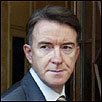 |
| Mandelson: Warned |
Peter Mandelson must stay out of British politics while in Brussels, a senior spin doctor has warned.
Farrington told ePolitix.com that the twice-dismissed former Cabinet minister should not try to use his new role as a European commissioner to influence the UK's attitude to Europe.
In an exclusive interview with this website Farrington said Mandelson, who takes up his new post in November, should resist the temptation to campaign for British entry to the euro or for a yes vote in an EU constitution ballot.
"I think that he should stick to the job he has been given with the European Commission. It would be very unwise for him to be seen or try to act as some sort of communication bridge in that way," Farrington said.
"He will have a very big and important job to do and he should leave the management of the relationships between Britain and Europe to the foreign secretary and the Foreign Office. He is going to be sorely tempted to interfere in things that are not part of his remit.
"A European commissioner is an extremely important job that is meant to be completely objective and not influenced by national policies. European commissioners are obliged to say that they are not there to pursue national interests."
Asked if Mandelson, himself a former spin doctor, is capable of performing that role, Farrington said "we shall wait and see".
"But I think he would be well advised and it would not be in Britain’s long term interest if he did anything which suggests he had another agenda being there," the trade body's chief executive added.
"It is probably a dubious appointment on those grounds because people will see it as something that is connected with British politics and British Euroscepticism.
"He needs to prove quite quickly that that is not his intention and he needs to avoid those interpretations."
Campbell
Farrington, who last year called for the then Downing Street communications director Alastair Campbell to resign, also said that he has been proved right.
He agreed with Daily Mail editor Paul Dacre, who told a Commons committee earlier this year that Campbell's departure has "drained the poison" from government-media relations.
"I think that is right. I did say last year that we thought he should go," Farrington argued.
"Although I think he did a great job in the early years of being New Labour into being alongside others and, possibly, in some of the early initiatives in government communication, I think the whole thing had just become too personalised and regressive.
"I'm not sure the word poison is correct but there had been a certain atmosphere created which meant it was very difficult to keep that important dividing line between political spin and factual presentation."
And the IPR executive claimed that the Butler report is unlikely to change communications working practices in Whitehall, despite its exposure of flaws in the system of putting intelligence in the public domain.
"There are particular circumstances around, in a war situation there are always certain barriers that are crossed, one has to be realistic about that," Farrington said.
"But also I doubt myself whether it is an issue that is really fundamentally going to affect the way that government communications is operated."
However he went on to argue that the prime minister will fail to recover to his previous standing in the public mind as a result of going to war in Iraq.
"I think he is widely seen to have shown poor judgement in the way that intelligence reports were received and handled," Farrington said.
"Some sections of the public, not myself but some sections of the public, believe that he lied over the issue.
"So it is probably more going to have a direct impact on the public’s perception of Mr Blair rather than of government as a whole."
|


