|
Hutton defends inquiry process
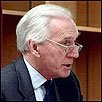
Lord Hutton has defended his decision not to conduct a widespread review of intelligence issues during his investigation into the death of Dr David Kelly.
Giving evidence to the Commons public administration committee on Thursday, the now retired senior judge said it would have been "inappropriate" for him to examine the issue when his focus was on the death of the government scientist.
"Many people thought that I should have inquired into intelligence matters," he said.
"I think it is quite understandable that they thought that... I thought it was right for me to consider the issues that I set out in my report."
Committee chairman Tony Wright said that to many it seemed "inexplicable" that the inquiry had not reviewed wider issues about the use of intelligence on Iraq.
But Lord Hutton said it was only at the second stage of the inquiry, after hearing the first round of evidence, that he made the final decision on how wide the remit should be drawn.
"You have to draw a line and I thought I was right to draw a line where I did," he said.
And he warned that a wider inquiry could cause delays and add to costs.
"I was asked to conduct the inquiry urgently, and if I had gone into all the very widespread matters of intelligence the inquiry would have been very lengthy indeed," he said.
Relevant factors
Lord Hutton also told the MPs that he had decided to look at events affecting Dr Kelly and those who had dealings with the former scientist.
The controversy that led to Dr Kelly's death arose from former BBC journalist Andrew Gilligan's claim the government "probably knew" it was wrong about the claim that Iraq could launch weapons of mass destruction within 45 minutes.
"So I thought I should concentrate on that and the broader issues of intelligence did not fall within my terms of inquiry," Lord Hutton said.
He also defended his decision not to allow cross-examination of the prime minister.
He argued that cross-examination could only be allowed when it was "fair and appropriate" because of the duty to treat witnesses fairly.
"I have to say that I consider that I would be regarded simply as playing to the gallery," he said.
"Various allegations would be put to the prime minister and there would be headlines about the allegations. I didn't think it was appropriate to do that."
Website
Labour MP Gordon Prentice said the decision to post information on the internet was "revolutionary".
Lord Hutton said he had decided "at a very early stage" that the inquiry should be in public.
"I'm not an expert in technology matters but I was advised that to assist the public in knowing what was happening it was desirable to have a website," he said.
Prentice said there had been implications for the machinery of government, with the public able to see who was "in the loop" or left out of important emails.
The peer said he was "merely taking advantage of modern technology" to make documents available that would otherwise have been read out to the inquiry.
"I have to confess I didn't think of all the repercussions," he added.
He smiled at suggestions his decision had delivered a "good press" for the committee.
"Perhaps I did, in certain aspects," Lord Hutton noted.
Inquiries proliferate
Lord Hutton was giving evidence to the public administration committee, which is examining the best way to deal with key issues of public concern.
Observers believe that the speed and openness of his inquiry have set a new benchmark for the conduct of investigations into public affairs.
With evidence and transcripts published on its website and key evidence sessions concluded in a matter of weeks, the Hutton inquiry is viewed as standing in marked contrast to the Bloody Sunday investigation which is still continuing the work it began in 1998.
The issue of how to run inquiries has become a key concern for the committee, which is reviewing what role parliament should have in any public investigations.
At the moment, continuing inquiries include the Butler inquiry on intelligence gathering in Iraq, the Bichard review of how Ian Huntley passed police record checks to gain employment at a Soham school, the Morris inquiry into Metropolitan Police Service employment practices, the Shipman inquiry led by Dame Janet Smith and the Saville inquiry into the events of Bloody Sunday.
|