|
Quo Vadis, Europa
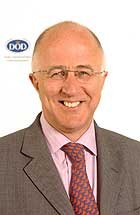
Speech to Chatham House by Minister for Europe, Denis MacShane MP. June 26th, 2003.
It is now seven months since the Prime Minister asked me to join his government as Minister for Europe.
It has been one of the most momentous periods in Britain's relationship with Europe.
The enlargement of the European Union agreed at Copenhagen. The conflict over Iraq. The Chancellor's statement on the euro. The votes in old European nations like Poland and Hungary to say Yes to a new European Union. The presentation of a new constitution for Europe by Valery Giscard d'Estaing.
In the 1980s some complained that there was no more European history worth writing. My goodness. I feel at times today that European history is now accelerating in ways no-one can quite tell. In which direction is Europe heading? In which direction does Britain want to go? And, are we alone in our vision or is it shared by friends and allies?
Let me go back 154 years to a speech Victor Hugo made about Europe. 'The day will come when the idea of war between Paris and London, between Petersburg and Berlin, between Vienna and Turin is as absurd and as impossible as the idea of war between Rouen and Amiens, between Boston and Philadelphia. The day will come when the only battlefields will be those of markets open for business and the human spirit open for ideas.'
Well, mon cher Maitre Hugo, we have had to wait for that day but here it is.
And I want my country, Britain, to be fully part of this new Europe which we are shaping. In Europe and helping run Europe.
Go to Valetta and you will see over a building put up when the British arrived 200 years ago the claim that Britain is, 'Vox Europae' - the voice of Europe.
I would not be so pretentious as to make that claim today but I do believe Britain can and must help decide the answer to the question, Quo Vadis Europa?
EUROPE'S GROWTH
Forty years ago when Britain first realised its mistake that being absent at the creation of the European Community needed to be put right, half of Europe lay under communist rule. Three major western European nations had no democratic government. European nations like Ireland and Italy were poor.
Across the Atlantic too there were wide disparities between the income and internal democratic rights of the United States and Canada, on one hand and nations further south on the other.
Spain and Mexico in 1960 had roughly the same GDP per capita.
Today, the European Union operates the reverse Gresham's law of politics - good practice drives out bad. All of Europe is free and democratic.
All of Europe aspires to high standards demanded of membership of the European Union. All of Europe has watched wealth grow so that today income per head in Ireland is as high as Britain, and Ireland has become a nation of immigration not emigration.
Spain is now a vigorous democracy with a quality of life envied worldwide. Her GDP per capita is 86 per cent of the EU average. In other words, Europe has an osmotic effect and we have learnt as European nations to grow with each other, not against each other.
I know from my time as Foreign Office Minister responsible for Latin America that there are many Latin American nations who wished that they, too, could share fully the prosperity and rights to a full life that nations in the European Union have achieved.
The European Union has learnt the art of nation building - that most precious and useful tool in the armoury of shaping a better world. Enlargement and the stabilisation of the Balkans and Central Europe are major success of the European Union. In addition, Europe has begun to make us of its new security and defence capabilities to tackle international crises - in Bosnia with the police operation, in Macedonia with Operation Concordia and now operation Artemis in Bunia.
EUROPE'S RELATIONS WITH THE US
To be sure, Europe will never replicate the hi-tech or sheer military power of the United States, nor should it seek to do so.
We need, to use the words of Fareed Zakaria in the current issue of Newsweek on Tony Blair's vision, to see Europe as 'a far more purposeful, active continent that uses its strengths not to compete with America but to act as a partner.' As the German Chancellor, Gerhard Schröder, wisely told the German-American Chamber of Commerce last month, we do not need talk of Europe as a 'Gegenpol' against America. The talk of multipolarity with its echo of cold war blocks and 19th century spheres of influence is to take Europe is the wrong direction.
I think we are moving out of the choppy waters of the Iraq conflict to an understanding that Europe and the United States need each other as partners, not rivals, with complementarity, not duplication of methods and means now established.
The EU security strategy set out by Javier Solana with its acknowledgement that diplomacy without at least the presence of force behind it will not get very far is an important step. President Bush's speech in Krakow and the joint statements from the G8 leaders in Evian as well as the EU-US summit yesterday are all reinforcements of Tony Blair's point that the best answer to unilateralism is partnership and the best response to isolationism is engagement.
Europe does bring something to the party.
In the Balkans, EU member states have 22,000 troops in comparison with 3,200 from the US.
Taken as a whole - the UN, SFOR in Bosnia, KFOR in Kosovo, Macedonia, ISAF and now in Bunia EU member states are deploying over 30,000 troops and the US fewer than 4,200.
Europe is moving ahead with a comprehensive counter-terrorism strategy, including EU legislation like the arrest warrant, judicial assistance and extradition agreements, sanctions against terrorist organisations, and using EU relations with third countries to press governments on issues like terrorism and WMD.
Not perfect, much still to do, but let no-one say Europe is not accepting its responsibilities to deal with today's international agenda.
Poverty is not a proximate cause, still less a justification for the new fascism of fundamentalist violence, but world poverty fuels anger. So the fact that the EU spends nearly two and half times as much on development assistance than the US, despite having an economy 20 per cent smaller is not to be dismissed.
CHALLENGES
But for Europe to be a full and equal partner we need to meet the following challenges:
First, we need to get Europe moving again. Less talk in seminars on Europe's future and more work for the working class in new enterprises.
Today the EU produces 20 per cent less wealth each year than the United States. According to the Foreign Office economists that wealth gap will increase to 40 per cent - to Europe's disadvantage by the year 2010.
France's International Institute of International Relations has just produced an important report 'Le commerce mondiale dans le 21eme siecle'.
It paints a picture of European growth declining to an average 1.1 per cent between 2020 and 2050 and Europe leaving the world stage as a serious economic, let alone political actor.
Pro-European politicians, and I count myself as a passionate pro-European, should stop making speeches about European finality and destiny and make effort to persuade employers and trade unions as well as all citizens of the need for reform to get Europe's economy moving again.
The second challenge is to make a success of enlargement.
Poland and Hungary are very old nations who will now shape a very new Europe. Five years after the Stunde nul of 1945 we had created the European Iron and Steel Community, the OECD, NATO, and the trente glorieuses - the 30 years of strong European growth (alas not fully enjoyed by Britain because we refused to join the European institutions when we should have) were under way.
We will have had to wait 15 years after the fall of the Berlin Wall to see the former communist countries of East and Central Europe enter the new EU on May 1st next year.
One of the keys to making enlargement work depends on the third challenge facing Europe - the reform of its budget and clear action to root out corruption. It is becoming more and more absurd every day that out of the 100 billion euros in the annual EU budget nearly half is devoted to one relatively small part of the EU economy and society - namely agriculture.
Each cow in Europe gets a subsidy of 2 dollars or euros a day via the Common Agricultural Policy. At the same time more than one billion of our fellow citizens worldwide have to survive on a daily income of less than 1 dollar a day.
The agreement reached this morning by EU Agriculture Ministers is a good outcome for Europe. It shows what we can achieve in Europe, working constructively with colleagues in the Council. We are breaking the link between farm subsidies and production in order to reconnect farmers to their markets, reducing damaging environmental impacts and reducing bureaucracy: this is at the heart of our approach to sustainable food and farming.
EU budget reform is now a priority not the least because EU agro-protectionism, along with US and Japanese agro-protectionism threaten to derail world trade negotiations so vital to send positive world economic signals.
The fourth challenge is to make a success of the Intergovernmental conference which will take forward the work of the Convention.
The new rules needed to make an enlarged EU work will now be taken forward by the Inter-Governmental Conference. I welcome the work of Giscard and his Conventioneers.
Robert Badinter, the great French constitutionalist, writing in the current issue of the Nouvel Observateur, states that Giscard's Convention should be called the 'British' constitution - so seriously did British ministers, politicians and officials take the work of the Convention and so hard did our diplomats work to ensure that British ideas and values inform the constitution.
In November last year Tony Blair made clear what Britain wanted from the Convention.
We wanted a strong Commission, a stronger role for the European Parliament and for national parliaments, and a clear role for the European Council representing the nations of Europe with a new post of standing Chair of the Council.
We wanted neither a federal European state nor a loose association of bickering nation states. We wanted a team Europe - what Mark Leonard has called a Network Europe. Not a Europe with one telephone number on the desk of some Nietzschean super-president but a Europe of citizens and a Europe of their nations.
We wanted and have got a strong Commission president with an elected mandate via the European Parliament - but not please a highly partisan or politicised figure - to focus on getting Europe back to work and energising and leading the Commission in Brussels.
We wanted and have got a standing chair of the European Council. This person - a Chair or Vorsitzsender - not in English a president - will be elected by his or her peers and will have walk-in rights to talk to all 25 heads of government.
I personally think the Council chair will most likely come from one of the smaller countries, and be someone who can act to bring Europe's nations and peoples together in a closer union.
We want more common foreign policy but we understand that foreign policy remains often a vital national question and the presidents, prime ministers and Chancellors of Europe's nations understandably do not wish to transfer competence in foreign policy work to Brussels.
Today more and more we see that foreign policy has defence, security or military component. It can alas mean asking young men and women to put at risk their lives to carry out the expression of foreign policy. Therefore the idea that this is about counting votes to find a majority in Brussels does not make sense.
Because the final challenge for Europe is to create a partnership so that we can leave behind the 20th century idea that the nations of Europe have to be in conflict with the idea and identity of the European Union.
We want more Europe and more Britain More Europe and more France and Spain and Poland and so forth. Europe is not a zero sum game in which Europe can only grow at the expense of a strong national identity for its component nation states.
In my adult lifetime I have seen Germany become more German, France more French, Ireland more Irish thanks to the increase in the sharing of sovereignty in the European Union.
A new European Union will allow Poland and the other old nations of Europe to develop the cultural identity and strengthen their sense of nationhood while burying the atavisms of negative nationalism.
We want more Europe but we do not want less Germany or less Sweden or less Britain. In tomorrow's Europe Britain and our partners must work together to create a new alliance for permanent reform and constant renewal. There is no European finality but a journey of nations and peoples to build a better tomorrow.
This new Europe will never be built against Britain or without Britain, against France or without France, against Germany or without Germany. I agree with Jean Monnet when he said that there are no small and no big nations in Europe just some that think they are bigger than others.
In tomorrow's Europe, size really does not matter. What counts is will, determination and a desire to cooperate. We have to measure our ambitions one against the other. But we have to accept that any axis for Europe's future that does not have London, Paris and Berlin on it will not turn or attract others.
And for Britain that means a new approach to Europe which the Prime Minister will launch later today in the Cabinet Room in Downing Street.
INCREASING KNOWLEDGE OF HOW EUROPE WORKS
When I was appointed I made clear that I wanted to be Britain's Minister for Europe in Europe making the case for British policy and ideas in every capital of the EU. I am not the Minister who alone should make the case for Europe in Britain. In fact every Minister should be a Minister for Europe arguing in speeches and interviews the need for Britain to be fully engaged in the EU.
We need a change in our political approach to Europe because we will not maximise benefit to the UK from EU membership unless we increase our knowledge of how Europe works. That is why I welcome the fact that MPs can now travel three times a year to EU capitals. They should be networking to build parliamentary links to oversee what Brussels does. In addition the main European Committees of the Commons and the Lords could consider holding more evidence sessions in Brussels and put the EU under direct parliamentary scrutiny on the spot where the decisions are finalised. We should stop treating Europe as a faraway place of which we need to know nothing.
Ministers can learn from other European nations and we can contribute to EU policy-making in areas like economic policy and job creation.
Each minister and each MP has to build into speeches and political work the need to make the case for Britain being in Europe and helping to run Europe.
It is not the job of the Minister for Europe to be the only Minister who puts the case for Europe in the UK. On the contrary, my task is to advance the British position in the capitals of Europe and make sure the future direction and decisions of the European Union help promote Britain's interests.
After the Chancellor's speech on 9 June we can now move from analysis to action. Our partners worldwide want Britain to be leading not lagging in Europe.
That is why I ask my fellow ministers in the Cabinet and in all ministries to make the case for Europe in their speeches and interventions.
There are good stories from Europe in terms of health, public transport, and protecting the environment. We need to learn from Europe as well as taking the British example of job creation, economic growth and social solidarity to our partners in Europe.
Since the Maastricht Treaty 11 years ago Europe has been engaged in an internal political, institutional and constitutional debate.
By the time the new member states enter next May we will have had four Treaties, enlargement, and a Convention.
A NEW POLITICS
The question Quo Vadis Europa also has to be answered politically as well. Because slowly we can sense a new politics taking shape. Next month the Prime Minister is hosting a progressive governance conference. Centre- Left leaders like Lula in Brazil, Helen Clark in New Zealand, Goran Persson and Gerhard Schröder and Alexsander Kwasniewski from Europe and others will be Tony Blair's guests at an ambitious project to define a new progressive politics. At the heart of this politics is the notion of community governed by law on the basis of a contractual relationship above that of the nation state. It is end the traditional politics which left domestic affairs wholly separate from international policy.
In Europe, in the Americas, north and south, in Asia and in Africa we have find an answer to the new challenge of what I would call intermestic politics. The days when government policy was neatly divided into domestic and international politics are over.
Globalisation has created new rules and new ideology for market economics. Finance and industry ministers now have to think how their policy decisions will echo across national borders. Intermestic economics means that decisions taken far away from London or Berlin or Sao Paulo or Seoul or Washington determine the scale and nature of economic growth in Europe, South and North America or the Far East.
Europe is now governed by intermestic politics.
Intermestic political organisation is now required in place of a narrow nationalist perspective of old political thinking. The new challenges of terrorism, of handling asylum-seekers, of fraudulent money transactions which fuel the trade in drugs, in prostitution and arms all demand an intermestic approach.
Our domestic problems can no longer be solved politically within national frontiers. Foreign or European ministers like myself now have to think in intermestic terms too. Long gone are the days when diplomats and foreign policy specialists could negotiate treaties or do deals without reference to domestic constituencies.
As an elected member of the British Parliament I have to answer to my constituents every week and increasingly their questions have an international flavour. They want to talk about Iraq, about relations with the United States, about cruelty against birds and beasts in countries which do not share the English love for animals, about the future constitution of Europe, or about how we can move from disagreement to persuasion over the issue of Gibraltar.
The new intermestic politics demands a new sense of explanation and discourse to lead citizens away from a narrow defensive, trench-like position on political decisions.
We need more Europe not less. After the divisions on Iraq we need to ensure that Europe is present, not absent, at the key decisions taken about global political questions. The new EU of 25 rejects an inward-looking continentalist Europe. Europe's Atlantic nations - France, Spain, Britain, Portugal and Ireland - want an oceanic Europe. Old countries like Poland and Hungary define themselves as belonging to the Euroatlantic community of nations.
Intermestic politics requires new thinking about global rule of law, about the right to interfere in nations that refuse to respect human rights or UN resolutions, and how we can find equilibrium between what Brussels does in the common name of the European Union and what the nations of Europe represented by their elected governments and parliaments do.
Intermestic economics requires a deeper commitment to open trade. It is little use making polemical speeches about the protectionism of the Common Agricultural Policy in England in English. If we want CAP reform to continue beyond what was achieved this morning we need to make the case in French, Spanish, Italian and Irish and persuade America to reduce its protectionism against third world products. NGOs have created proto-intermestic political space. Now government and progressive politics need to go intermestic.
So intermestic politics require a major shift in political thinking, discourse, and organisation. The future of progressive politics depends on making intermestic politics work for the benefit of all our citizens.
And as Britain is transformed for the better this can only happen within the context of being fully part of Europe, including once economic conditions are right, joining the Euro.
CONCLUSION
And what kind of Europe do we want. It is set out in the preamble of the new constitution which affirms that:
'believing that reunited Europe intends to continue along the path of civilisation, progress, prosperity, for the good of all its inhabitants, including the weakest and most deprived, that it wishes to remain a continent open to culture, learning and social progress; and that it wishes to deepen the democratic and transparent nature of its public life, and to strive for peace, justice and solidarity throughout the world.'
Peace, justice, solidarity. If that is where Europe is going it is where I want to be.
|