|
Britain Tanzania Society/Royal African Society Lecture: “The importance of International Development”
School of Oriental and African Studies, London
2 December 2004
On Thursday the 2nd of December 2004 more than 200 members of the Britain Tanzania Society, The Royal African Society, The Centre of African Studies, SOAS and others attended this lecture at the Vernon Square Campus of SOAS.
Dr John Sankey, Chair for the evening, welcomed the Right Honourable Clare Short on behalf of the Britain Tanzania Society, and mentioned that she would be willing to sign copies of her recently published book after the discussion. Robin Newell, Chair of the BTS Development Aid Committee, gave a short account of the foundation of BTS and the work it currently undertakes. BTS was founded in 1975 at a time when relations between Britain and Tanzania were somewhat strained, the objective being to help preserve the good relations which existed between the people of the two countries, an objective fully supported by the then Tanzanian President, Julius Nyerere. The current membership, including those in Tanzania, is 730, and the Society warmly welcomes new members. The development wing of BTS, the Tanzania Development Trust, has disbursed over £½ million on projects across the Republic, and expenditure is currently running at the rate of £60,000 pa. Project expenditure is principally focussed on self-help income generating projects for women and orphans, development work at schools, irrigation in rural areas and assistance with provision of health care.
Ms Short commenced by pointing out that the title of her book, “An Honourable Deception?” is qualified by the question mark at the end. It floated the question as to whether the war in Iraq had been launched on the basis of a deception and, if so, whether it was justified by honourable motives.
The Importance of Development lay in the present inequalities in the world, which are immoral and shameful. Without a valid development programme these inequalities will grow. This will lead to instability and conflict. People are cynical about politics and politicians. This is dangerous because if we do not vigorously pursue what is morally right, the world will be in increasing trouble over the next two decades.
World Population is increasing rapidly as shown below:
1900 1 billion
1960 3 b
2000 6 b
2030-50 9 b [projected]
In OECD countries, 20% of the population suffers from the “diseases of plenty”, and also a lack of meaning in their lives. Of the 3 billion new people expected, 90% will be in the poorest countries. Society will become more urbanised. The proportion in cities will go up from 50% to 65%. Poor people, concentrated in cities, will be more inclined to demonstrate and take direct action.
Clare Short spoke also about global warming, the problems of which were highlighted by an article in The Independent on last year’s heat wave in France. Fifteen years ago international scientists thought there was a strong possibility of global warming. Now they agree it is a virtual certainty. To give an example of the sort of problem which will arise - the population of Bangladesh, currently 130 million is expected to increase by 50% whilst land area reduces by 30% as a result of rising sea levels over the next 30 years.
There is a problem with capital surplus and also a problem of pensions for the ageing population. We need young people to produce for the old, but demographics are working against us. If we invested these surpluses in developing countries, they would aid development and produce a return for pensioners in the future. We have the capital, knowledge and technology that could massively reduce poverty worldwide but are we wise enough to use them by investing our surplus capital to help developing countries produce the goods and services needed?
In 1990 there were grounds for optimism. The Berlin Wall came down, Mandela was released and there were Velvet Revolutions in Eastern Europe. Then came great instabilities. Genocide in Rwanda was not described as such by the either the USA or UN because genocide would have obligated all countries to intervene. In the Balkans communist leaders had tried to hold on to power through inciting ethnic conflict with disastrous consequences.
However, to mention some of the positive signs - the 2000 UN General Assembly had been attended by more world leaders than ever before, and the world committed itself to the Millennium Development Goals which focus on the reduction of poverty. At Doha, it was agreed that there should be a new trade round with the needs of the developing countries to the fore. Through the Montreal Protocol it was agreed to phase out CFCs. In Sierra Leone civil war was ended by UN intervention. Debt reductions have been agreed for heavily indebted countries on the basis of them instituting Poverty Reduction Programmes.
Unfortunately, the war in Iraq, apart from being bad in itself, undermines the UN and puts development in danger. The Israeli withdrawal plan for Gaza is not a genuine contribution to peace.
When great countries tear up international agreements it proves that Might is Right.
Two thirds of the world’s poor are in Asia, but there have been remarkable developments in China and India. The future centre of the world economy will be in Asia.
Africa is moving forwards, but needs annual growth of 7% up to 2015 if it is to meet the Millennium Goal of halving poverty. There are encouraging signs of stability and growth in Tanzania, Mozambique, Ghana and even Rwanda but much economic advance is absorbed by population growth. The NEPAD movement to reform the continent is significant because the leadership of the reform movement comes from Africa.
In Darfur, the African Union are willing to provide troops, but the UN Security Council have not been prepared to provide funds.
What happens in Nigeria is very important since it is the most populous nation in Africa with almost ¼ of the total.
The troubles in Rwanda and Burundi have affected Tanzania which has hosted 500,000 refugees.
Latin America went through a period of many dictatorships, but now has more democratic Governments although half the population of the Continent say their lives are no better.
We are living at a time of great danger. Problems could be solved, but the mistakes of the past continue to be repeated.
Questions and Discussion
1] What about the problems of Trade, War and Corruption?
Trade rules are grossly unfair. GATT was set up to prevent the pre-war problems of competitive trade restrictions. WTO rules should apply to everyone. All trade rounds to be by consensus. Primary producers get little because raw materials are imported, and processed in developed countries. There is hope that WTO will be good for undeveloped countries but there is danger that they will be forced into bilateral deals to their disadvantage.
War. Some arms are made in Africa so not all blame falls on the West. Tanzania’s new Air Traffic Control system was not good for the country.
Corruption. Petty officials resort to small scale corruption to keep alive. Some progress has been made in combating major corruption. Resources should be provided to African Union who are trying to sort out problem.
2] Was there a danger in financing political parties, as was done by Nordic countries?
The question of how we pay for politics is an important one. Often, too much money was put into parties, albeit from the wrong sources. Some figures from India were quite shocking. There need to be limits set on the amount of political spending.
3] What can be done to combat public hostility to aid expenditure?
DFID did study this. The public are very hostile when confronted with evidence of corruption. However if you say that you are trying to put more children in school they say Great!
4] What about the International System?
Does not think that it can be completely rebuilt but it could be improved. It is all a matter of will. The Security Council could be reformed.
There seemed to be a problem in that colonial economies were linked to the colonising country and that there was very little trade with neighbouring countries. Often regulations stifle trade with neighbours. These have been eliminated in Europe.
5] Girls’ Education
Violence against girls prevents them being educated. What is needed is a framework of human rights. The whole international system is committed to getting girls educated. If girls are educated there is a great benefit to their future children [the provision of adequate school toilets was mentioned as being an often neglected, but highly important, necessity]
6] What about the Iraq War?
A disaster in many ways. We have had to pledge money which had to come out of existing budgets. This has affected programmes in South America.
7] What effect has the ‘War on Terror’ on development?
Although opposed to terrorism, Clare Short said that the concept of a “War on Terror” is idiotic. We have had terrorism in Northern Ireland and Spain [ETA], which has finally been dealt with by negotiation.
After 9/11 there was a great feeling of solidarity. This has been dissipated.
The meeting concluded with a summing up by the Chair and a vote of thanks from Hildebrand Shayo.
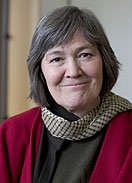
Clare Short MP, 2 December 2004
|