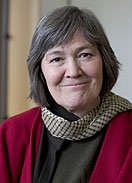
This interview was first published in Devout Sceptics: conversations on faith and doubt, and was given in 1997
The Rt. Hon. Clare Short MP (Labour) for Birmingham Ladywood since 1983, and Secretary of International Development from 1997 until her resignation in 2003. She was Director of All Faiths for One Race, Birmingham, from 1976 to 1978, and has published three books, including a handbook of immigration law.
If your grandchildren were to ask you one day, 'What is God?' what would you say?
I would say God is the encapsulation of everything that is good - and humanity turned that into an old man with a beard because that was the only way they could imagine it. It's not a person, but it is a beautiful and very important thing.
Would you have said the same when you were twelve?
No. Id did my catechism: 'Who made you? God made you. Why did God make you?' There must be something there. I was brought up very thoroughly Catholic in a way that I really like and took very seriously, and I think I thought God was quite a stern God who said what was right and wrong and you had to do it or be damned. I used to go to sleep at night when I was seven, playing - that is a Catholic tradition - for the last soul in purgatory, because these are the neglected ones. And I used to imaging the last one overtaking the next to last one and my prayers having to be transferred to the new last one. So when I was twelve I went with all the literal and old-fashioned ideas of a rather strict judgemental God.
Did that make for a universe which was actually fearful?
No. I always loved the world. It's just that as I got to be fourteen, fifteen, sixteen, it didn't stack up. The ideas I'd been taught, that I'd taken so seriously about what was right and what was wrong, increasingly didn't chime. Although I came from the old-fashioned strict Catholicism I was never really scared of God. I always quite liked him.
Was that part of your parents' teaching, because you come from a very large and devout Catholic family and religion played a large part in your family life?
Yes. My mother still lives with me in Birmingham and she's a very dedicated Catholic, though of a sort of liberation theology type. She would say of her children - there's seven of us - that she slightly regrets that the version of Catholicism we got wasn't the love-driven one, it was the rules one. She thinks that most of us were lost to it by that. My father, on the other hand, who is dead but who was also a devout practising Catholic ... for him it was very much part of his identity as an Irishman, a thing that the British had tried to beat out of the Irish historically - you know, the penal times and so on - so he was much more rational about religion and more critical, less emotional about his Catholicism. So already, within the model we had there were different kinds of versions and nuances, but it was very Catholic.
And presumably for both your parents, although coming at it from those different angles, the idea of God overlapped with politics ... a just God?
Oh, absolutely. Religion is all about what is right and what is wrong, both for the world order and for your own life, and so is politics. Being involved in politics is to stand up for what is right, so that two were just part and parcel of the same quest. In the way I grew up it would be hard to think (and I know this sounds terrible) that a Tory could be a Christian. I know better now, and it wasn't that I was ever taught to criticise others - but it was the values we had, and clearly we had to be right. We knew people like us were often not victorious, when you look at history, but you have to stand up for what's right no matter how long it takes. That was just part of the politics and part of the religion.
So how come you made this shift away from religion and more towards politics, given they'd been so much entangled?
I remember when I was fourteen of fifteen, this question of contraception ... the thing is the Pope says you can't use contraception and this is quite ridiculous. Therefore he's wrong and therefore ... And then, of course, Catholicism pays the price of its clarity because if the Pope's wrong then he might be wrong about something else ... So increasingly I didn't believe in the teachings of the Church, thought they were wrong about some things, began to doubt the existence of a personal God. I've never disrespected religion or indeed the idea of a god, but a lot of the details in the teaching. My mum didn't like this much and found a sort of trendy American visitor priest and sent me off, and we had a nice chat and I sort of went back a bit, but it was going from me, and by the time I was seventeen ... My mum then said, 'You must go to Mass when you're at home or you'll give a bad example to the little ones.' And I said, 'Yes, of course.' And once I'd left home and went to university I went to one Catholic thing, and then I didn't go - and it wasn't like 'I've escaped these rules', it's 'I don't believe in it and I respect it so much I'm not going to do it hypocritically.'
It's very interesting, in the kind of constituency I represent, because it's very mixed and multi-ethnic; I have all the centre of Birmingham, so I have all the great world religions there and I get invited to various celebrations. I go and I'm very moved by it - by spaces in local churches where the questions of what is right and what is wrong are reflected upon, and great beautiful text area read that talk about the most profound moral and human questions. I love and honour religion, and I have my own sort of version: like the idea of God is the encapsulation of goodness, and the wish to honour God is the wish to honour the quest after goodness, which is a wholly fine thing. And immortality is not that we're going to be in heaven and live, but that every single human being that's ever lived will leave traces behind them on this earth for good or ill, and that's a form of immortality. Of course, every one of us that has ever loved anybody knows they will be alive in us until we die, and that's another form of immortality.
And, for example, the Christian teaching of sin - that you have to try to be good but won't always succeed, that we will do wrong sometimes, that we can be forgiven but we have to be truly sorry, but that you can be forgiven and try again, you're not written off - that's very important and right. So I go in and out of these churches and I have these deep experiences and I love all that space, but I don't believe in a personal god and I haven't got my own one. Sometimes I feel a bit lonely and I go with my mum to the church that I was baptised in, my parents were married in. It's just there on the edge of my constituency; I made my first communion and my confirmation there and I love it, and I think sometimes that perhaps I could have my funeral there.
I'm an ethnic Catholic, profoundly shaped by my Catholic upbringing.
My politics are a continuation of that quest, and so in that sense I'm still one of those old-fashioned Labour people - the Labour party is my church. I'm in it because I want to work for the decent moral order in our country and in the world ... it's a religion. It's not an alternative religion. I know this doesn't seem to fit with modern politics, but that's me.
A lot of people reject the Church, as indeed you did and I did as a teenage, because you think so many bad things have been done in the name of religion, whether it's making women have lots of babies or worse ...
The Catholic Church and Franco, for example ...
Exactly. But lots of awful things are also done in the name of socialism. Was that a problem for you?
I hate awful things being done to anyone, but I've never been tempted by any of them. Those ones were never socialism. If I'd lived in the Soviet Union I would have been in a gulag - I've said it in committees in the House of Commons. My socialism is ethical. It never was an Economic System Socialism - it's an ethic that says every single human being is of equal moral value, and we have to try and organiser the world to recognise that and give everyone equal moral space to be valued to enable them to live a full life.
So it's not that different from the kind of ethical Christianity which stood up to communism in Eastern Europe and fascism in South America?
Some Christians have been very principled and fine people and some have been monsters. My father used to say, when I was starting to have my doubts, he said, 'Remember, Clare, Christianity was the religion of the slaves. It spread through the Roman Empire among the slaves because it said everyone is equal in the sight of God.' That's a very important argument ...
Would it be true to say that, having removed yourself from the Catholicism of your parents, by moving to socialism what you're actually doing all the time in your life is expressing a belief in the perfectibility of humankind?
'Perfectibility' sounds as though we're in a sort of lost condition and we can improve ourselves. I think human beings are intrinsically incredibly beautiful. They're capable of being damaged, They're capable of great and heroic and beautiful things and they're capable of being crass and mean and unjust and cruel, and I think human life is about the journey of trying to be the better side of what we are. You'll never be perfect, but you have to keep struggling with yourself and trying to work for the world, which maximises that beautiful goodness, knowing that it will never always be perfect, that we have to have a way of accommodating our own personal inadequacy and other people's and our incapacity to be what we are at our most beautiful. So that isn't quite perfectibility, but it's that struggle between good and evil - in how we organise the world and how we live our own lives and how we relate to other human beings.
But when you talk about the struggle between good and evil, for you that's in humankind, it's not 'out there'?
Yes, it's in us. I think we are intrinsically fine and lovely creatures, but we are capable of evil and if we treat any one of us with great cruelty it tends to make people become bad. One of the things I've learned is that most cruelty and evil comes from weak and damaged people. It doesn't therefore mean that you don't blame them, but you can see. You go into Winson Green Prison in the middle of my constituency and some of those people have done really bad things, but ever such a lot of them are messed up and not educated and mentally damaged, so there's a dilemma. Hate the sin and not the sinner. Don't forgive anything that's evil, because it doesn't matter how damaged you are, part of being a human being is that you have to take moral responsibility for yourself. But understand that it's not fair, that we all start from different places, that some people are very damaged and hurt, and if they've had lots of ugliness and cruelty they haven't learned their full moral capability. These are big questions, but they're in politics all the time.
So you can believe in wickedness but at the same time preach what Christ preached, which is the possibility of redemption?
That is the human condition. We can be wicked. Some people are very wicked. They can be forgiven. They have to be sorry, really profoundly and truly sorry. This is a Christian teacher, but it's now completely incorporated in my world view. I think it's profoundly right. It's, off course, in all the other great world religions. On these deep moral questions of human life, of course, they agree.
To that extent you wouldn't put the religion of your childhood as superior to that of Island or any other? You don't think that any one religion has the monopoly on truth?
Absolutely not. They're all questing for the same thing. Of course, each religion has to think that it's the only one that's right, but that just belongs in its origins. Humanity used to think that the end of the universe is over the next mountain, and religion is full of all sorts of prehistoric concepts from history and science - that's part of the clutter that's a problem of our era. They give us loads of nonsense that we can't possible believe, and if we're not careful we'll lose beautiful buildings, fabulous music, lovely texts, some of the finest reflections of human history on what is right and wrong, written in the most beautiful ways - all because these religions are still carrying clutters of silly teachings.
What you want is an acknowledgement of the mystery, the sacred?
I don't even want it. I have it. I think my religious childhood partly gave it to me, but I had to leave the rules they gave me to preserve it. This might sound silly, but I sit in my advice bureau and people come to see me with their problems and pain and I love them. I feel I'm doing this service and I have this power because they put it into me with their votes - and I feel like a priest! The I get up and make speeches, talk about what I think is profoundly right and wrong, and I try to inspire people. We're talking about relevant things, not just some mystery of something in the sky but what's right and wrong and how we could do it one way of the other. I do my sermons. I have my flock. I have my rituals in my party, although some people are trying to get rid of them all. I know some rituals should be updated but I love that part of being a politician. I think it's better than being a priest, because if you could realise it you could make the world finer, and what greater work could you do?
Are you the sort of person who gives thanks?
Well, I do in my mind. I do it when I'm walking along the street or listening to music or swimming - that's when I have my really honest conversations with myself, when I say, 'You're wrong about that, Clare,' or 'You were arrogant,' or 'You were too rude to that person,' or whatever. That's when I make my acts of confession and admit to myself that I'm wrong. Or I say, 'You are so lucky - life is profoundly wonderful and you should just be so grateful that you have all these lovely things.' I do that with myself in my own head, really.
Are those moments like prayer?
... I used to pray when I was little, and a lot of prayer is appealing to God to put it right. I mean, when I'm desperate I do sometimes say, 'Well, God, I know you're not there, but if you are, please help me out here.' I have been known to do that, not very often but in my most desperate moments of prayer ... I think a lot of it is posited on asking this all-powerful God to do it, but that can't be right. And it can't be that God, who has to be the encapsulation of what is moral and right, would do it if enough people asked him. That would not be a proper way to proceed, so God couldn't behave like that. So I think prayer is this: if in moments of tranquillity and total honesty you encapsulate what is of the deepest important to you, to give praise of thanks or to appeal for something to happen, you're actually creating moral resolve in yourself.
... You speak like somebody who has total faith - in that to believe in goodness, as you do, despite the proof that comes in every day to the contrary, is as big a leap of faith as believing in God.
I've had lots of bad things happen to me and lots of pain, but the whole of my childhood I was given love and kindness, and things that were good were celebrated and honoured all around me ... My own experience of my own life and human history is that the people who yearn for what is right are the creators of history. The people who just want their own greedy, selfish thing might get it in the short term, but they don't shape anything. To be a human is to be a moral creature.
You speak of religion as being totally about issues of right and wrong, but isn't there more to it than that? Isn't there a philosophical dimension which you're not actually embracing?
I think I am embracing it, I think it is most immediately about right and wrong, but we all have to say what is our place in the universe. What does this concept of God mean? What does our life mean? What does it mean to die? How do we make sense of who we are? What moves us? What inspires us to try again? What does 'spiritual' mean? Is it like when you go by a beautiful mountain or by the sea and it's moving, it lifts your spirit? I think it is, a bit. And very fine music and things that elevate you to another kind of level, that makes you the think more deeply and profoundly about the meaning of life. But that's all part of the religious, too. But the day-to-day of it is: here am I, a human being, within my understandings or life, the universe, beauty, music, death, and I've got to try to be a good person. We have to try ... If all we are is selfish little beings, it's not worth the struggle.