|
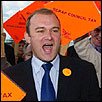
Ed Davey MP - Lib Dem local government spokesman
Question: Will local income tax generate the same revenue as the present system?
Ed Davey: No, it won't. The overall burden of tax will be lower; lower than the current council tax take. To make up the shortfall, we have earmarked £2.3bn from our policy to increase the top rate of income tax to 50p in the pound.
Question: Won't this give central government more power, contradicting Liberal Democrats as the party of devolution?
Ed Davey: Not at all. The national government only acts as a collector and
administrator. The local income tax is controlled, in terms of the rate, by the local authority, just in the way they control council tax levels at the moment. So there's no change there.
If you look at our package of proposals on local government finance, we want to return the control of business rates to local authorities. So local authorities would have more tax raising powers than they do at the moment.
Question: But in the past central government has used money as a way of controlling local authority spending, through capping and other devices. How are you going to prevent that?
Ed Davey: We have always been opposed to centralisation, under the Tories and under Labour. We've opposed capping, we've opposed ring-fencing, we've opposed the passporting, all of which put a straightjacket on local authorities' finances. There is no reason why we should have those under our system at all.
Question: So you would abolish those?
Ed Davey: We would certainly remove those. The other issue about centralisation are the unnecessary targets and inspections. We are proposing to merge eight inspection organisations, including the adult learning inspectorate, Ofsted and the various social services inspectorates, into one under the auspices of the Audit Commission.
There would be a much more holistic approach to regulating and inspecting local authorities. That would reduce costs on them, and again free up time for decision-making.
Question: The local income tax is quite a redistributive proposal, as it hits high income earners and takes much less from low income earners. Is the more free-market end of your party happy with the redistributive bent to this policy?
Ed Davey: I don't think fairness is necessarily a left wing issue. I strongly believe in market forces and competition, but I don't think that's inimical to having an agenda of fairness as well.
I've found that a lot of people who have the potential to be losers in our system actually understand that it's fair, because they have elderly relatives who are crippled by council tax bills. They also know that they are going to retire themselves, and they know that a local income tax will benefit them when they retire.
Let's face it, working people are having problems saving for pensions, and by having a guarantee that they are going to have a lower tax bill when they retire, that has got to be attractive. It's a more logical and sensible tax.
Davey on local government
Question: What are your key priorities in local government beyond the local income tax?
Ed Davey: In terms of the county council elections on May 5, our local parties have their own manifestos because local problems require local solutions. But because they are Liberal Democrats they tend to have similar themes.
Those are educational investment, improving youth services, and making sure that the environment is a high priority through recycling and cleaner streets.
We are also doing a lot of work on tackling crime at a local level. Islington Liberal Democrats, for example, have developed Acceptable Behaviour Contracts, which are the most successful device against anti-social behaviour and used far more frequently than ASBOs.
Question: Do these kind of locally generated policies feed into the national campaign?
Ed Davey: Quite a number of policies that Liberal Democrats have developed at local level have influenced national thinking, for example Acceptable Behaviour Contracts are now a major part of our strategy for the fight against crime.
In housing, Liberal Democrats on South Shropshire District Council introduced a scheme called Golden Share, to make sure we have more affordable housing that stays in the local community.
That Golden Share scheme is going to be rolled out across Shropshire if we do well at the county council elections in Shropshire, and it's also now part of our national housing policy.
Davey on negative campaigning
Question: The Lib Dems have attacked Labour and the Conservatives for
running a negative campaign, but they have been grabbing the headlines. By
staying aloof, do you risk being ignored by the media?
Ed Davey: Well, I hear that, but to be honest when the other parties are playing that kind of Punch and Judy politics I find it so distasteful. I think it's one of the reasons why we may have a problem with turnout in this election, because the old parties are turning people off politics. We're not going to join in that, and I don't see why we should.
We want to put over our positive message, which is about fairer taxes and avoiding this awful council tax revaluation that is going to hit so many people.
It's a tax policy that could rejuvenate local politics, which is fundamental to what Liberal Democrats stand for. I think we can get round this negative stuff that we are seeing from the other parties by sticking to our positive agenda.
Question: In the local elections last year you made a lot of progress in places like Cardiff, Birmingham, and Leeds. How many of those parliamentary seats are you confident about taking at the general election?
Ed Davey: I do expect that we are going to make a number of parliamentary gains based on our local government success. I wouldn't be an MP if we hadn't won control of Kingston council in 1994.
When I look around the country I see places like Cardiff Central, which is clearly a target seat where we have a superb parliamentary candidate in Jenny Willott.
You look at Durham, where we won overall control from the Labour Party relatively recently, and Carol Woods in Durham City is a superb candidate too.
You look at Newcastle Central, where we won last June, we have Greg Stone who is also an excellent parliamentary candidate. So I do see success off the back of that.
Question: How important do you think the Iraq factor is going to be in the campaign? Are you going to be reminding people?
Ed Davey: Well, it's an issue, it's an issue that people raise with us. It's an issue that affects the feel of politics.
What do I mean by that? Well, there are certain issues which give people a feel about the core values and the approach to politics of individual politicians and parties. The thing about Iraq is that it has reduced the trust people have in Labour and in Tony Blair in particular.
I think people were disappointed that the Conservatives basically backed the war, and they do see Charles Kennedy and the Liberal Democrats as taking a principled stand when we were very unpopular at the time.
If you look back at the opinion polls, despite the marches a lot of people supported the war, particularly all the newspapers. But we took a stand, and I think we were right to do so.
|
Published: Sat, 2 Apr 2005 00:01:00 GMT+01
"I don't think fairness is necessarily a left wing issue. I strongly believe in market forces and competition, but I don't think that's inimical to having an agenda of fairness as well"
Ed Davey
|